The Atheist Who Loved Christmas Eve

16 Dec

If it wasn’t for my aunt Sylvia, the wife of my mother’s brother and my first cousin Wendy, their daughter, my Christmas Eve memories would be much colder and bleaker, or worse nonexistent.  These two women organized the Christmas Eve parties I have fond memories of.

As a child, as long as I could remember my Christmas Eves were always the same.  My father would drive my mother, my brother, sister, and me to somewhere behind the Santa Monica Airport in Los Angeles, where my aunt and uncle’s family lived.

I remember walking the short distance from my parents’ car to my aunt and uncle’s home and feeling the dank air.  Entering their home was always a pleasure, feeling the coziness of their home on Christmas Eve.  Usually a 6-foot tall or taller, Christmas tree, decorated in white or sometimes red, would grace one corner of the living room.  Under the tree, were numerous gifts for my aunt’s immediate family and small gifts for my brother, sister and me.  A fire would be burning in the fireplace.  Sometimes for what seemed like minutes, I would stare at the flames flickering.  I could smell the burning wood and scent of the tree.

The routine was always the same.  Sooner or later after arriving, the two families would eat dinner together, segregated—the adults at one table and the children at theirs.  There were six children: three from my family and the three of my aunt and uncle.  Wendy was my aunt and uncle’s middle child.

After dinner, youngest children got the honor of distributing the gifts to the people in the room.  Then the gifts were opened, in reverse order by age.  After the gifts were opened, the families entertained themselves with parlor games or reminiscing or my two female cousins would attempt to entertain by singing and dancing, with catcalls from the young males, particularly me.  My sister recently told me she remembers our aunt dressing up, wearing an ugly Santa Claus mask and then chasing the youngsters around the house.

I attended these gatherings through high school, after high school, much less frequently.   Many years pass.  My father died; my mother, my aunt and uncle, my sister and her husband, and my cousin Wendy and her husband moved to Nevada.

By then, my cousin Wendy was teaching and had the responsibility of organizing the Christmas Eve parties.  After many years, Marlene, my wife, and I attended a couple more.

Wendy new how to entertain and could match my quick wit.  Two favorite things of hers were giving gag gifts and singing karaoke.  Some of the gag gifts were re-gifted over and over.  I appreciated her low-brow humor.  Once somehow I got a gift of a toy brown cow that dispensed chocolate candy out of its rectum.  Then there was the karaoke.  My cousin made sure everyone at her parties participated in the karaoke round.  It was great fun.

My aunt and uncle lived until their 90s.  They died five years ago.  Then, my cousin died two years later.  Now I only have those memories of Christmas Eve.

Oh, I forgot.  My parents were Ashkenazi Jews.  My uncle called himself an agnostic and I call myself an atheist.
Amy Hunter Talks on Race and Palestine

12 Dec

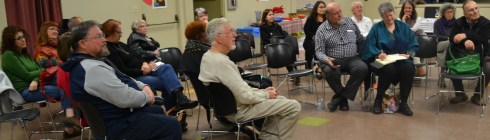
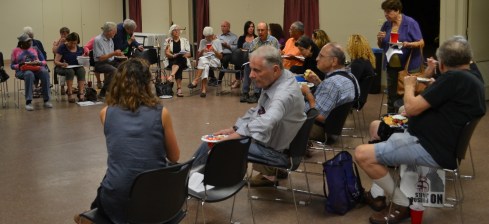
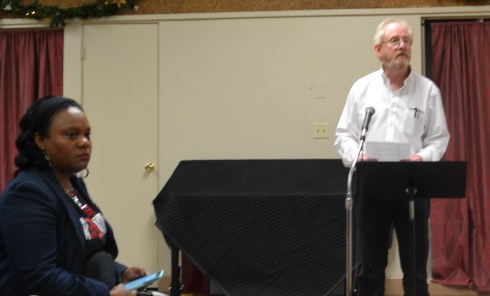
Amy Hunter, who is now the manager of diversity and inclusion at the St. Louis Children’s Hospital, spoke on Friday, Dec. 9, at the Christ Lutheran Church in Long Beach, on the similarities between racism in the U.S. and Palestine to more than 20 people.

People for Palestinian-Israeli Justice hosted Hunter’s talk.  Jewish Voice for Peace-LA and the Long Beach Area Peace Network co-hosted.

Dennis Korteuer, who is a Professor Emeritus from Cal State University, introduced Hunter.  In part, he said, “Hunter’s been seen on CNN, ABC, NBC, PBS, and interviewed by NPR and a host of print media publications.  She has published works and has presented on issues of race and social justice throughout the United States and globally.”

dsc_0178

He ended his introduction by quoting Hunter: “My lens is truth and liberation. My stance was a bit calmer before going to Palestine and now my sense of urgency has heightened.  With my travel to Palestine, there were so many similarities to what I had participated and witnessed in Ferguson.”

Near the beginning of her talk, Hunter admitted she uses Critical Race Theory, which Purdue University’s Online Writing Lab defines as “a theoretical and interpretive mode that examines the appearance of race and racism across dominant cultural modes of expression,” as a way to understand the history of property rights.

dsc_0192

She then explained the racist connections she saw between the United States and Palestine.  She said, “When I went to Palestine, of course, those things resonated…. This is America, with native-American people and the stealing their land and so it wasn’t hard to make the connection.  The over-policing of black bodies looked like the over-policing of Palestinians, while I was in Palestine and the conversations were very similar.  And so not only is it important to recognize what colonization in the country looks like, but globally what looks like to really inspire a global movement to decolonize.”

She soon defined what she meant by decolonization, when she said, “(It) will have to look like something different and if you’ve never belonged to community, it’s really hard to talk about community building, but ultimately … that’s what solidarity will look like between blacks and Palestinians … because the similarity between the communities are so very the same.”

Near the end of her talk, she said, “I would like to see a different world for my children, for all children and that’s why I do this work…. I’m pretty intentional to say what liberation looks like, what free looks like.  I’m really … clear that I’m not free until they’re free.”

Hunter’s Lucky Zip Codes TED talk may be viewed at http://www.youtube.com/watch?v=g36ijwr3wc8.

dsc_0196


The City of Long Beach Stands with the Standing Rock Sioux

9 Dec

dsc_0145

About 40 people, in the plaza outside City Hall, before the meeting of Long Beach City Council on Tuesday, Dec. 6, rallied with speakers in solidarity with the Standing Rock Sioux Tribe and against the construction of the Dakota Access Pipeline, in anticipation of the city council agenda item on the same subject.

The rally began with Tongva elder, Gloria Arellanes, leading a prayer and blessing, followed with speakers.

Noe Ramirez, Long Beach resident, emceed.  The first speaker Ramirez introduced was Elliot Gonzales. Gonzales is a leader of Stop Fracking Long Beach and according to the city’s website, a member of the city’s sustainable commission.  He said, “It is time as an environmental community we begin to recognize indigenous rights as part of why it is necessary for us to be able to sustain life on this planet…. We will perish, if we do not speak up to the abuses that are happening to our native brothers and sisters, I guarantee that it will happen to us…. We must become active in resisting in every aspect of our lives, like in government, in society, as in community.” He said environmentalists should view themselves as allies to the indigenous.

Ramirez then introduced George Funmaker, as a resident of Long Beach.  Funmaker belongs to the Dakota Ho-Chunk tribe.  He said, “As native people we’re healing from something called historical trauma.  Historical trauma is when the United States Government put us in boarding schools and we were not allowed to speak our language, we were not allowed to do our ceremonies and it wasn’t until 1978 (with the) American Indian Religious Freedom Act, where we were able openly  practice our ceremonies.”  He said one issue needing to be address is white privilege and white supremacy.  He said originally the pipeline was to go through Bismarck, North Dakota, but the mostly Caucasian city would not allow it, the company listened to them and the company decided to run it through native land.

dsc_0143

Then, Funmaker with some others shared a no DAPL (Dakota Access Pipeline) song with the audience.  He ended by pointing out that it was the women who provided the leadership for their movement.

The council chambers was about half-full, when the agenda item came.  Before public comment, First District Councilwomen Lena Gonzalez argued for the resolution and pointed out that “the protest and fight is not just about oil.  It is about respect for our indigenous communities and respect for the rights of treaties that were signed with this tribe more than 150 years ago.”

Second District Councilwoman Jeanine Pearce also argued for the resolution.  She said the protesters against the pipeline “were met with disproportionate use of force, in…freezing temperatures, tear gas, rubber bullets, even grenades, yet they still remained strong.”

During the public comments, Funmaker said that “Long Beach has to look at their own oil addiction…. It’s not (just) about this pipeline, it’s about transitioning to renewable energy and keeping fossil fuels in the ground.”

Another speaker during the public comment, in favor was Alex Montances, who identified himself as living in the Sixth District, as being from the Filipino Migrant Center and the National Alliances for Filipino Concerns.  Montez said that during the Thanksgiving weekend he was part of a six-person delegation who drove from Long Beach “to stand with the Standing Rock Sioux.”  Montances ended by quoting a native-American artist he met, who said, “It was the first time in history that almost all of the native-American tribes are united together to protect what is sacred to them: water, land and Mother Earth.”

After public comment but before the city council vote, Fourth District Councilman Daryl Supernaw thanked all the supporters and speakers and said he is working with others to bring forward a motion to create a Native Heritage Commission for the city.  Mayor Robert Garcia said he was a “strong supporter” of the resolution.

No city councilmember or anyone during the public comments spoke against the resolution.  The resolution passed unanimously.

dsc_0165


Low-Wage Workers Protest in Los Angeles and LAX

1 Dec

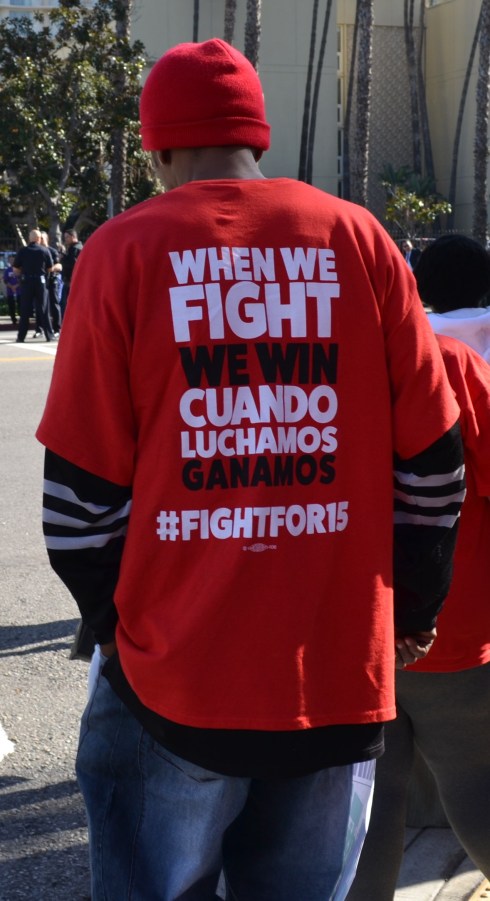
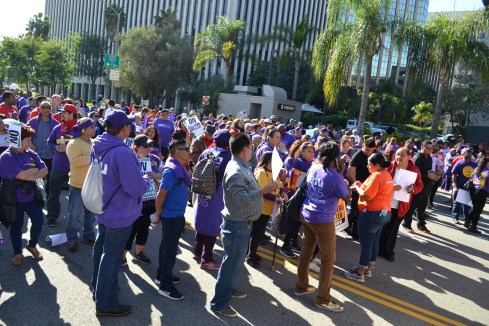
Hundreds of low wage workers, mostly people of color, and their allies marched and protested around the Los Angeles Airport, as part of a national protest in 340 cities, on Tuesday, Nov. 29, for $15-an-hour jobs, for unions, immigrant rights, and against cuts in the Affordable Care Act, against racist policies, which put newly elected President Trump on notice that his policies would be resisted.

Three groups marched and protested around LAX.  One group, around noon, walked and chanted on the sidewalk from West 98th Street and Aviation Blvd. toward Avion Dr.  At Avion, the group turned left toward Century and headed toward the airport proper.  Around Vicksburg Ave., gathered a Los Angeles Police Department contingent, where no sidewalk existed.  Near Vicksburg the group turned around before the sidewalk disappeared and headed back from where it came.   Two chants the group shouted out, while walking, were “If we don’t get it, shut it down” and “No Justice, No Peace.”

The local NBC affiliate, quoting an LAX management statement, it said, “Shortly before noon, two groups of demonstrators gathered on the Upper Level at LAX, with one group on the north side and the other group on the south side, marching toward the Tom Bradley International Terminal.”

No arrests occurred at LAX.

dsc_0029

Later in the early afternoon, on Aviation between 98th and Century, hundreds rallied and heard speakers on a flatbed truck.

One of the speakers was 44th District Congresswoman Janice Hahn, who was recently elected as the 4th District Supervisor.  Regarding the profits of the airline industry, Hahn said, “While these airlines are making record profits, we know that the workers are not getting their fair share.  Last year these airlines made over $25 billion in profit across the county, but 42 percent of all airline workers live below the poverty line…. I’m here in solidarity with you.”

A second elected official who spoke was Los Angeles Councilman Curran Price.  He reminded the audience his support for raising the minimum wage and for immigrant rights by his support for Los Angeles being a sanctuary city.

A third speaker was Tim Maddox, a vice president of USWW (United Service Workers West).  USWW represents service property workers, such as janitors, cabin cleaners, stadium and arena workers, and other airport workers.  Maddox said, “The Airport used to be good jobs….Reagan began busting the unions when he fired air traffic controllers who were on strike….This was the beginning of outsourcing our labor at the airport and deregulation…. Moments later on a more optimistic note, he added, “But, we know when we take action and fight back, we win…We have won wage increases in Los Angeles, New York City, Newark, Minneapolis, Boston, Philadelphia, Seattle, Portland and Fort Lauderdale.”

The same NBC affiliate, which reported on LAX, said, “The first (of the day) protest began about 6 a.m. at Seventh and Alameda streets in downtown Los Angeles. About an hour into the rally, protesters blocked the intersection of Seventh and Alameda streets and police arrested 40 of them, the Los Angeles Police Department reported.”

CNN reported dozens of arrests in Oakland and New York with a strike at O’Hare International Airport of janitors, baggage handlers, cabin cleaners and wheelchair attendants.  Reuters reported arrests in Cambridge Massachusetts and in Detroit.

dsc_0072

Protesters to Customers at Fry’s Electronics Manhattan Beach Store: “Boycott HP”

28 Nov

dsc_0017

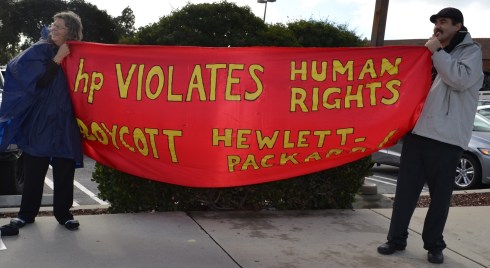
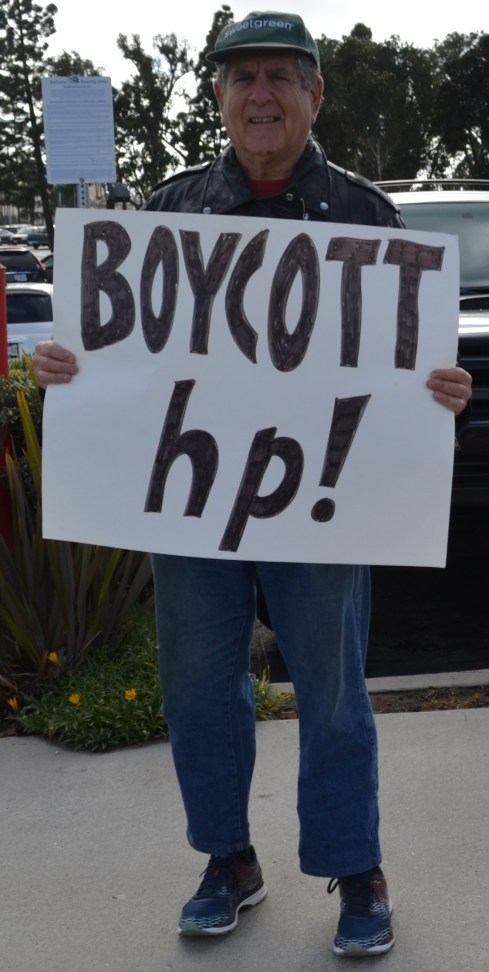
About 30 people, as part of the global week of action against the Hewlett-Packard Company, on Sunday, Nov. 27, stood on the sidewalk outside the Manhattan Beach store of Fry’s Electronics near the corner of Sepulveda Blvd. and Rosecrans Ave., displaying a mock Israeli apartheid wall, signs and banners denouncing HP’s complicity with Israeli apartheid.

While several people held up the mock Israeli apartheid wall, others carried signs or banners, and others passed out flyers explaining why they were there and asking people to boycott HP products.

Dennis Korteuer said he and Sherna Gluck, who are Professor Emeriti of Cal State University Long Beach, met with the store’s manager, Tonya Smith, and gave her a letter, which requested the store “to stop stocking products made by Hewlett-Packard” and which explained the reasons.

dsc_0018

Later, protesters chanted.  One chant was “Hewlett-Packard you will see.  Palestine will be free.  A second was “Segregation is a crime, from Ferguson to Palestine.” A third was “Not another checkpoint, not another wall, end the occupation, equal rights for all.”  A fourth chant was “Hewlett-Packard get in line, freedom now for Palestine.”   

The Palestinian Youth Movement, which its website characterizes itself as a “transnational, independent, grassroots movement of young Palestinians in Palestine and in exile worldwide,” sent an email before the action.  The email said that more than 90 actions worldwide were planned.

According to the BDS (Boycott, Divestment, Sanctions) movement website, the South Africa boycott of Polaroid inspired the global week of action.  Also according to the website, the HP company provides Israel the Biometric ID Card System used to restrict Palestinians’ freedom of movement and servers for the Israel Prison Service, where Palestinian children and political prisoners are routinely held without charge and where torture is widespread; the company manages the communications centers of the Israeli Navy, which collectively punishes the civilian population of Gaza through blockade; and, the company provides services to Israeli illegal settlements in the West Bank.

HP Media Relations and the management of Fry’s Electronics were unavailable for comment.

The full text of the letter given to the store manager may be viewed at http://hpboycott.org/content/menu/take_action/letter_to_store_managers.htm.

dsc_0015


Beth Miller Explains the Impact of the Israeli Military on Palestinian Youth

25 Oct
b

Beth Miller, who is the U.S. Advocacy Officer at the Defense for Children International Palestine, spoke on Friday, Oct. 7, at the Christ Lutheran Church in Long Beach, on the impact of the Israeli military occupation on Palestinian children and youth in the West Bank to about 30 people.

People for Palestinian – Israeli Justice sponsored Miller.  The cosponsors were Christ Lutheran Church, Jewish Voice for Peace – LA, Long Beach Area Peace Network, United Methodists’ Holy Land Task Force, Peace and Justice Ministry Team of Grace First Presbyterian Church of Long Beach and Friends of Sabeel – Los Angeles and Orange County, according to a flyer distributed before the event.

Dennis Kortheuer, who is a Professor Emeritus from Cal State University Long Beach, introduced the audience to PPIJ and Miller.  Regarding PPIJ, Kortheur said that PPIJ had recently had its two year anniversary and that PPIJ’s mission is “to work for a just resolution of the Palestinian-Israeli conflict through education, public discussion, coalition building and action.

Miller, who holds a master’s in Human Rights Law from the School of Oriental and African Studies of the University of London, said DCIP is an independent, local, Palestinian, child-rights organization, founded in 1991 and is based in Ramallah in the West Bank.  It started as a small group of volunteers to provide free, legal-aid services to Palestinian children the Israeli military arrested.  Now, besides providing the legal-aid services, DCIP monitors and documents all child-rights violations across the occupied Palestinian Territories.  It then uses the evidence gathered for its advocacy.

After describing DCIP and its work, Miller showed the 20-minute documentary, “Detaining Dreams,” which was produced in collaboration with the American Friends Service Committee.  It tells the stories of four Palestinian-male youth the Israel military detained and then prosecuted through the military courts for throwing stones.  The documentary, through the four’s own words, shows how the Israeli military ill-treated and tortured these youth and the trauma the four suffered from the experience. The four ranged in age from 14 to 16.

After the documentary, Miller spoke about the legal framework under martial law on the West Bank, specifically Israeli Military Order 1651, in which about 700 Palestinian youth are prosecuted yearly.  It is under 1651, which criminalizes throwing stones.  She did admit many Palestinian youth do throw stones.  Another criminal act defined under the same law is insulting the honor of an Israeli soldier.

She said, “So effectively, if you are a Palestinian child living on the West Bank you can be arrested by an Israeli soldier pretty much at any time for any reason…. Three out of four of the children who arrested in this way are going to experience physical violence at some point….They are using the system to control the population …and we see that how children are treated.”

After her presentation and during the discussion, Miller said Israel is the only country in the world that systematically prosecutes children in military courts.

dsc_0250


Pulitzer Prize Winner Sonia Nazario Speaks at the Long Beach Main Library

15 Mar

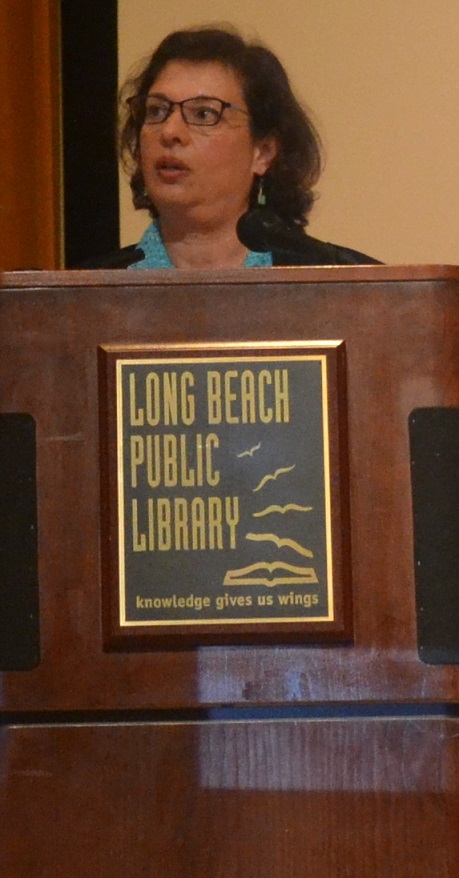
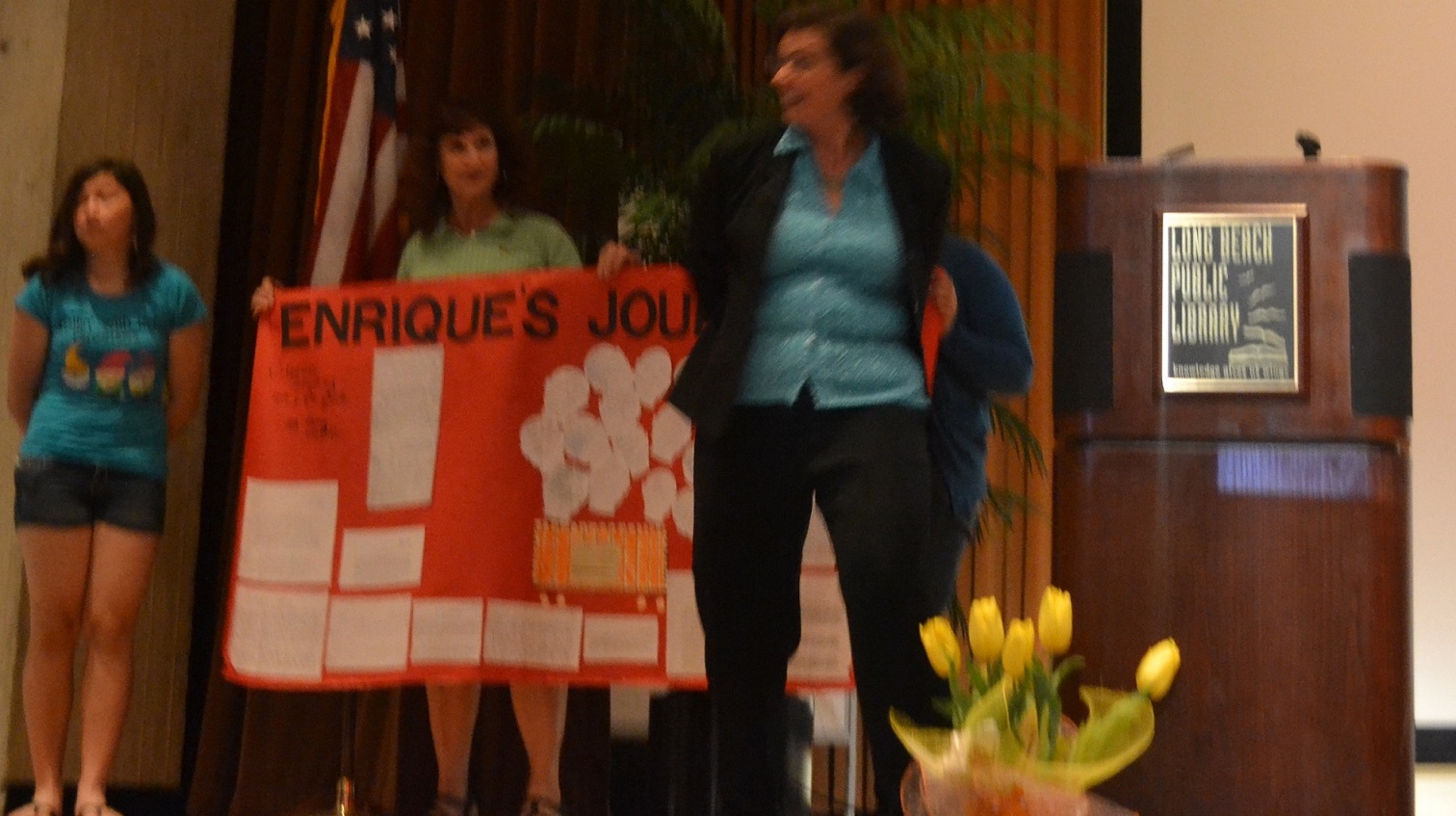
DSC_0246DSC_0248About 50 people heard Sonia Nazario, who won Pulitzer Prize for her Los Angeles Times series and in which the her book, “Enrique’s Journey” is based, speak on Saturday, March 15 in the Main Library Auditorium downtown.

The free event was sponsored by the Blanche Collins Forum.
“Enrique’s Journey” is about a 15 year-old boy who travels from Honduras to the United States in search of his mother, who left him when he was five.
Nazario first described her childhood in United States, where she was born, and in Argentina, during the Argentine military’s ‘dirty war.’ She told of one incident in Argentina, when she was 14. She was walking on a Buenos Aires street with her mother one day and saw blood on the ground. She asked her mother what had happened. Her mother told her the military had killed the two journalists because they told the truth about what was happening in Argentina. From that incident on, she said she was determined to become journalist.

Nazario wrote the Los Angeles Times series because she heard a common theme among many of the undocumented children she interviewed – that these children migrated to the United States in search of their parents who had left them behind. To write the story, Nazario said she followed the same route Enrique followed to be able to gather more details on Enrique’s journey.

After Nazario spoke, a book signing followed.

Immigrants and Their Supporters March in Long Beach

13 Jan

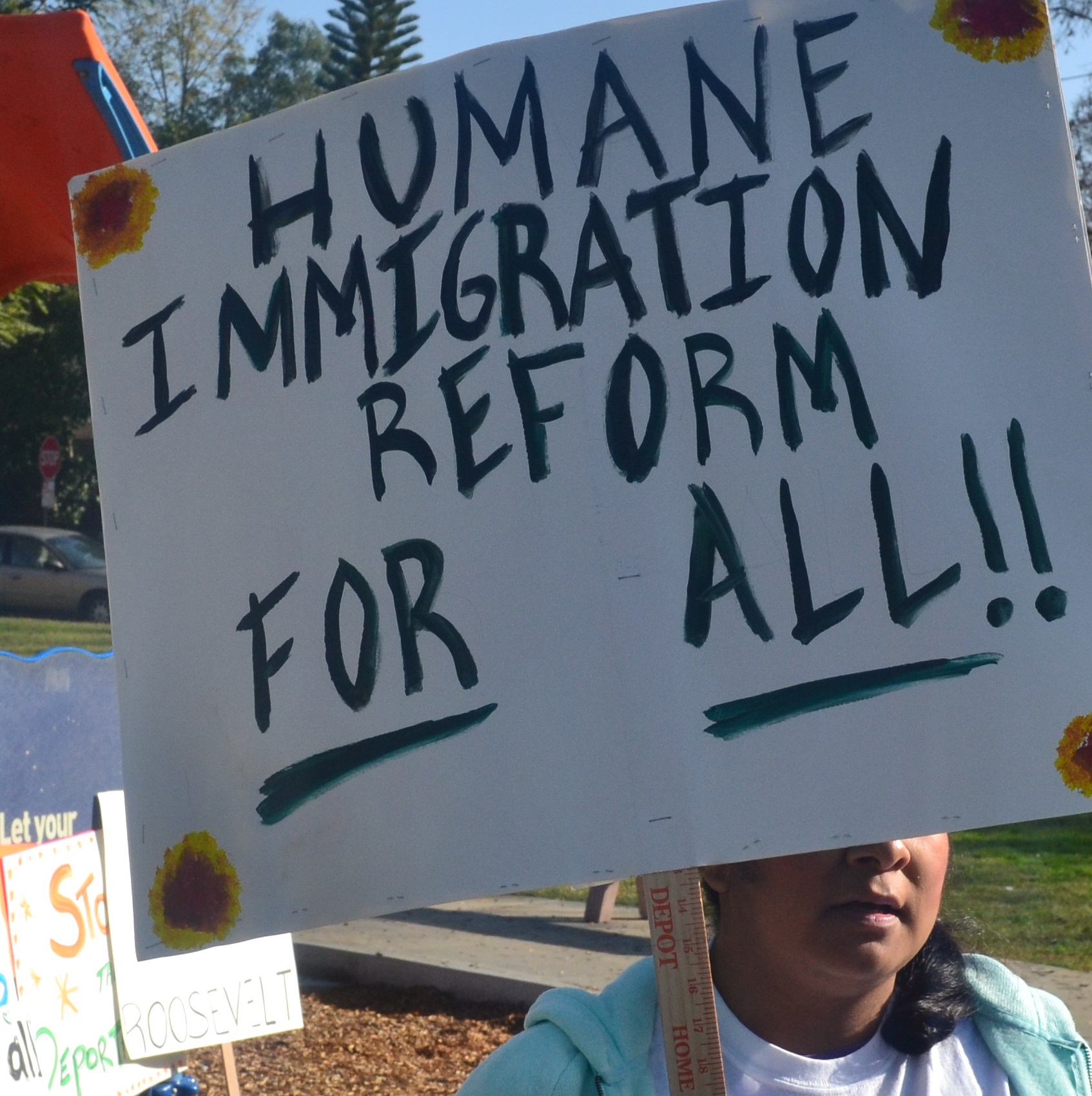
ImageImageImageAbout 100 people, in the late morning of Saturday, Jan. 11, marched from Orizaba Park to MacArthur Park in Long Beach for comprehensive immigration reform and to voice local grievances..

One marcher was Laura Merryfield.  Merryfield, who works for the Long Beach Immigrant Rights Coalition, said “We are marching for comprehensive immigration reform that is the big overarching theme…We have realized that there are local campaigns that are really important…that are advancing immigrant rights agenda…We are calling for a moratorium on car impoundments… Another thing we are asking for is to end wage theft…We brought together a diverse coalition.  We have groups that represent Latinos, Filipinos, Cambodians, (and) other residents of Long Beach because it is an issue where everyone is connected.”

Marissa Martinez, 16 was another marcher.  Martinez, who attends Wilson High School, said, “Just by being here, having people here, we are actually making a difference.”  Martinez said that her father drove her to march and that he supported her being there.

At MacArthur Park, Nicole Cababa, who identified herself as a community organizer with the Long Beach Coalition for Good Jobs and a Healthy Community and as a daughter of Filipino immigrants.  Cababa said, “When my mom first got here … she wanted to create a better life for her family.  She was faced with making sure she could support a young daughter with a studio apartment and a mattress and a rice cooker…The only work she could find was cleaning windows for a fast food restaurant….This is a common story that we hear today from many immigrant families….That is why we are here today in solidarity with all immigrant families to say we deserve living-wage jobs to be able to support ourselves, to be able to live and to work in dignity.”

At each end of the march, which was slighter longer than one mile, were chants and testimonials from individual.  All of program at both end points were in English and Spanish.  The chants were in English, Spanish, and Tagalog.  One chant was “Blacks, Latinos, Asians, Whites, We all stand up for human rights.”  Another chant was “Immigrants are under attack.  What do we do?  Stand up, fight back.”

On the sidewalk, the marchers marched from Orizaba Park down Orizaba Ave. to Anaheim Street, where they turned right; they then marched down Anaheim Str. until they arrived at MacArthur Park, 1312 E. Anaheim St.

Some of the local organizations that sponsored the march were the Long Beach Immigrant Rights Coalition, the Greater Long Beach Interfaith Community Organization (ICO), Khmer Girls in Action, Filipino Migrant Center, The Center, Long Beach and The Long Beach Coalition for Good Jobs and a Healthy Community.

Flying Home

6 Dec

I did not sleep well the morning of our flight, because of the chocolate.  I woke up about 4:15 a.m. and then I woke up Marlene.  She got upset, but quickly got over it.   We showered, finished packing, and ate our breakfast.  The taxi came on time, but we were a few minutes late.  The hotel clerk helped load up the taxi and the female taxi drove us to the airport.  It was about 7 a.m. at the airport.  No one was at the British Airways desk.  About 7:15 the desk opened. We were told then the security workers were on strike.  We made it through.  A woman who was flying to Toronto helped us find our plane.  We were on our way.  I must confess the plane food was good.


When we arrived at Heathrow, we know how difficult it was going to be to make our connecting flight, but we quickly found out.  We arrived near Terminal 5.  A bus took us to the terminal.  We had to carry our carry-on luggage.   We then took another bus to Terminal 3.  An hour had passed and we still had not gone through security.  At Terminal 3, security decided to check through everything Marlene carried on.  This was all her photography equipment she did not use.  The supervisor called ahead, so our plane would wait for us.  After checking our luggage, we hurried as fast as we could to get to our plane.  We finally made it.  After two hours going through Heathrow, we had a long flight ahead of us.  Again the food on the plane was good.  I don’t remember how long the flight was.  I’m guessing it was about 10 hours.


A couple of days before we were to fly home, Marlene suggested perhaps we should spend our first night back near the airport.  From Lisbon, I made the reservation.  While we had some wait for our luggage at LAX, once we were outside, we only had a short wait before the bus took us to airport.  The next day, we had a slow day getting home.  The house was in good order.  In all the years traveling with Marlene, this is the only year that we came home without any problems except for poor, sick TJ.  TJ was sick.  He was infested with fleas.  He had chewed himself raw while we were gone.

Last Day in Lisbon

4 Dec

That Thursday evening, we had dinner with Jorge and Chico at a little place of Jorge’s choosing.  It was across from the Bank of Portugal and close to their place.  The fish and the potatoes were great. Plus, I got Marlene’s potatoes and her Salmon skin.  I brought six little pastries Lisbon is known for.  The guys ate four.  I ate one and they took one home.  Almost like a comic routine, Jorge was on the phone and he Chico had a little spat.

Chico announced to us and Jorge officially he and Joanna are now a couple.  I only had a brief encounter with Joanna and it was positive.  She is quite witty and entertaining.  It was she I quoted about “thinking outside the box,” in a much earlier post.  Chico was driving to Porto that evening, because on Saturday, some of his Super 8 video will be in an art show.  I said it to Marlene and I’ll say it now, “I would not be surprised if Chico becomes famous someday.”  What little I saw of his work was really impressive.  He had in the room we stayed in an unsigned pen and ink drawing.  It looked like a Picasso, but I knew it wasn’t because it was not signed.  He also had some movie posters I found interesting.

At dinner, Jorge mentioned to Marlene he would like to have his electrical interface back.  She mentioned if he would have said something earlier to her she could have brought it with us.  Chico invited us to his opening, but I told him that Saturday we would be flying home.  It was raining and it was late for Marlene and me, so we got a taxi and went back to the hotel we were staying at.

The next day we returned the interface to Jorge.  We then took the metro from Anjos station to the Chiado Baixa, where not far from the metro stop we went to our first museum, the Chiado Museum, also known as the national gallery of contemporary art.  Marlene’s knees were hurting her.  She got a wheelchair, but one tire had no air it.  My back was bothering me.  Unfortunately only the permanent collection was available for viewing.  We rushed through it.  I wish we would have had more time.  I especially liked the most modern stuff.

We then took the metro to the San Sebastian metro station, where we went to another modern art museum complex, the Fundacao Calouste Glulbenkian.  It seems this complex houses three museum spaces.  We again rushed only covering one.  I only wish we had more time.  Marlene was tired.  We went to the museum cafeteria and ate something small because we were still going to have dinner.  We walked back to the English Court at the metro station.  Because it had been raining, we got wet when some cars splash water on us.  We bought our usual fare of fruit, cheese, bread, and lox.  I also bought some chocolate confection.  We then took the metro back to Anjos metro station.  From there we walked back to the restaurant we ate at the night before with Jorge and Chico.  The restaurant seasons the fish with a little salt and grills it.  Again it came with potatoes that I love and again I ate Marlene’s leftovers.  We then caught a taxi back to our hotel.  I ate the chocolate, but it upset my stomach causing me not to sleep well.  Marlene packed.  About midnight I packed.  We needed to be at the airport by 7 a.m. for our 10 a.m. flight.  We’ll by flying home soon.