Standing Rock Sioux Supporters to L.A. City Council: “Divest from Wells Fargo.”

14 Mar

DSC_0113

About two hundred people, led by local indigenous leaders, marched on Friday, March 10, from Pershing Square to the steps of Los Angeles City Hall, to demand the city council divest from the banks that have invested in Dakota Access and the Keystone XL pipelines.

The Los Angeles event was in solidarity with the demonstrations in Washington, D.C. and was part of the solidarity effort in 12 other cities across the United States, according to website of Indigenous Environmental Network and the Native Organizers Alliance.  Click here to go to the website.

DSC_0032

Lydia Ponce with microphone speaking at Pershing Square, March 10, with Frances Fisher standing behind her.  Photo by Barry Saks

Before marching to Los Angeles City Hall, a rally was held on Olive Ave. near the corner with 5th Street, next to Pershing Square.  Lydia Ponce, who is from the American Indian Movement and Idle No More of Southern California, emceed the rally.  Ponce said, “Standing Rock in not over…. The water wars are not here yet, but they are happening in Mexico.”  She also pointed out water has been rationed in Canada for the last four years.

DSC_0036

Before speaking, Fixxco (left) standing next to Lydia Ponce (right) on Friday, March 10.

One speaker Ponce introduced was Fixxco.  Fixxco said he only goes by his one name.  He said he went to Standing Rock the first week in November and that he was asked to be part of the group “to protect the camp—women and children and elders.”  He said, “On Nov. 20, they (law enforcement) attacked us for simply removing a vehicle off the bridge…. My camp elder, my grandfather, Standing Horse, fell.  He had a heart attack.  He was hit by a concussion grenade in the heart and he died in my arms…. We are protectors, not protesters.”
DSC_0170

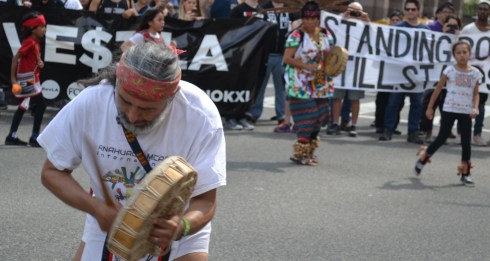
An elder drumming and dancing, Friday, March 10, with children behind him dancing in front of Wells Fargo branch.  Photo by Barry Saks

After the first rally on Olive next to Pershing Square, the march weaved its way through the financial district, where it stopped at a Wells Fargo branch for a brief second rally, which included a prayer.

DSC_0199

Cheyenne Phoenix addressing crowd, on Friday, March 10, at L.A. City Hall.  Photo by Barry Saks

From the second rally, the march headed through Grand Park to the steps of Los Angeles City Hall for the final rally of the day.  Cheyenne Phoenix, who characterized herself as coming from Navajo and Northern Piute Nation, emceed.  Phoenix, who is a Long Beach City College sociology student, in her opening remarks, said, “We are gathered here today because our relatives at Standing Rock in Washington, D.C. are gathering for a native-nations-wide march…. We are standing in solidarity with each other, with our water protectors everywhere.”  She then pointed out that L.A. get more than 40 percent its water from the Owens Valley, which was once Piute land.

DSC_0202

Shannon Rivers speaking, Friday, March 10, at L.A. City Hall.  Photo by Barry Saks

One of the speakers at the rally on the steps of Los Angeles City Hall was Shannon Rivers.  Rivers said, “Five hundred twenty-four years ago, an ideology was brought here….  It’s the idea of greed and capitalism.  You suffer from a disease called capitalism.  You keep taking from the earth and without giving back.  You constantly want something without giving thanks.”

Another speaker was Frances Fisher.  Fisher, who also spoke at Pershing Square, said, “We are here to divest L.A.”  She asked the crowd to go online and sign a petition, which was going to be sent to the City Council after another 500 signatures are gathered.  She then read the petition.  The beginning of the petition reads, “We the people call on the Los Angeles Mayor Eric Garcetti and City Council to divest from Wells Fargo.”  She then announced the phone numbers of the city council representatives for the crowd to call.  To read the petition online, click here.
DSC_0243.JPG

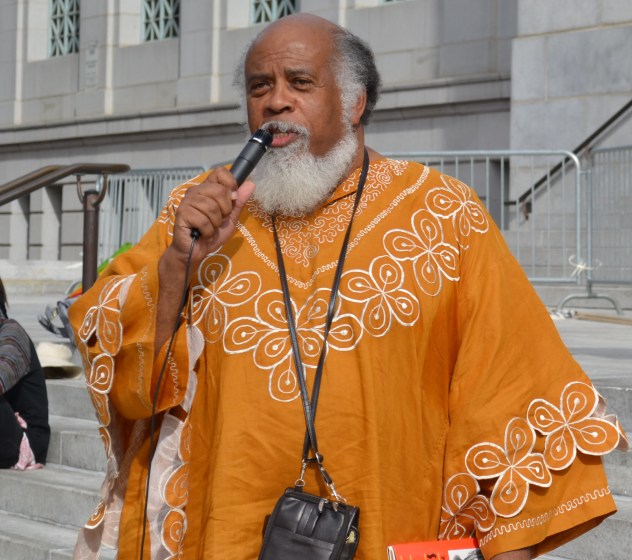
Kwazi Nkrumah, Friday, March 10, speaking at City Hall.  Photo by Barry Saks 

And still another speaker was Kwazi Nkrumah. Nkrumah, who is a leader of the MLK (Martin Luther King Jr.) Coalition of Greater Los Angeles, pointed out the week before the temperature of the outer edge of Antarctica was measured at 65 degrees Fahrenheit and added it meant the Pacific Island nations could be submerged in years.  He then said L.A. has about a 100 neighborhood councils and urged the crowd to get their friends and neighbors to go to their councils and get them to come out in favor of divesting.

One chant on the march was “Sisters and brothers, let’s defend our mother (earth).”  Another was “The people united will never be divided.”  A third chant was “Who is funded by the banks?  Pipelines and Tanks” and a fourth chant was “Up, Up with people.  Down, down with the pipeline.”  A fifth chant was “Who stands with Standing Rock.  We stand with Standing Rock” and a sixth was “You can’t drink oil.  Keep it the soil.”  A seventh chant was “Whose streets? Our Streets” and an eighth was “They’re killing our sons and daughters.  They’re poisoning the water.”  A ninth chant was “Wells Fargo opens fraudulent accounts.”  A tenth chant was “When your body is put to the test? Stand up, fight back.”

DSC_0023

Michael Rotcher with his sign, Friday, March 10, before marching.  Photo by Barry Saks

One of those who marched was Michael Rotcher.  Rotcher said that he was from Orange County, that he was in support of those who oppose the Dakota Access Pipeline and that he was “concerned for the water rights of the indigenous people there.”  He added, “We got a head of the EPA (Environmental Protection Agency) now that does not believe in climate change.  That is shocking… It is a bad thing for the people who depend on that water for their livelihood and it is a terrible thing for all of us.”

DSC_0021

David Calvillo with his sign, on Friday, March 10, before marching.  Photo by Barry Saks

Another marcher was David Calvillo.  Calvillo said he was from north Long Beach and had taken the light-rail system to get to Pershing Square.  Calvillo said he woke up and realized he had to be there with like-minded people.  He said his family is from Arizona and is Hopi.  He said his great-grandparents looked like the Native American on “the Buffalo nickel.” He said this struggle was “important for the generations that come after us.”

A third marcher was Alvaro Maldonado, who characterized himself as a longtime activist.  Maldonado said, “I’m worried the direction the fossil fuel industry is taking us…. I believe that working-class folks are the ones who will create the change.  By no means is the Democratic Party going to a make these changes because they are completely tied to Wall Street, big capital, big oil corporations, war production companies, etc.  So they are not going to do it.  It’s going to take us from below, the people from below.”

A fourth marcher was Natasha Gascon.  Gascon said she is “truth speaker” and a 37-year-old female business student at East Los Angeles College, where she has also studied Administration of Justice.

DSC_0111

Unknown Artist Drawn Banner, Friday, March 10.  Photo by Barry Saks
 

Long Beach Planning Commission Votes Unanimously to Proceed with the Belmont Pool and Aquatic Center

8 Mar
DSC_0018

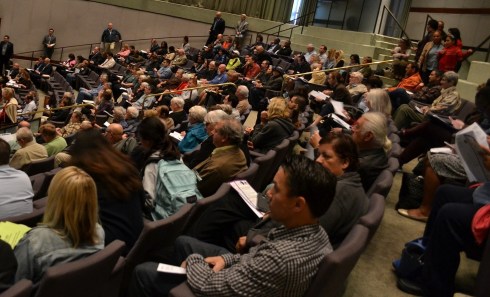
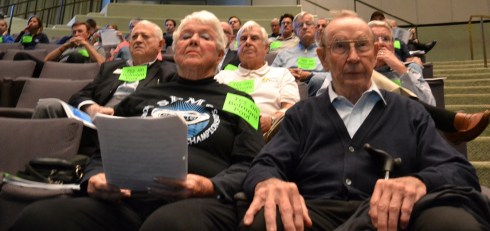
An audience of less than 100 attended the Long Beach Planning Commission of Thursday, March 2.  Photo by Barry Saks
With public comment of more than an hour, in front of an audience of less than 100 people, the Planning Commission of the City of Long Beach on Thursday, March 2, voted 7-0 to recommend to certify the Environmental Impact Report, to approve the Site Plan Review, the Conditional Use Permit, the Standards Variance and Local Coastal Development entitlements for the construction and operation at 4000 E. Olympic Plaza for Belmont Beach and Aquatic Center.

Mark Hungerford, planner, presented the project for the Belmont Beach and Aquatic Center.  He provided a history of the former pool and said, “The (pool’s) building was closed to the public in January 2013 after studies found major seismic and structural deficiencies that were deemed an eminent threat to public safety.”  Hungerford, besides describing how local residents were notified of the meeting, he said the staff received 173 written testimonies, in which 161 were in favor and 12 were against the construction of the new pool.

Assistant City Manager Tom Modica said, “The City Council has a demonstrated commitment to the aquatics community…. The pool, if you’ve ever been out there today, is very heavily utilized.  It is a wonderful facility but it is not come close to meeting the demand we have not only from our residents but also from the entire region.  Because it is in the state’s tidelands we need to serve the region we also need to serve the state and we do but it is undersized.”

One person who supported the project and who attended the Planning Commission meeting was Parks Wesson.  Wesson said he lives about a half a mile from the pool and has been a swimmer almost all his life.  He said there should be pools in the other council districts in Long Beach and that there are.  Wesson said, “Swimming was great for me when I was a kid…. I think it is great for the community to have a pool like that.”

Another person who supported the project and who also attended the meeting was John McMullen, 65.  McMullen said he lives in the 3rd District about five or six miles from the pool.  McMullen said, “I actually was selected by the City Manager to participate in the stakeholders’ committee to determine programmatically how we should build the pool and that I was an at-large member.”  He then added, “My father was a seasonal Long Beach lifeguard.  I was a seasonal Long Beach lifeguard.  Both of my children were employed by the City of Long Beach as seasonal lifeguards.”

Another person who supported building the project is Debby McCormick, who is the head coach and owner of McCormick Divers, on the board of the Aquatic America Foundation and a member of the Long Beach Century Club.  McCormick said, “I put my heart and soul into this project…. The entire world of diving is totally supportive.  They want to come.  Everybody loves Long Beach.  They’re going to have the greatest facility in the world.”

Not everyone at the meeting supported the building of the pool.  Gordana Kajar didn’t.  Kajar, who spoke during public comments said she lives in Belmont Heights and added, “I’m here today municipal pools for residents and recreation.  I do not support a sports facility that is designed for aquatic competition and spectator tourism in my neighborhood.”

Another person who spoke against the project was Mel Nutter, the former chair of the California Coastal Commission.  Nutter said, “The variance approval must be based on unique conditions that place a property at a disadvantage when compared with other sites.  This is not what we have here.  Instead, the city is faced with zoning and LCP (Local Coastal Planning) rules that this project violates.  It appears that the city is, in effect, treating the variance procedure as if it were a get out of jail free card.”

Another person who spoke against the project was Anna Christensen, who represented the Long Beach Area Peace Network.  She said the issue is about environmental and economic justice.  Christensen said, “The Belmont Beach and Aquatic Center is a poster child for race and class privilege…. The Belmont Beach and Aquatic Center exasberates inequities.”

The ratio of speakers for and against the project was about 3 to 2.

Gene Simpson, who spoke in favor of the project, responded to the unanimous decision of the commission in favor of the project.  Simpson said, “It was really nice to see.  It was surprise, 7-0.”

To see the meeting notice, click here.    To see the meeting agenda, click here.  To see the video of the meeting, click here.

South Los Angeles County Residents Rally for Healthcare for all in California

26 Feb
dsc_0236

Crowd rallies at Harvey Milk Promenade Park in downtown Long Beach healthcare for all in California, Friday,  Feb.24.  Photo by Barry Saks
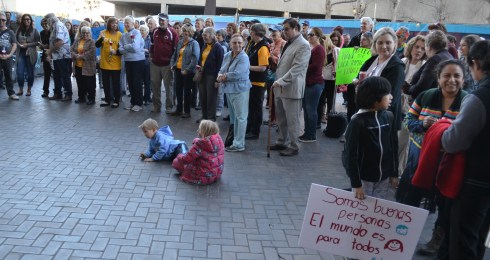
 

About 150 people, mostly local residents, rallied at Harvey Milk Promenade Park, at 185 E. Third Street, Long Beach, on Friday, Feb.24, in support of the newly introduced California State Senate Bill 562, which will provide healthcare for all California residents, and listened to California State Senator Ricardo Lara (D, Long Beach-Huntington Park), Long Beach Mayor Robert Garcia and others who spoke for the bill.

The bill was introduced by Senator Lara and Senator Toni Atkins (D, San Diego).

dsc_0221

Long Beach Mayor Robert Garcia speaks, Friday, Feb. 24, at healthcare for all in California rally.  Photo by Barry Saks

Mayor Garcia emceed.  During the rally behind the speakers, a contingent from the California Nurses Association, one of the primary backers of the bill, held their banner.

The Mayor acknowledged the other elected officials who were present from Long Beach were 2nd District Councilwoman Jeannine Pearce, 7th District Councilman Roberto Uranga, as well as the former 7th District Councilwoman Tonia Uranga. Other elected officials from other jurisdictions were Long Beach Community College District Trustee Sunny Zia, Signal Hill Councilman Larry Forester, as well as representatives for Los Angeles County Supervisor Janice Hahn and United States Congressman Alan Lowenthal.

dsc_0209

Myron Wollin speaks to crowd, rallying, Friday, Feb. 24, for healthcare for all in California.  Photo by Barry Saks

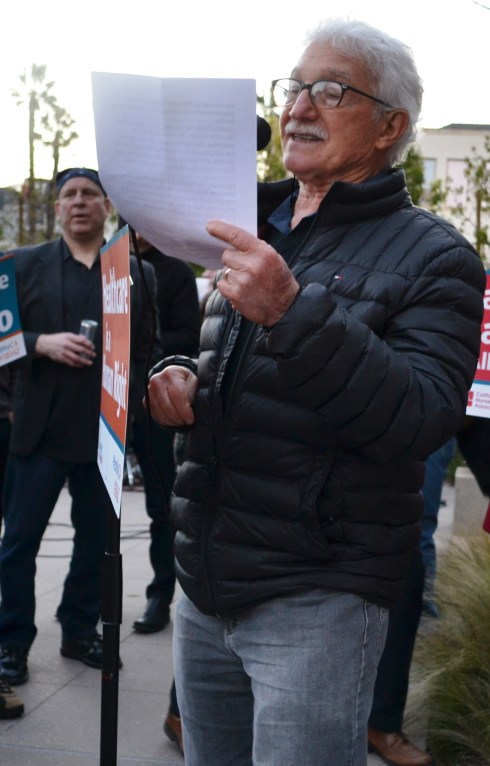
The first speaker the Mayor introduced was Myron Wollin, the President of the Long Beach Gray Panthers and a member of the California Alliance for Retired Americans.  Wollins said, “We need healthcare that is guaranteed, not healthcare based on what you can afford…. We’ve have enough of the insurance industry trying making a profit off our health.”

dsc_0170

California Nurses Association contingent to rally for healthcare for all in California, Friday, Feb.24.  The woman with her fist in the air, is retired nurse Marjorie Keenan who spoke representing, CNA.  Photo by Barry Saks
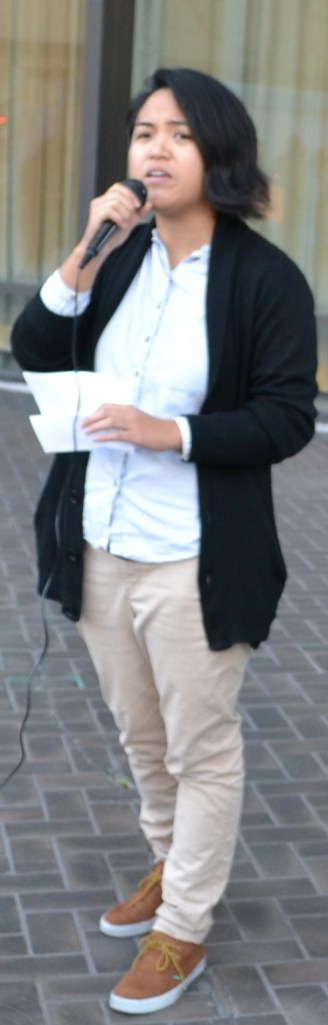
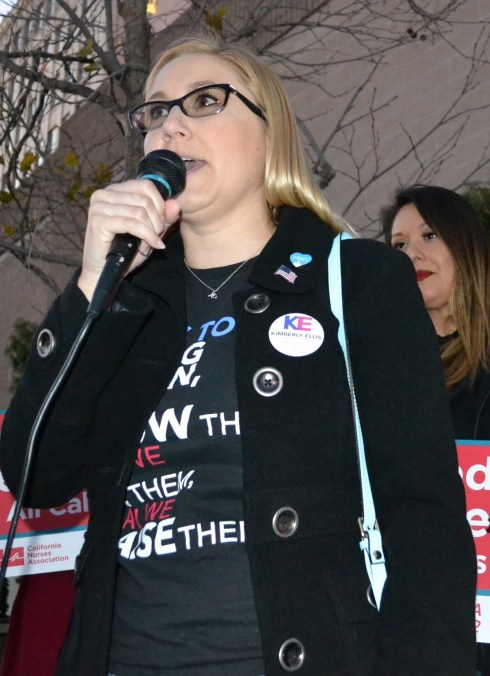
Garcia then introduced Marjorie Keenan, another Long Beach resident and a retired local leader of the CNA.  She said, “Care delayed is care denied.” She pointed out that healthcare in the U.S. is rationed because “people are cutting their pills in half, they’re not going to the doctor, they’re not going to the hospital when they need to go.”

dsc_0219

Shannon Ross speaks at healthcare for all rally, Friday, Feb. 24, in downtown Long Beach.  Photo by Barry Saks
The next speaker the Mayor introduced was Shannon Ross, an Assembly District 70 delegate to the California Democratic Party.  Ross said this issue was close to her heart.  Her sister was diagnosed yesterday with cancer.  Three years before she went to the hospital with pains in her stomach but she could not afford to follow up with a doctor.

Before introducing California State Senator Lara, Garcia said, “As I know that we’re here to support universal coverage, I know we’re also together united in all those other issues that matter, whether it’s standing up for the LBTGQ (Lesbian, Bisexual, Transgender, Queer) community, whether it’s standing up for women’s rights to make choices about their own bodies, whether it is standing up for workers’ rights … whether it is standing up for our brothers and sisters all across this country that are black and brown, that are gay.”

dsc_0240

California State Senator Ricardo Lara speaks at rally, on Friday, Feb.24,  for healthcare for all.  Lara was one of two State Senators who introduced Senate Bill 562 in legislature.  Photo by Barry Saks

Lara spoke last.  He said, “This is the first rally outside of the Capitol (Sacramento).  Lara pointed out Garcia was the first mayor to endorse this bill.  Regarding healthcare for all, Lara said, “Canada has done.  Europe has done it.  Countries around the world have done it.”

One of the people who attended the rally was Terry Beebe, who lives in Long Beach’s first district.  Beebe, who is 72, said he was a retired teacher from the Los Angeles Unified School District and is lucky to have healthcare for the rest of his life and said, “I don’t understand why they (the Congress) wants to repeal the ACA (Affordable Care Act).”

Another person at the rally was Karen Reside.  Reside said she lives in Long Beach’s 1st District, is the Secretary of the Long Beach Gray Panthers.  She estimated that about 12 Gray Panther members were at the rally.

dsc_0147

Bill Grisolia Band plays, Friday, Feb. 24, before the rally for healthcare in California for all.  Photo by Barry Saks

Before and after the rally, the Bill Grisolia Band played, setting the festive mood of the rally.

dsc_0158

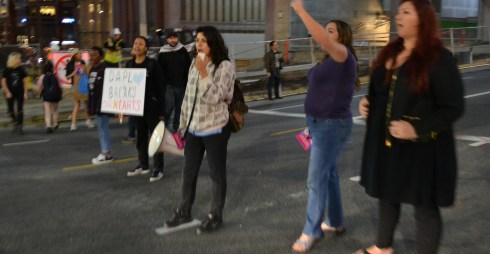
Before the rally, a some people decide to face traffic, on Friday, Feb.24,  on Third Street with their signs for healthcare.  Photo by Barry Saks.

Some of the people were dancing to the music, while others stood on the sidewalk with their pro-universal healthcare signs facing the one-way traffic on Third St.

California State Senate Bill 562, titled California for a Healthy California Act, states, “It is the intent of the Legislature to enact legislation that would establish a comprehensive universal single-payer health care coverage program and a health care cost control system for the benefit of all residents of the state.”

The link to the text of Senate Bill 562 is.

Long Beach City Council Discusses Affordable Housing

25 Feb
dsc_0111

Long Beach City Council on Tuesday, Feb. 21, before Study Session on Affordable Housing.  Photo by Barry Saks
To an audience in the chamber which was about three-fourths full, the Long Beach City Council, on Tuesday, Feb. 21, held a study session on affordable and workforce housing.

At the beginning of the session, Mayor Robert Garcia said, “California, in particular, is having incredible demands” for affordable housing.  He then added the state mandates cities to build yearly affordable housing with specific target numbers and that “Long Beach, along with most cities, normally falls short” in reaching those targets.  Then near the end of his introductory remarks, the Mayor said, “We want to make sure that we are building enough housing for our graduated students … for our workers and we continue to build all the market-rate housing that we are already building.”

Then, Director of Development Services Amy J. Bodek reiterated for the City Council the findings of the draft report.  Near the beginning of her presentation, she posed, “With public funding dwindling, how are we going to move forward and invest in affordable housing as a legitimate infrastructure investment and what policies can we implement to stimulate housing development, both affordable housing and market-rate housing, how do we incentivize developers and what new revenue sources are available?”

Bodek said there are two ways to develop affordable housing.  One way is by “providing special financing that underwrites the market rents for those units in exchange … we achieve covenants that require that the affordability of those units remain in place either for 45 years or 55 years.”  The second is “through direct rental subsidies.”

The Director said the trend over time in Long Beach is that housing costs are rising for one and two bedroom units.  She pointed out while for the last 15 years, Long Beach renters have been about 58 percent of the residents.  However in the last five years Long Beach renters are now between 59 and 60 percent of the residents.

Bodeck said, “The resources that used to be available (for affordable housing development) have frankly plummeted.”   She then pointed out about eight and a half percent of the city’s housing is either under covenants or has protections for affordability.

Regarding the production or the rehabilitation of affordable units, the Director said, “The City itself does not produce the units ourselves.  We assist in the financing.”

Bodek then explained how the city was encouraging affordable housing development by developers through incentives, such as “developer impact fee waivers,” which is in the municipal code, and “density bonuses,” which could require the relaxation of some requirements, like height or parking.

Next to speak was the chair of the Affordable Workforce Housing Study Group, former Assemblywoman Bonnie Lowenthal.  The former Assemblywoman then mentioned possible funding sources, like a real estate recording fee, which is a transaction fee, or the city passing its own bond measure.  Near the end of her presentation she said, “It is pretty clear that tonight we were not able to discuss the issue of renters’ rights….But, that’s a separate issue, that has to be discussed at length, at length, at a separate time.”

Bodek, in response to a question from 1st District Councilwoman Lena Gonzalez on possible programs from HUD (U.S. Department of Housing and Urban Development), said, “We’re hoping frankly that HUD keeps are budget stable.”

After Gonzalez commented, 2nd District Councilwoman Jeanine Pearce said, “To say that the situation of affordable housing in California is becoming urgent is simply an understatement.” Then near the end of her comments, she said, “We were able to incentivize development in downtown and that’s been really great.  But the fact that we were unable to develop one affordable housing unit in that downtown plan means we are in the crisis mode we’re in today.”

Then 9th District Councilman Rex Richardson said homeownership “is slipping away for a lot of people.”

After Richardson, 5th District Councilwoman Stacy Mungo said she had “a serious concern that the recording fee would be passed on” to the renter, homeowner or buyer.

Then 7th District Councilman Roberto Uranga said, “Gentrification is a big issue….then you’re pushing people out.”

The Mayor ended the study session with some comments.  He said the city has been building market-rate housing in the city, that he supports that effort and it will continue, but now affordable housing is what is needed.

After the councilmembers spoke and asked their questions to city staff, the study session was opened for the public to speak.

Twice during the public and comments, the Mayor reminded the audience and the speakers that the question of tenant protections was not part of the study session.

Several people spoke, who identified themselves as members of Long Beach Residents Empowered.  One of them was Jorge Rivera, who characterized himself as a volunteer Program Director of LiBRE.  Rivera said, “LiBRE directly is in support of creating more affordable housing.  Yet we want to ensure that you are creating it for those people that are most in need…. I hope you agree that there is no way to build ourselves out of this crisis…. But let us not forget that we desperately need resident retention policies to keep people in their homes now.”

Many others echoed Rivera for the need for resident retention policies, also known as tenant protections.

However, not all of the speakers spoke in favor of tenant protections.  About an equal number of speakers, some of whom identified with Better Housing Long Beach, spoke against tenant protections or what they called rental restrictions.  One of them was John De La Torre.  Another was Dan Mulherin and a third was Gary Michovich.

Supporting documents for the study session may be found at and at.

Free Outgoing: A Play About Gender Roles

19 Feb

Free Outgoing

By Anupama Chandrasekhar.  Directed by Snehal Desai.  Until March 12 at the David Henry Hwang Theater at the Union Center for the Arts, 120 Judge John Aiso St., Calif. 90012. (213) 625-7000, http://www.eastwestplayers.org.

For theatergoers who like tension, Free Outgoing by Anupama Chandrasekhar has a lot.  The tension builds and builds, however, with no denouement.  While no classical denouement exists, the plot moves forward rapidly with short scenes and an economy of words to Chandrasekhar’s credit.

It’s 2007.  The setting is the city of Chennai, India.  The plot centers on a family, whose 15-year-old daughter, Deepa, is caught on video having sex with her boyfriend, who shoots the video.  The video goes viral, because of the boyfriend sends the video to his male friends.  Once the video is on the web, the mass media further publicizes video, which enrages the population against Deepa and by extension, the whole family.

The main character is Malini, the family’s matriarch played by Anna Khaja.  Malini, at first, is in denial about her daughter’s willingness to participate in sex and the shooting of the video.  Soon, however, Malini realizes the truth.  While Khaja had a couple of missteps in her performance, she transfixed audience for most of her performance.

While the character, Malini, is rounded, the other characters are flat, unchanging.

Sharan, the son, is played by Kapil Talwalkar and Ramesh, Malini’s, awkward friend from work, is played by Anil Kumar.  The performances of Talwalkar and Kumar are well executed.

The play addresses the hypocrisy of gender roles not only in India, but in the West.  For this reason alone the play is worth seeing.  Because there are no scenes of sex, adults can bring their teenage boys and girls to the play as a means to discuss societal gender roles with their children, if the parents are so inclined.

Civil Disobediance in Solidarity with Standing Rock Sioux Ends with No Arrests

16 Feb

About 70 people, mostly young, in front of the Los Angeles District of the Army Corps of Engineers, Tuesday, Feb. 14, during rush hour, protested the granting of the easement to the Dakota Access LLC (Limited Liability Corporation) and the termination of the environmental impact statement.

According to the Facebook page, the protest was organized by Gender Justice Los Angeles, the National Queer Asian Pacific Islander Alliance and Mujeres De Maiz (Women of Corn).

One protester was Robert Gamboa, 40, said, “I’m part native American. So, to me, there is very sincere concern about sacred lands being compromised, being stolen back….I just feel like there is greedy people that are coming in trying to push their way through to take the land back … and use it for, you know, other purposes that is not good for the environment, that’s going to be hurting people.”

dsc_0060

Sally Escamilla holding protest sign 0n the sidewalk outside Los Angeles District of Army Corps of Engineers, Feb. 14.  Photo by Barry Saks

Another protester was Sally Escamilla, 64, who said she was from Nebraska.  She said she was concerned about the water, which runs through the river, which the buffalo, the birds and all the wildlife depend on.

A third protester was Courage, who said he had no last name and said he spent two months at Standing Rock.  He said he was part Sioux with roots with indigenous Mexico.  While at Standing Rock, he said he witnessed the police violate the rights of the protesters, as if they were terrorists, threatening them with pepper spray, grenades, water cannons, rubber bullets and attack dogs.

While Courage was beating a drum on the sidewalk, the protesters, while holding their signs, chanted in the street on Wilshire Blvd. at the intersection of Francisco St.

One chant was “Hey, Hey, Ho, Ho, this pipeline’s got to go.”  A second chant was “If we don’t get no (sic) justice, then they don’t get no (sic) peace.”  A third chant was “If indigenous rights are under attack, what do we do?  Stand up, fight back.”  A fourth chant was “Who stands with Standing Rock?  We stand with Standing Rock.”  A fifth chant was “Divest, defund, disrupt.”

One protest sign read, “You can’t drink oil, leave it in the soil.” Another, a child carried, read, “Kids for indigenous power.”   A third on the back of a dog with its owner nearby had two messages: “Dogs against DAPL” (Dakota Access Pipeline) and “Respect indigenous rights.” Another read, “Aqua is Vida (Water is life) and still another read, “We stand with Standing Rock.”

dsc_0025

Protesters at Wilshire Blvd. and Francisco St., Feb. 14.  Photo by Barry Saks

The protesters were divided into three groups.  One group of about 25 stood in the street near the corner of Wilshire and Francisco, blocking oncoming traffic.

dsc_0030

Driver stops auto in front of protesters and honks horn, Feb. 14.  Photo by Barry Saks

While most of the drivers slowed and turned right on Francisco to avoid the protesters, two did not.  One drove up to the protesters and honked the car’s horn continually for several minutes.  Finally, the driver stopped honking and turned right.

dsc_0039

Driver carries protester in front of car on Wilshire Blvd.  Photo by Barry Saks

A second driver drove through the protesters.  The driver, moving slowly, carried the protester with his feet off the ground on the front of the car about a couple hundred feet.  The car stopped and the protester got off the car.

A second group of about 20 stood in the street at the corner of Wilshire and Figueroa St. chanting, carrying signs and also blocking traffic on Wilshire.

A third group of about 25 people stood in front of the building on Wilshire on the north side of the street, which housed the district office, peacefully carrying signs and chanting.

After a little more than an hour, the Los Angeles Police Department warned the protesters if they did not halt their stopping of traffic, they would be arrested without any further warning.  The protesters at both locations stopped and held a brief rally in front of the district office.

The Omaha District of the United States Army Corps of Engineers in its press release of Feb. 8, said, it “granted an easement to Dakota Access, LLC allowing the installation of a thirty-inch diameter light crude oil pipeline under Federal lands … at the Oahe Reservoir.  The granting of this easement follows … the Army decision to terminate the Notice of Intent to Perform an Environmental Impact Statement and notification to Congress of the Army’s intent to grant an easement to Dakota Access for the Lake Oahe crossing.  In operating and maintaining the federally-authorized project at Lake Oahe, the Corps will ensure the portion of the pipeline that crosses Lake Oahe complies with the conditions of the easement.”

According to the press release of Energy Transfer Partners also of Feb. 8, when completed will consist of two parts.  The first part runs about 1,172 miles from North Dakota to Patoka, Illinois.  The second part is more than 700 miles that has been converted to crude oil service from Patoka to Nederland, Texas.  Together the pipeline will be more than 1,872 miles of pipeline and is expected to be in service by second quarter 2017.

In response to the intent of Army Corps of Engineers to grant the easement to Energy Partners and the cancellation of the environmental impact statement, according to a press release, Dave Archambault II, chairman of the Standing Rock Sioux Tribe, said, “The drinking water of millions of Americans is now at risk. We are a sovereign nation and we will fight to protect our water and sacred places from the brazen private interests trying to push this pipeline through to benefit a few wealthy Americans with financial ties to the Trump administration…. The environmental impact statement was wrongfully terminated. This pipeline was unfairly rerouted across our treaty lands.”

dsc_0066

Protesters at Wilshire and Figueroa, Feb. 14.  Photo by Barry Saks

Long Beach City Council Defies President, Supports California Bills–Values Act, Religious Freedom Act

10 Feb
3rdchosen

Photo by Barry Saks; Audience member holding sign, on Tuesday, Feb. 7, 2017 at Long Beach City Council Meeting

The Long Beach City Council, in a full chamber with a small overflow, on Tuesday, Feb. 7, voted to support California Senate Bills 31 and 54, as amended.

California State Senate Bill 31, known as California Religious Freedom Act, prevents the “state or local agency or public employee acting under color of the law” from (p)rovid(ing) or disclos(ing) to federal government authorities personally identifiable information regarding the religious beliefs, practices, or affiliation of any individual for the purpose of compiling a list, registry, or database of individuals based on religious affiliation, national origin or ethnicity” and prevents using “agency money, facilities, property equipment, or personnel” for the creation of a list, registry or database “for law enforcement or immigration purposes.”  California Senator Ricardo Lara (Democrat, 33rd District) introduced the bill.

California State Senate Bill 54, known as the “California Values Act,” states it will immediately take place, it prevents state and local law enforcement agencies from using “agency or department moneys, facilities, property, equipment, or personnel to investigate, interrogate, detain, detect, or arrest persons for immigration enforcement purposes.”  It also prevents those same law enforcement agencies from “(p)erforming the functions of an immigration officer.”  However, it doesn’t prevent the same law enforcement agencies “from responding to a request from federal immigration authorities for information about a specific person’s previous criminal arrests or convictions.”  California Senate Pro Tempore Kevin de Leon (Democrat, 24nd District) introduced the bill.

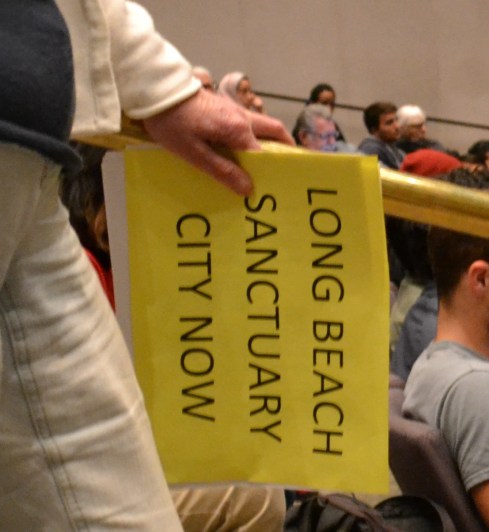
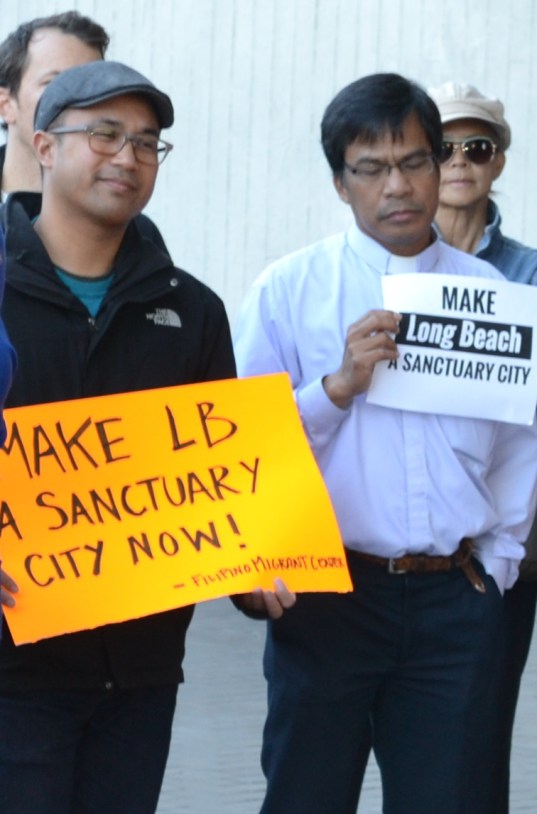
In the council chambers, during the comment period, while two speakers spoke against supporting the two bills, dozens of speakers spoke in favor and most added they wanted Long Beach to become a sanctuary city.

2ndchosen

Photo by Barry Saks; Member of Audience Holding Sign, at the Tuesday, Feb. 7 2017, While Standing in Line to Speak During the Time for Public Comments

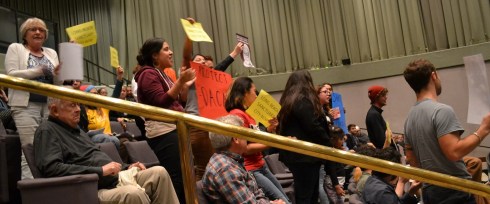
Just before the last speaker, many in the audience stood up and chanted, “Sanctuary, not deportation.”

5thchosen

Photo by Barry Saks; Members of Audience Chanting Tuesday, Feb. 7, 2017, in Council Chambers during Long Beach City Council Meeting

After public comments, 1st District Councilwoman Lena Gonzalez, who put forward the support motion, said Senate Bill 54 sets a statewide standard and asked Diana Tang, Manager of Government Affairs, about the legislative process, the status of the bills, and more specifically the issue of violent and serious crime, and human trafficking as it is related to SB54. In response, Tang said both bills are now in the Senate and because both are emergency bills, a two-thirds vote will be required in both houses.  She said, if they pass, they then will be sent to the Governor for him to consider and that SB54 is still in its original form.

The Mayor, in response to the discussion between the councilwoman and Tang, reported he had spoken that day to the Senate Pro Tempore, who told the Mayor he is in discussion with the State Police Chiefs Association to ensure there is interagency communication, particularly regarding human trafficking and other issues, and that he is looking at and supports language that allows for interagency coordination with Federal law enforcement regarding violent and serious crimes.

Then, the Councilwoman Gonzalez said while she supports the two bills, she said she also supports the same amendments the Senate Pro Tempore is pursuing.  She then amended her motion to include her two concerns.

Then, 2nd District Councilwoman Jeannine Pearce, who also signed on in support of the two bills, reminded the other councilmembers that they supported last November a motion urging the Federal government to provide Jose Alvarez humanitarian parole and then said, “As a state and as city we have gone too far and we will not go back.”  She then asked how Long Beach Police Department has implemented the recently passed California Trust Act, (Assembly Bill 4), which prohibits law enforcement from detaining an individual for Federal Immigration after the individual becomes eligible for release from custody, unless specified conditions are met.

Deputy Police Chief Michael Beckman responded.  He said LBPD complies with the California Trust Act and said since the act’s implementation, “I.C.E. (U.S. Department of Homeland Security Immigration and Customs Enforcement) has never provided the Long Beach Police Department a signed court order and/or has traveled to the Long Beach Police Department to take custody of an undocumented immigrant.”

Then 7th District City Councilman Roberto Uranga, who also endorsed the motion of support, said, “We are experiencing a President who is a thug, who is a blackmailer and who is potentially an extortionist.  He is threatening to withhold federal funds to not only the states and the state of California, but to the City of Long Beach, as well.”

Then, 3rd District City Councilwoman Suzie Price said, “I am a descendant of immigrants from one of the countries, where there is currently the ‘non-ban’ and it has been a very scary time for people in my community, as well, and I actually had an opportunity to meet with them on Sunday…. and I explained to people in that community my concerns with sanctuary city.”  For the Councilwoman, her concerns centered on the fiscal impact of the city becoming a sanctuary city and asked for clarification.

Tang said it was unclear what the fiscal impact would be.

The Councilwoman then said Long Beach becoming a sanctuary city was not the agenda.  She then voiced her concerns about Senate Bill 54 and offered an amendment to support Senate Bill 31, but asked Senate Bill 54 be sent to the State Legislative Committee and the Public Safety Committee.

Councilwoman Gonzalez responded politely and then rejected Councilwoman Price’s amendment.

Then, 8th District Councilman Al Austin said it was a “no brainer” for him to support the motion.  He added, as a suggested amendment that there may be other bills, which could be supported.  Councilwoman Gonzalez accepted his amendment.

Then, 9th District Councilman and Vice Mayor Rex Richardson, who also initially supported the motion, said, “These bills on the table they demonstrate some very critical values, religious freedom and trust….The tone in Washington is quickly eroding that trust.”

The last councilperson to speak before the vote was 4th District Councilman Daryl Supernaw.  The councilman echoed Councilwoman Price that the issue of sanctuary city was not on the agenda.  He then said because the item was not put on the agenda until Friday afternoon, consequently he was not able to notify the people in his district.

After the councilmembers spoke, the Mayor stated his support for the motion and pointed out that Long Beach is not only a city of immigrants, but also of refugees.

The council voted 7-0 for the motion with the three amendments.  Absent were 5th District Councilwoman Stacy Mungo and 6th District Councilman Dee Andrews.

4thchosen

Photo by Barry Saks; audience holding signs, Tuesday, Feb. 7, 2017 during the Long Beach City Council Meeting.

Immigration Supporters to City Council: Make Long Beach a Sanctuary City

2 Feb
mydsc_0277

Pro-Immigration Rally of Tuesday Jan. 31, 2017, at Long Beach City Hall

More than a hundred Long Beach residents rallied outside City Hall on Tuesday, Jan. 31, to demonstrate their solidarity with immigrants and their opposition to President Donald J. Trump’s recent temporary ban on immigrants from the mostly-Muslim countries of Iran, Iraq, Libya, Somalia, Sudan, Syria and Yemen.

Clergy and Laity for Economic Justice (CLUE) organized the rally.  A recent statement from the CLUE website said, “Clergy and Laity United for Economic Justice reiterates (sic) our fervent belief that this country must be a haven for those escaping violence and crushing poverty.”

dsc_0275

Rev. Ricardo Avila of St. Luke’s Episcopal Church

The Rev. Ricardo Avila of St. Luke’s Episcopal Church emceed.  The Reverend in his opening remarks to a round of applause said his church last week had voted to become a “Sanctuary Parish.”  Near the end of his remarks he said, “We now ask Long Beach City leaders to not be threatened and rise as well by declaring Long Beach a Sanctuary City and committing to be on the front lines of resistance.”

The Rev. Noel Andersen, of Church World Service and a leader of the national sanctuary movement, said that since the Presidential election the national sanctuary movement has grown from 400 to 800 congregations.

dsc_0304

Rev. Noel Andersen of Church World Service

The other faith-based clergy who spoke from Long Beach were Pastor Gregory Sanders of The Rock Christian Fellowship, Pastor Melinda Teter Dodge of the Los Altos United Methodist Church, Rabbi Emeritus Howard O. Laibson of Shir Chadash Congregation, Rev. Leon Wood of the North Long Beach Community Prayer Center and the Executive Director of the South Coast Interfaith Council, Milia Islam-Majeed.

Besides the faith-based community, Long Beach City Councilmembers—Lena Gonzales representing the 1st District, Jeanine Pearce representing the 2nd District and Roberto Uranga representing the 7th District—spoke.

Besides the local elected representatives, representatives of the immigrant community also spoke.  One of them was Alicia Morales, who represents the Long Beach Immigrant Rights Coalition.  Morales, who now is covered by the Deferred Action for Childhood Arrivals (DACA) program, said that because she is undocumented she understands the fears the undocumented face.  She then said, with her voice quivering, “When you have the highest power in the country threatening your livelihood, threatening your humanity, threatening your dignity, it makes it very difficult to continually wake up in the morning…. We cannot allow this administration to relegate people to cages, to jail and to imprisonment.  We cannot let this administration determine who is deserving and who is not deserving because we are all deserving of a better life.”

dsc_0311

Nikole Cababa of the Filipino Migrant Center

Another speaker representing the immigrant community was Nikole Cababa from the Filipino Migrant Center.  Cababa, a long-time resident of Long Beach, said almost 30,000 Filipino immigrants live in Long Beach.  She then led the crowd in the chant, “Sanctuary, not deportation.”

Many of those who rallied came from the faith-based community.  Carol Quinlan, who is from the Unitarian Church of Long Beach, estimated about 20 members of her church with their yellow shirts rallied.  Quinlan said, “We are standing here on the side of love.”   Another person who rallied was long-time Long Beach resident Julie Baker.  Baker, who identified herself as a member of the North Long Beach Christian Church said she was there in solidarity.  A third person at the rally was Reina Mansilla, 62 and attends the St. Luke’s Episcopal Church, said there were more than ten people from her church at the rally.  Mansilla, who was originally from Guatemala, said she was at the rally because immigrants need to have rights.

dsc_0287

Error
This video doesn’t exist

Another version of this story was published at LBReport.com. It can be found at http://www.lbreport.com/news/saks/immig1.htm.

Women and their Allies March in Los Angeles

24 Jan

dsc_0225

Hundreds of thousands of people in Los Angeles marched from Pershing Square to City Hall, on Saturday, Jan. 21 in solidarity with the call for the Women’s March, as part of the local, national and worldwide protests in response to the newly inaugurated 45th President of the United States Donald J. Trump.

While most of the protesters were women, many men marched.  Many men and women wore knitted pink pussyhats.

dsc_0253

Some protesters showed their former support for Hillary Clinton.  While clearly a protest, the mood was festive, including drummers.

dsc_0245

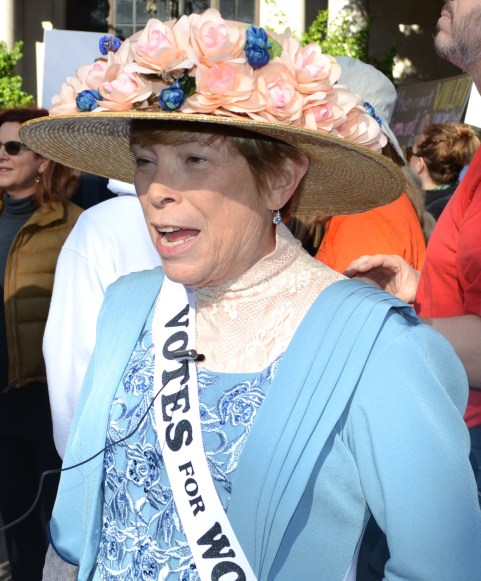
Emmilene Pankhurst at Los Angeles Women’s March, Saturday, Jan. 21, on Olive St., outside of Pershing Square.

One protester, who was dressed as a suffragette, was Emmilene Pankhurst.  She said, “I march for my daughter and my granddaughter … for women, for all the most vulnerable in our society, and I march because this is just the beginning.  We’re going to organize.  We are going to take over the House (of Representatives) and the Senate.”

While most of the protesters marched from Pershing Square down Hill St. toward City Hall, some protesters at West 6th and Olive Streets marched down 6th toward Grand Ave.  At Grand, they turned right and marched up the steep incline toward City Hall.

While they marched up Grand, a group of five or six other women, sharing a bullhorn, chanted.  One chant was “Our bodies, our choice.”  A second chant was “Love trumps hate.”

dsc_0247

The mission and vision statement of the national Women’s March set the tone of the Los Angeles march. The statement, in part, said,The Women’s March on Washington will send a bold message to our new government … that women’s rights are human rights. We stand together, recognizing that defending the most marginalized among us is defending all of us.  We support the advocacy and resistance movements that reflect our multiple and intersecting identities…. This march is the first step towards unifying our communities, grounded in new relationships, to create change from the grassroots level up.”

The mission statement of the organizers’ of the national Women’s March can be found at https://www.womensmarch.com/mission.

Award-Winning Journalist to Speak on Friday, Jan. 13, in Long Beach, California

2 Jan
10757174_ben-ehrenreich-humanizes-the-israelipalestinian_be17a8be_m

From Creative Common, Images of Book Cover and Ben Ehrenreich

Award-winning journalist Ben Ehrenreich, on Friday, Jan.13, at 7 p.m., at the Christ Lutheran Church, at 6500 Stearns St. in Long Beach, will sign and discuss his new book, “The Way to the Spring: Life and Death in Palestine.”

In December of last year, the Economist magazine in Britain announced it considers Ehrenreich’s book one of the best of 2016.

The New York Times called his book a “Love Letter to Palestine.”

According to a flyer issued before the book signing, People for Palestinian-Israeli Justice will sponsor Ehrenreich along with the cosponsors: Christ Lutheran Church, Peace and Justice Ministry Team of the Grace First Presbyterian Church of Long Beach, Jewish Voice for Peace-Los Angeles, Long Beach Area Peace Network and United Methodists’ Holy Land Task Force.

When being interviewed by Anne Strainchamps, the host of “To the Best of Our Knowledge” of Wisconsin Public Radio, Ehrenreich, regarding violence, said, “I think suicide bombings are terrible.  I think attacks on civilians are terrible…. I do think there is, however, extraordinary hypocrisy in the way we talk about violence in this conflict in situation.  So basically every act of Israeli violence, whether it is the bombing of Gaza, which left 2,200 people, two-thirds of them civilians, dead or shooting a 15-year-old boy in the back who was throwing stones, as happened this week and killing him, all of this is legitimate, all of the violence of the (Israeli) state.  It is never questioned whether or not Israel has the right to exert lethal violence on a daily basis against the civilian population.  But if there even is the tiniest amount of violence coming from the Palestinian side, it is immediately condemned, called terrorism.”

Ehrenreich, who studied religion at Brown University, won, in 2012, a PEN Center USA award for his journalism.  According to the website of PEN Center USA, it is “a branch of PEN International, the world’s leading international literary and human rights organization.”

In 2011, he won an Ellie from the American Society of Magazine Editors for feature writing.  In 2009, he won a GLADD (Gay and Lesbian Alliance Against Defamation) media award for an outstanding magazine article.

Besides his immersion journalism, he’s written two novels, “Ether” and “The Suitors.”  His short stories have been published.  The Poetry Foundation has published his literary pieces.

Gatsby Books will be selling his book.

Parking and the event are free.  However, donations will be accepted.

People may call Dennis Korteuer at 310-427-2265 or email him at dkortheu@gmail.com for more information regarding the book signing.