Long Beach May Day Marchers Demand City to Become Sanctuary

3 May
DSC_0150

May Day 2017, Long Beach, California; Photo by Barry Saks

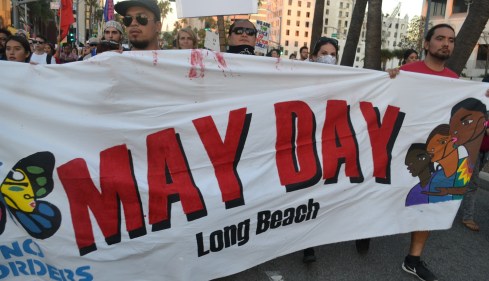
About two hundred people, many who were youth of color, marched, Monday, May 1, from McArthur Park to Long Beach City Hall, to celebrate May Day and to highlight for Long Beach to become a sanctuary city.

Before marching at the park, a picnic table was used as a stage for the program of speeches.  The two emcees, Alex Montances from the Filipino Migrant Center and Maria Lopez from Housing Long Beach, began the  program with a chant, “Ain’t (sic) no power like the power of the people, cuz (sic) the power of the people don’t stop. Say what!”
DSC_0004

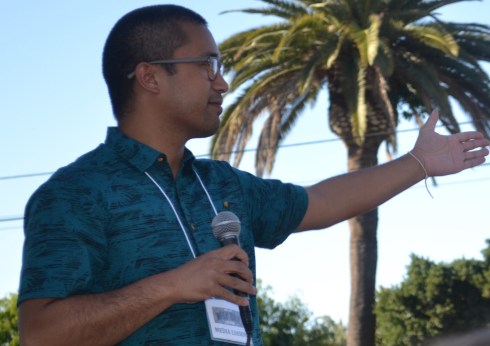
Alex Montances, one of two emcees, speaks on the history of May Day, in Long Beach; Photo by Barry Saks

Montances and Lopez gave a brief history of May Day and described the local May Day Coalition, including the self-characterization that the coalition is “pro-immigrant, pro-worker, pro-human rights, pro-social justice and pro-Black Lives Matter,” which was followed with cheers from the audience.

DSC_0025

Maria Lopez, the second emcee, leading a chant on May Day 2017, Long Beach; Photo by Barry Saks

Lopez pointed out that this year’s theme was “sanctuary for all.”  Montances was more specific.  He said the May Day Coalition wanted Long Beach to become a sanctuary city and defined briefly what he meant.  He said, “We demand a sanctuary city policy … for the police officers not to cooperate, not to use funding or resources for deportation and immigration enforcement.  They (the police) shouldn’t be sharing people’s sensitive information about people’s immigration status (with the U.S. Immigration and Customs Enforcement).”

Elisa Gomez, from the Greater Long Beach Interfaith Community Organization, spoke in Spanish with English translation.  She told the audience of the deportation and subsequent death of her brother-in-law, and that the local city representatives have been silent on making Long Beach a sanctuary city.  At the end of her talk, she said, “The city needs to protect us, but I say to ICE we are also observing you and your actions.”

Marabel Cruz of the Long Beach Immigrant Rights Coalition, who is bilingual, spoke in English and then Spanish.  She said she came to this country when she was two years-old and echoed the earlier statements for the need for Long Beach to become a sanctuary city.

DSC_0052

Gabrielle Sibal recites her spoken-word poem on the need for International Solidarity, May Day 2017, Long Beach; Photo by Barry Saks

Gabrielle Sibal of Gabriela Los Angeles, who characterized her organization as a “Filipina anti-imperialist organization,” read her spoken-word poem on the need for international solidarity.
DSC_0076

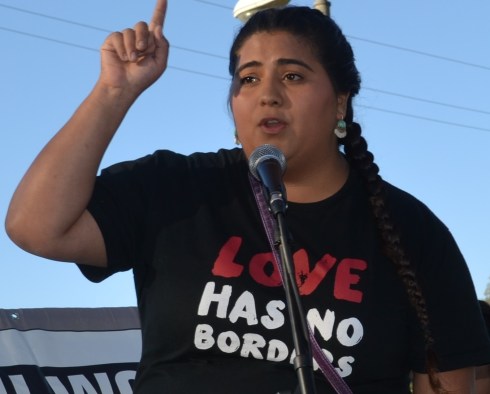
Nereyda Soto speaks on the struggle of hotel workers in Long Beach, May Day 2017; Photo by Barry Saks

Nereyda Soto of Coalition for Good Jobs and a Healthy Community also spoke.  Soto said she works in the Long Beach hotel industry and is the daughter of Salvadoran refugee.  She said, “My coworkers and I have been fighting for Claudia’s Law for two years….for a policy to protect us from sexual harassment in our workplace and overbearing workloads….and we still have not heard anything from (the Long Beach City) Council, shame.”

Three other chants, which were part of the program were “Get up, get down.  There’s a people’s movement in this town,” “I believe that we will win” and “Si se puede (Yes we can),” which was the motto of the United Farmworkers.

At the other end of the march at Long Beach City Hall, a second program of speeches began.  Montances and Lopez again emceed.  One of those who spoke was George Funmaker, who was identified as being from Red Earth Defense and who has previously organized against the Dakota Access Pipeline.  Funmaker pointed out to the crowd they were standing on Tonga land and said as indigenous people national borders aren’t recognized.  Funmaker urged the crowd to move its money from the banks, which are funding the oil pipelines, like Wells Fargo and Bank of America, to local credit unions.
liz

Liz Waite of Housing Long Beach Marching on May Day 2017, Long Beach; Photo by Barry Saks

Liz Waite, from Housing Long Beach, spoke.  Waite said, “Housing is a human right….We are the only city on the West Coast without renter protections.”

Bruce Jefferson, from the Warehouse Worker Resource Center, also spoke.  Jefferson said he works at Cal Cartage through a temp agency.  He said the Warehouse Worker Resource Center was organizing because of low paid, the lack of respect, no health care, favoritism and racial discrimination.

Sergio Gonzales also spoke.  Gonzales said he has been a truck driver for seven years and that he and the other drivers have been misclassified as owning their business instead of as employees.

Naida Tushnet, from the Long Beach Area Peace Network, was the last to speak.  Tushnet said, “What we are fighting for did not begin with Trump’s election…Let me tell you that the war budget is part of our problem and we need make sure we argue for a peace budget that takes care of everyone.”

While marching to Long Beach City Hall, the chants were “When workers’ rights are under attack, what do we do?  Stand up fight back.  When immigrant rights are under attack, what do we do?  Stand up, fight back,” “We are people, we are not illegal,” “From Palestine to Mexico, all these walls have got to go,” “No ban, no wall, sanctuary for all,” “Sanctuary, not deportation,” “Everywhere we go people want to know who we are.  So we tell them.  We are the workers, the mighty, mighty workers” and “Black lives they matter here” and “Move ICE, get out of the way, get out of the way, get out of the way.”

One of the marchers was Stephanie Deschams, 29, said she was there to support the rights of the immigrant community and hoped Long Beach would become a sanctuary city.  Deschams, who said she got certificates in nursing and phlebotomy from Long Beach City College, pointed out Donald Trump’s grandfather had immigrated from Germany and Ivanka Trump had immigrated from Slovenia. She said, “We (should) stand united.  If one person goes down, we all go done.”
DSC_0001

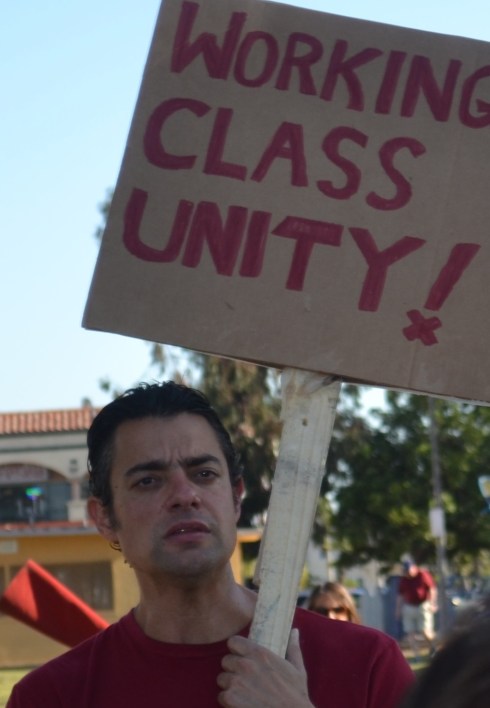
Robert Jay carrying is sign in McArthur Park, May Day 2017, Long Beach; Photo by Barry Saks

Another marcher was Robert Jay, 43.  Jay said he lives in Long Beach, works part-time in long shore and is a member of Local 13 of the International Longshore and Warehouse Union.  Jay said, “May 1st is important to me…. (It) is the original Labor Day, which is a sign of solidarity because every society the working-class is always in the majority.”

Besides the trade unionist Jay marching, contingents of hotel workers, teamsters and teachers also marched.

According to the website for the May Day Long Beach, the event was “presented” by Anakbayan Long Beach, Black Lives Matter Long Beach, California Faculty Association, Clergy and Laity United for Economic Justice, Coalition for Latino Advancement at Long Beach City College, DAYS, Filipino Migrant Center, Gabriela Los Angeles, Greater Long Beach Interfaith Community Organization, Justice for Port Truck Drivers Campaign, LAANE-Los Angeles Alliance for a New Economy, LiBRE-Long Beach Residents Empowered, Little Brown Church, Long Beach Area Peace Network, Long Beach Coalition for Good Jobs & a Healthy Community, Long Beach G.R.R.R.L. Collective, Long Beach Immigrant Rights Coalition, Palestinian Youth Movement, Semillas de Esperanza (Seeds of Hope) and Stop Fracking Long Beach.


Protesters March in Los Angeles Against U.S. Wars

26 Apr
DSC_0106

Antiwar Protest at Pershing Square, Los Angeles, April 2017; Photo by Barry Saks

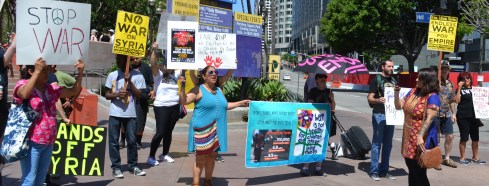
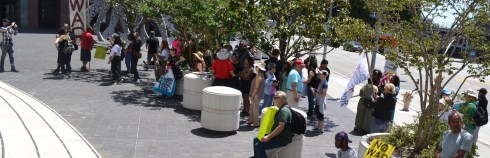
About 25 people, many were from California for Progress and the local Green Party, marched from Pershing Square in Los Angeles, on Sunday, April 23, to the downtown Federal Building on Temple Ave. to protest the U.S. interventions in Afghanistan, Syria, Iraq, Yemen, Libya, Pakistan and Somalia.


Whether standing outside of Pershing Square on the corner of 5th and Olive Streets or marching to the Federal Building, the protesters chanted.

DSC_0111

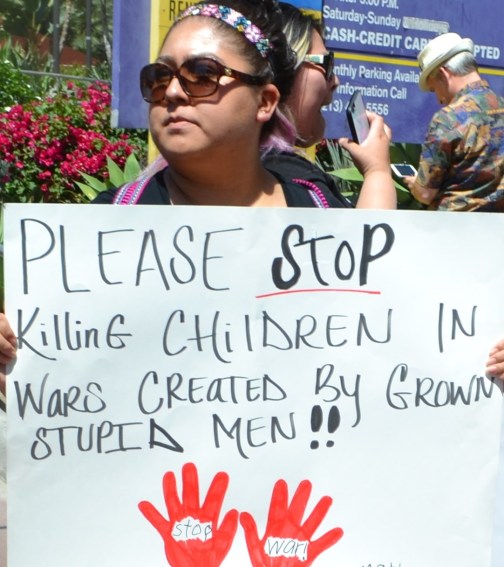
Stephanie Delgado, standing on the edge of Pershing Square on April 23, 2017, with her sign, protesting; Photo by Barry Saks 

One chant was “Funds for jobs and education, not for wars and occupation.”  Another was “No war in the Middle East.” A third chant was “When the Middle East is under attack, what do we do?  Stand up, fight back.”  A fourth chant was “All we are saying is give peace a chance.”  A fifth chant was “What do we want?  Peace.  When do we want it?  Now.” A sixth chant was “Love and peace, no more war in the Middle East.”  A seventh chant was “This racist war has got to go.”

DSC_0131

Antiwar Protesters Marching Toward the Downtown Federal Building, April 23, 2017; Photo by Barry Saks

While most of the chants, addressed peace, war and its costs, the issue of immigration was, particularly raised with the chants, “No ban, no wall, sanctuary for all. No hate no fear, refugees are welcome here” and “You build a wall, we tear it down.  From Palestine to Mexico, all the walls have got to go.”

DSC_0162

Antiwar Protesters Listening to Speakers, April 23, 2017, Outside an Entrance to the Downtown Federal Building; Photo by Barry Saks 

On arrival to one side of the Federal Building, a pro-immigrant rights rally was taking place.  The antiwar protesters, who had early chanted a couple of pro-immigrant chants, greeted the other rally by continuing their pro-immigrant chants.  After about 10 minutes, the antiwar protesters moved to another entrance to the Federal Building, where they ended their protest with more speakers and announcements.

DSC_0166

Tania Singh Speaking, April 23, 2017, at Downtown Federal Building; Photo by Barry Saks

The idea of the protest came initially from Tania Singh, 28, who has a bachelor’s degree in political science.  Singh said she started thinking about the need to protest two or three months ago and was aware of the U. S. bombings.  She tried to get people in the Democratic Party involved, but found no interest.  At first she was going to stand on a corner by herself in her neighborhood with a sign.  She posted her desire to protest on Facebook; she heard from California for Progress and others, which wanted to do more and this is how this protest came about.  Singh said, “There has never been a time when they (the United States) go in and that place is left better than it was before….(T)here are better ways to achieve peace.”

DSC_0102

Allie White at Pershing Square, Los Angeles, April 23, 2017; Photo by Barry Saks

One of those who encouraged Singh to build something larger was Allie White, 29, who is with California for Progress.  White characterized California for Progress as leaderless.  She pointed out her organization supports indigenous and immigrant rights.

One of those who marched was James Carter, 24.  Carter said he was a member of the Socialist Party of Los Angeles and belongs to West Angeles Church of God in Christ.  He said he was there to oppose U.S. imperialism in the Middle East and added, “Usually we (the U.S.) say we are freeing people or liberating them from some kind of dictator, but that is rarely ever the case…. But then we occupied them for two decades or so.”

Another marcher was Jimmy Rivera.  Rivera said he was “part of the Green Party.”  Rivera, like Carter, said he was opposed to the U.S. imperialist wars.

DSC_0118

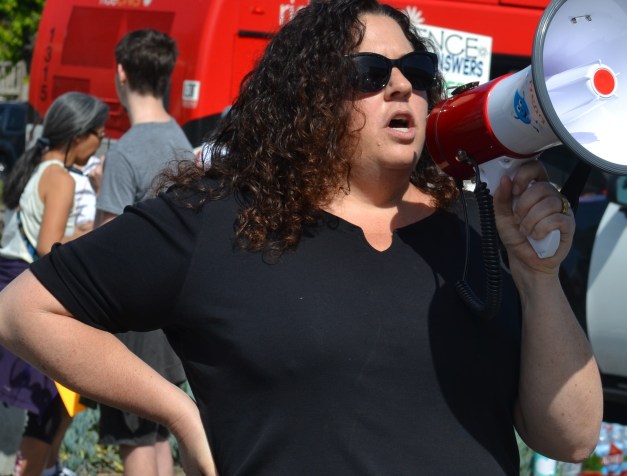
Yolanda Gonzalez, outside Pershing Square, Los Angeles, April 23, leading chants; Photo by Barry Saks

Another marcher was Yolanda Gonzalez, 56.  Gonzales said she’s a member of the Green Party and a teacher of 25 years, who teaches in a project-based-learning classroom.  Gonzalez, said, “I want to teach my students about the militarization that has been occurring in this country since its inception and that peace has to come from each one of us.”

The Facebook page for the event said, “On April 23, 2017 the people of Los Angeles unite to denounce military interventions, wars, and war crimes the United States is culpable for…. (W)e unite to call for demilitarization, de-escalation, & diplomacy….We call on our human family around the world to join us in demanding a demilitarized world.”


Long Beach Marches for Science

24 Apr

DSC_0068

Hundreds of people, many of them—teachers, scientists and students—marched on the sidewalk on Saturday, April 22, north on Atlantic from San Antonio Drive to Houghton Park in Long Beach, which was part of the marches worldwide, nationally and in California, which was self-identified as the March for Science.

The Facebook page for the Long Beach event said, “We are people who value science: scientists, educators, journalists, students, neighbors, friends, and family. We come from all races, all religions, all gender identities, all sexual orientations, all abilities, all socioeconomic backgrounds, all political perspectives, and all nationalities…What unites us is a love of science, and an insatiable curiosity. We all recognize that science is everywhere and affects everyone.”

According to the Facebook page for the national event, marches were in more than 600 cities nationally and in more than 40 cities across California.

DSC_0028

Long Beach Unified School District Board Member Megan Kerr speaking at March for Science Rally, on April 22, in Long Beach, California; Photo by Barry Saks

An organizer of the march was Megan Kerr, who is a member of Long Beach Unified School District Board of Education.  Kerr estimated just as the march began at about 400 people.

DSC_0036

Elaine Villanueva holding a sign before speaking on April 22, at the rally before the March for Science in Long Beach; Photo by Barry Saks

Kerr introduced Elaine Villanueva Bernal, who teaches organic chemistry at Cal State University Long Beach.  Bernal said, “Today I march because chemistry is an essential science that allows us to connect to the world around us and to each other.  It is one, of the many scientific disciplines, that enables us to see that climate change is real and chemistry empowers us to advocate for cleaner air and cleaner water.”

DSC_0038

Lisa Martin-Hansen speaking April 22 at rally before the March for Science in Long Beach, California; Photo by Barry Saks

Next to speak was Lisa Martin-Hansen, who also teaches at CSULB.  Martin-Hansen said she was speaking officially for the Association for Science Teacher Education and the National Science Teachers Association.  She said, “When the EPA (Environmental Protection Agency) tells scientists not to share data with the public, science was silenced.  When the NIH (National Institute of Health) budget is cut, it affects research that directly relates to our wellbeing.  When funding for satellites to gather climate data is no longer provided, that holds back our progress.”

DSC_0043

Chris Lowe speaking at March for Science rally before marching on April 22 in Long Beach, California; Photo by Barry Saks

The last CSULB educator to speak was Chris Lowe, who is the Director of the Shark Lab.   Lowe said, “I’m here today to march for the ocean.  So, we have made great strides improving our ocean health.  In fact, sharks have come back….Marine mammals have come back…. and, of course, our oceans are getting cleaner…. As someone who is training the next generation…we need to be here today and we need to show that we care about science.”

DSC_0060

Long Beach Mayor Robert Garcia on April 22 speaking at rally for March for Science; Photo by Barry Saks 

The last to speak before the march was Long Beach Mayor Robert Garcia.  The Mayor said he wanted to thank the women because they were the ones who organized the march.

One chant was “more science less silence.”  Another was “science is discovery.”

DSC_0003

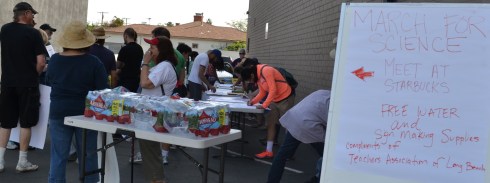
In the parking lot of Teachers Association of Long Beach, on April 22, before the March for Science; Photo by Barry Saks

Before the march, just south of Atlantic, the Teachers Association of Long Bead hosted in the union parking lot, tables, where signs could to made before walking a couple of blocks north, where the march was to begin.

Before the march, one person who took the local bus to San Antonio and Atlantic and then walked south to the TALB parking lot was Domenica Coronel.  Coronel, who is 35 and a Licensed Vocational Nurse, said science is fundamental because “It’s in everything, it’s in medicine, it’s in technology.”  Coronel said this was not her first march and she had been at the Women’s March in Los Angeles.  She said people had to wake up, we need to hold our government account and ended that the future scares her.

DSC_0006

Friends, Nancy Patterson and Anne Wright, on April 22, in the Teachers Association of Long Beach parking lot before the March for Science; Photo by Barry Saks 

Another marcher in the TALB parking lot was Anne Wright, 51, who said she is an unemployed secretary and lives in Long Beach.  Wright said she was scared of Betsy DeVos, the Secretary of Education, wanting to make public education heavily involved with fundamentalist Christianity.  With Wright was her longtime friend, Nancy Patterson, 52, who said she is a social worker.  She said she lives in the city Orange and drove over in her hybrid car.  Patterson said she doesn’t usually go to demonstrations, but she thought this one was important enough for her to be at.  Patterson said she was partly influenced as a child by the television program, Cosmos, with Carl Sagen, and now reads Scientific American.

Another person in the TALB parking lot was Nrapendra Prasad, 72.  Prasad, who lives in Newport Beach, said he is a scientist.  Prasad, who said he became a U.S. citizen for at least 45 years, said he has a Doctor’s degree in entomology, however, now he is a photographer.  He said, “We have one planet and we need to save this planet…People don’t realize that we have clean air, clean water and clean cars.  It’s all because of science.  It’s not because some religious propaganda.”  He said he’s not political but this last election changed his mind that he had to come out.

Barry Saks has a bachelor’s degree in mathematics from Cal State College at Long Beach, now CSULB.

Long Beach City Council Pulls Proposal for Rental Application Credit Check Reform

20 Apr

Outside of City Hall, at a rally to urge the Long Beach City Council on Tuesday, April 18, to proclaim the third Wednesday of April, yearly, as Renters Day, Jorge Rivera, the Program Director of Long Beach Residents Empowered, local renters’ rights organization, announced the other agenda item on the council, called the Rental Application Credit Report Reform, was pulled from the agenda, without stating his source, because of pressure from the Apartment Association of Southern California Cities and from some property owners.

The agenda item which was pulled was sponsored by 2nd District Councilwoman Jeanine Pearce, 7th District Councilman Roberto Uranga, and Vice Mayor and 9th District Councilman Rex Richardson.

If the agenda item passed, it would have required the City Manager to work with the Department of Development Services, housing groups and property owners to draft a report on streamlining and making the rental credit check more affordable through a third-party, which would be presented in 60 to 90 days.

Rivera, after his announcement, urged the crowd to tell the City Council that they needed credit check reform.

Daryl Supernaw, who represents the 4th District, in an email after the meeting, said, “I have absolutely no knowledge of any such allegation nor any idea of why the item was pulled from the agenda.”

Celina Luna, who is the Chief of Staff for 7th District Councilman Roberto Uranga, in an email after the meeting, said, Councilman Uranga has had no communication with either the Apartment Association of California Southern Cities or with Better Housing  for Long Beach.

Alyssa Gutierrez, who is the Business and Community Relations Manager for Vice Mayor and 9th District Councilman Rex Richardson, in an email after the meeting, said, “Vice Mayor Richardson’s wife just delivered their second child this morning, which is why he was not at the council meeting last night” and added, “Vice Mayor Richardson was not the sponsor of the item. He is in no position to pull or withdraw the proposal. This item was brought to council by Councilmember Jeannine Pearce’s office, and pulled by Councilmember Pearce’s office.”

Joani Weir, who is the President of Better Housing for Long Beach, said she volunteers her time for the organization.  She didn’t deny Better Housing for Long Beach lobbied to pull the item off of the agenda.  Weir, who admitted she is a property owner and manages her rental units herself, said she and other members of her organization were concerned about the liability associated with credit checks because of personal information being confidential.  She said, “Me personally, I get my credit reports done with one agency and I wouldn’t want to move from one agency to different agency and have them hold all of my prospective tenants’ credit reports.  So yes, we weren’t in favor of the 90-day credit report having (the Apartment Association of California) Southern Cities holding all the credit reports.”

Josh Butler, who is the Executive Director of Housing Long Beach and who said his salary is $60,000 each year before benefits, said, “Items are regularly pulled from the agenda and this item will come back and Housing Long Beach looks forward to that conversation.”

The vote on making the third Wednesday April, Renters Day passed 7-0, with 5th District Councilwoman Stacy Mungo and Vice Mayor Richardson absent.

The Apartment Association of Southern California Cities was not available for comment.  Mayor Garcia, 1st District Councilwoman Lena Gonzalez, 2nd District Councilwoman Jeanine Pearce, 3rd District Councilwoman Suzie Price, 5th District Councilwoman Stacy Mungo, 6th District Councilman Dee Andrews and 8th District Councilman Al Austin were also not available for comment.


California Senate Bill 562, Healthy California: An Analysis

17 Apr
California Senate Bill 562, which was amended on March 29 and which Senators Ricardo Lara (Democrat, 33rd District) and Toni Atkins (Democrat, 39th District) introduced as an intent bill, on Feb. 17, is now known as the Healthy California (HC) Act.  The amended bill now lists Senators Allen, Galgiani, McGuire and Skinner, all Democrats, as coauthors.  It also now lists Assembly members Bonta, Chiu, Friedman, Nazarian and Thurmond, all Democrats, also as coauthors.

While before being amended the bill stated that it was the Legislature’s intent “to … establish a comprehensive universal single-payer health care coverage program and a health care cost control system for the benefit of all residents of the state,” the amended bill adds that “(i)t is further the intent of the Legislature to establish the Healthy California (HC) program to provide universal health coverage for every Californian based on his or her ability to pay and funded by broad-based revenue.”  Other than stating that “(i)t is the intent of the Legislature for the state to work to obtain waivers and other approvals relating to Medi-Cal, the state’s Children’s Health Insurance Program, Medicare, the PPACA, and any other federal programs so that any federal funds and other subsidies that would otherwise be paid to the State of California, Californians, and health care providers would be paid by the federal government to the State of California and deposited in the Healthy California Trust Fund,” no further discussion of funding is provided as amended.

The amended bill states, “Every resident of the state shall be eligible and entitled to enroll as a member under the program” and that “(c)overed health care benefits under the program include all medical care determined to be medically appropriate by the member’s health care provider.”

It lists the benefits as licensed inpatient and outpatient medical and health facility services; inpatient and outpatient professional health care provider medical services; diagnostic imaging, laboratory services, and other diagnostic and evaluative services; medical equipment, appliances, and assistive technology, including prosthetics, eyeglasses, and hearing aids and the repair, technical support, and customization needed for individual use; inpatient and outpatient rehabilitative care; emergency care services and transportation; necessary transportation for health care services for persons with disabilities or qualify as low income; child and adult immunizations and preventive care; health and wellness education; hospice care; care in a skilled nursing facility; home health care or provided in an assisted living facility; mental health services; substance abuse treatment; dental, vision, pediatric, prenatal, postnatal, podiatric and  chiropractic care; prescription drugs; and acupuncture.

Additionally it lists therapies that are shown by the National Institutes of Health, National Center for Complementary and Integrative Health to be safe and effective; blood and blood products; dialysis; adult day care; rehabilitative and “habilitative (sic)” services; ancillary health care or social services previously covered by county integrated health and human services programs; ancillary health care or social services previously covered by a regional center for persons with developmental disabilities; case management and care coordination; language interpretation and translation for health care services, including sign language and Braille or other services needed for people with communication barriers; health care and long-term supportive services now covered by Medi-Cal or the state’s Children’s Health Insurance Program (CHIP); covered benefits for members shall also include all health care services required to be covered under any of the following provisions: the state’s CHIP, Medi-Cal, the federal Medicare program, health care service plans pursuant to the Knox-Keene Health Care Service Plan Act of 1975, health insurers, as defined in Section 106 of the Insurance Code, any additional health care services authorized to be added to the program’s benefits by the program and all essential health benefits mandated by the Affordable Care Act as of January 1, 2017.

Regarding governance, the amended bill will create an independent 9-member board to govern the “Healthy California” program.  The nine members are all appointed.  The California governor will appoint four, which the Senate must confirm.  The Senate Rules Committee will appoint two.  The Assembly Speaker will appoint two.  The California Health and Human Services Secretary, who the California governor also appoints, will serve as an ex-officio member and his or her appointee will have a vote.  All are appointed for four years except for the ex officio member.  Regarding the appointments, the amended bill states that each appointee “shall have demonstrated acknowledged expertise in health care,” that the “(a)ppointing shall also consider the expertise of the other members of the board and attempt to make appointments so that the board’s composition reflects a diversity of expertise in the various aspects of health care, and that among the appointees that “(a)t least one representative (be) of a labor organization representing registered nurses,” that “(a)t least one representative (be) of the general public,” that “(a)t least one representative (be) of a labor organization” and “(a)t least one representative of the medical provider community.”

Besides the amended bill stating that the 9-appointed-member board will govern the program, the amended bill states, “The Secretary of California Health and Human Services shall establish a public advisory committee to advise the board on all matters of policy for the program.”

The amended bill also states that “any state or local agency, or a public employee acting under color of law shall not provide or disclose to anyone, including, but not limited to, the federal government any personally identifiable information obtained, including, but not limited to, a person’s religious beliefs, practices, or affiliation, national origin, ethnicity, or immigration status for law enforcement or immigration purposes” and that “law enforcement agencies shall not use Healthy California moneys, facilities, property, equipment, or personnel to investigate, enforce, or assist in the investigation or enforcement of any criminal, civil, or administrative violation or warrant for a violation of any requirement that individuals register with the federal government or any federal agency based on religion, national origin, ethnicity, or immigration status.”

The amended bill defines a carrier as “either a private health insurer holding a valid outstanding certificate of authority from the Insurance Commissioner or a health care service plan, as defined under subdivision (f) of Section 1345 of the Health and Safety Code, licensed by the Department of Managed Health Care”and states, “(a)carrier may not offer benefits or cover any services for which coverage is offered to individuals under the program, but may, if otherwise authorized, offer benefits to cover health care services that are not offered to individuals under the program.”

The text of the amended bill may be found here.


Local Christian-Faith-Based Clergy and Other Supporters of Warehouse Workers Show Their Support for the Teamsters Union in Front of California Cartage

13 Apr

DSC_0090

Dozens of people, from the faith-based Christian community and other allies of the Teamsters union, prayed and walked in procession carrying a large wooden cross on Tuesday, April 16, in the “Stations of the Cross at the Port,” at seven sites near the warehouse and trucking facilities in Wilmington of the California Cartage Company, likening Christ’s crucifixion to the working conditions and management’s alleged mistreatment of the port’s warehouse workers.

Clergy and Laity for Economic Justice (CLUE) organized the event.  Each site represented two of the 14 stations with the last site being used to present management a letter stating the grievances the workers had with the company.

DSC_0072

Rev. Scott Fritz; Photo by Barry Saks

At the first site, Rev. Scott Fritz of Trinity Lutheran Church, welcomed those present and linked the crucifixion to support of the warehouse workers by saying, “Today we gather to commemorate the crucifixion and death of Jesus Christ. At the same time, we proclaim the modern-day wounds and injustice that workers at the ports experience daily.”  Rev. Fritz then introduced Rev. Michael Eagle of Grant African Methodist Episcopal Church Long Beach.

DSC_0076

Rev. Michael Eagle; Photo by Barry Saks

Rev. Eagle introduced the first two stations and echoed Rev. Fritz’s linking the crucifixion with support for the warehouse workers.  Then Rev. Eagle introduced Manuel Rios, who told his story as a port driver.  Rios spoke in Spanish.  Grecia Lopez-Rios, who is on CLUE staff, translated for Rios.

DSC_0086

Manuel Rios; Photo by Barry Saks

Rios said he had worked at K & R, which is one of the subsidiaries of California Cartage, for 23 years.  He said (as an owner-operator,) he was responsible for paying for all the costs for his rig, those costs were deducted from his pay and he never received overtime, workers compensation or health insurance, in which he worked 14 hours each day.  He added management was disrespectful to the drivers by humiliating them; if the drivers complained about the humiliation, management would prevent the drivers from working for two or three days; and when the union was trying to recognized, management threatened to close the warehouse if the workers unionized.

At each of the other stations except for the last two, the Christian-faith-based leaders linked the crucifixion to support of the warehouse workers.  Besides the Christian-faith-based leaders showing their solidarity, Alicia Morales from the Long Beach Immigrant Rights Coalition and Ann Burdette, who identified herself as a parishioner at Saint Luke’s Episcopal Church of Long Beach and active in Long Beach United spoke briefly declaring their solidarity with the warehouse workers.

At the last two stations, CLUE led a delegation of the Christian-faith-based leaders and other union supporters into California Cartage, which was the same entrance workers leave or enter when a shift changes, to deliver a letter to management, stating CLUE’s support for union rights and the alleged violation of labor laws by California Cartage.

DSC_0158

Bishop Bonnie Radden; Photo by Barry Saks

Bishop Bonnie Radden, of the Refiner’s Fire Fellowship United Church of Christ, was the spokeswoman for the delegation.  She stated the delegation was there to discuss the injustices that have occurred to the workers and “we know these workers will triumph.”  When leaving, several of the clergy, including Bishop Radden, said to the workers coming in that they were there to support them.  The delegation left chanting, “The workers united will never be divided.”

DSC_0088.JPG

Javier Rodriguez dragging the Cross; Photo by Barry Saks

One participant was Javier Rodriguez, who identified himself as an organizer for the Teamster international.  Rodriguez said the event was to show the clergy and the community the “poor” and “bad” conditions the workers work under, and to show the workers they have support of clergy and the community.  He estimated about one-third of the people there were either organizers for the union or supporters who work inside.

VictorGonzales

Victor Gonzales; Photo by Barry Saks

One union supporter, who has worked at California Cartage for eight years, was Victor Gonzales, 55.  Gonzales said he took time off time from work to be there.  He said he wasn’t worried about being harassed for his pro-union activity because he is such a hard worker.  He said, “They (management) love me in there.”  He said the activist workers inside are getting support from the Warehouse Workers Resource Center.  He said because of threats to expose those who are felons or those who are undocumented and threats to close the warehouse down, the majority voted against being represented by the Teamsters.  Gonzales said by sending delegations, of from four to 20 people, to air their grievances with management during their breaks the activists have been able to win some gains like water breaks and better respectful treatment by managers to more microwave ovens.

California Cartage management was unavailable for comment.


Long Beach’s People’s State of the City Urge City Council to Support Their Issues

8 Apr
DSC_0005

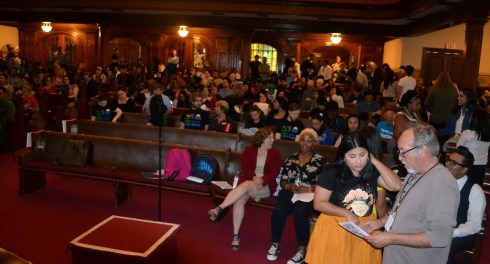
Crowd on the ground level at People’s State of the City, April 5; Photo by Barry Saks

Hundreds of people sat in the pews on the ground level and in the balcony of the First Congregation Church in downtown Long Beach in the evening of Wednesday, April 4, to hear and see speakers, videos and dramatizations regarding issues Long Beach residents face and confront, such as police killings of young men of color, gentrification, ICE (U.S. Immigration and Customs Enforcement) raids, struggles by hotel workers and port drivers, and struggles around education by students and parents.

The press release for the event said Long Beach Rising organized the event and characterized Long Beach Rising as a coalition of organizations focused on promoting civic participation, voter engagement, and organizing among communities historically marginalized from the political process.

DSC_0014

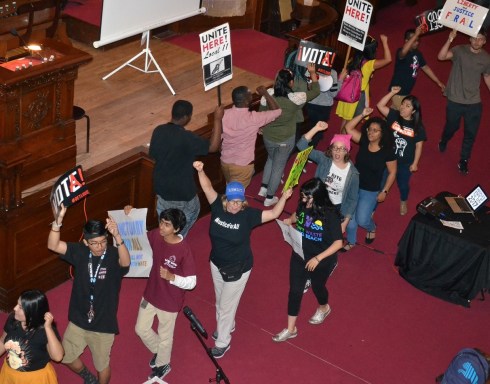
Staged potest, April 5, at State of City; Photo by Barry Saks

The evening program began with about 20 young people marching in a circle in front of the audience chanting are carrying signs, as if they were at a protest.  While they aimed some of their anger toward the President by chanting “Hey, hey, ho, ho, Donald Trump has got to go,” they included two other chants, one indicating their solidarity with “Black Lives Matter” and another indicating their solidarity with women’s reproductive freedom.

Some of the young people spoke individually.  While one referred to Hillary Clinton and said she would have a better president the Trump, others raised the need for people who are new to activism to continue.   They ended with the chant, “The people United will never be divided.”

DSC_0024

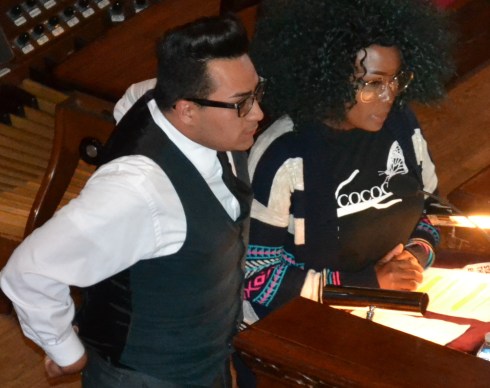
Emcees Victor Espinoza and Yunique. on April 5, at People’s State of the City; Photo by Barry Saks

The emcees were Yunique Pettigrew and Victor Espinoza.  They introduced the Rev. Elena Larssen, the Senior Minister of the First Congregation Church.  The Reverend welcomed everybody.

A video was next shown, which started with a quoting the Mayor Robert Garcia, where he said he would defend the rights of the people of Long Beach.  It then highlighted the efforts to get the City Council to address sexual harassment of hotel workers by passing Claudia’s Law and to create affordable housing, and to spend more money on youth programs; it also highlighted the marches of Black Lives Matter regarding police killings and the organizing efforts of port drivers.

DSC_0058

Amber-Rose Howard and Maria Lopez, April 5, at People’s State of the City; Photo by Barry Saks

Amber-Rose Howard presented the People’s State of the City.  Howard said that she grew up in Pomona in a poor Black and Brown community and was a focused student.  By the time, she was a high school senior, she said, she had lost her mother and sister, and a month after her eighteenth birthday she was in prison for committing a felony.  After being released, she said she was determined to succeed.  She worked 40 hours a week, went to school fulltime and stayed connected with her community.  She said even after doing everything right, she still continued to face barriers and realized that she had to dedicate her life for people’s rights and for fighting for social justice.  She said her father worked hard and sacrificed himself for his family, but like her faced the same systematic barriers.

She said while some people get ahead, most don’t because of systemic barriers—like low paying jobs, poor housing, toxic air, abuse and discrimination that prevents them from succeeding.  Howard said what makes tonight exciting is we’re moving into action to change the odds for everyone.  She pointed out a couple of the local victories—getting the minimum wage raised to $15 per hour and getting the City Council to allocate $700,000 to fight wage theft.  Howard said, “Tonight we renew that call to our City Council and ask them to stand up for working families.”

She, then, highlighted the need for safe and affordable housing, and the need for renter protections.  She talked about the polluted drinking water in west Long Beach and the expansion of Tesoro Refinery, as examples of environmental racism.  She said that we stand in solidarity with Don’t Waste Long Beach and reiterated the need for the City Council to pass Claudia’s Law.

Howard brought attention to activity in the Long Beach Unified School District, such as the youth-led “Every Student Matters” campaigns led by Khmer Girls in Acton and the legal-struggle by parents represented by the Uniform Complaint Procedure.  Then she introduced Maria Lopez.  They left for the audience to see and hear two dramatizations between a parent and a child.  One dealt with police killings of young black men.  The second dealt with the fear of deportations immigrants face.

Howard and Lopez returned and in response to the dramatizations, Lopez spoke.  She said, “Communities like ours have been oppressed for trying to unite and fight against racism, sexism and capitalism….Unity is the only thing that will lead us toward a true sanctuary, a sanctuary where families don’t get deported, where I don’t worry about my black brothers and sisters being killed, and where all workers are treated with dignity and respect.”

Before the evening’s program, a community fair was held, where about 30 local organizations with their volunteers had set up informational tables to engage community members.

One volunteer was Annika Swenson, 28, standing behind a table for Long Beach 350, which according to a flyer is a group of residents “with a passion for climate justice table.”  Swenson said she lives in the northeast of Long Beach, near Lakewood.  She said she has been with Long Beach 350 about four months and that she has volunteered in the past to do beach cleanups and trash collections.  Swenson said, “I think events like this are important because they bring a pretty-wide variety of groups together and so that we can learn about other people’s interests and things they care about and learn how we can collaborate together.”

Another person who had volunteered to be at the table for Long Beach 350 was Sean Kearns, 29.  Kearns said he lived in Long Beach from 2009 to 2011, but now lives in Redondo Beach and studies Political Science at Cal State University Long Beach (CSULB).  Kearns said it was his first time at the Peoples State of the City and was interested in Housing Justice and Environmental Justice.  He said he had previously volunteered his time with Housing Beach and East Yards Communities for Environmental Justice (EYCEJ).

DSC_0001

Taylor Thomas of East Yards Communities for Environmental Justice Outside at the Community Fair, April 5, before People’s State of the City; Photo by Barry Saks

Meanwhile, Taylor Thomas, who is also a CSULB student said, “I’m here to get folks to come out to the People’s Climate March, in Wilmington, on April 29 (Saturday) at Banning Park.  We want to center front-line communities, communities of color (and) low-income communities in the climate discussion because they are the ones most impacted by climate change.”

DSC_0004.1

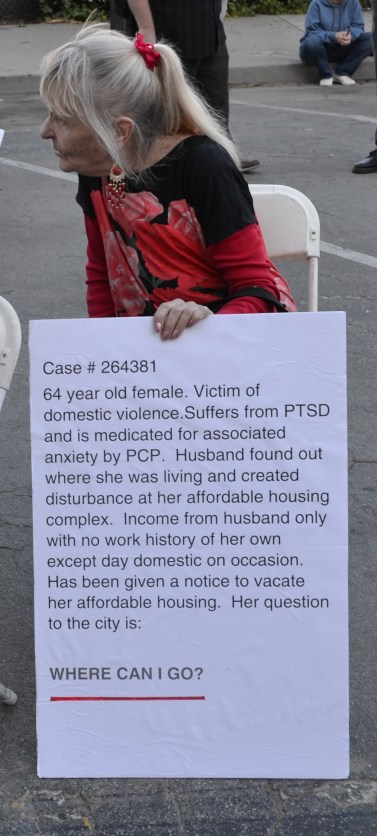
Bobbie Ferencsik Sitting with her Sign at the Community Fair, April 5; Photo by Barry Saks

Four people were sitting with signs.  Holding one in front of her was Bobbie Ferencsik.  Sitting with Ferencsik were Margaret Hennessey and Elizabeth Cino, both of whom identify with the Gray Panthers.  With her sign in front and wearing a line-green sweater, Cino indicated they lived at Plymouth West, which is about a block away from the church on Chestnut Ave.  Cino said she was 74 said she has lived in Long Beach since 1956.  She said, “There are (sic) not enough low-rent housing for seniors from HUD (Housing and Urban Dcvelopment) program.  They’re just not available” and added that costs for rental units locally are now thousands of dollars each month.

The event’s press release added the coalition’s member organizations include A New Way of Life Re-entry Project, All Of Us Or None, Anakbayan Long Beach, Building Healthy Communities: Long Beach, California Faculty Association Long Beach Chapter, Don’t Waste Long Beach, End Oil, Filipino Migrant Center, Housing Long Beach, Khmer Girls in Action, Latinos in Action California, The LGBTQ Center of Long Beach, Long Beach Area Peace Network, Long Beach Coalition for Good Jobs and a Healthy Community, The Long Beach Time Exchange, the Los Angeles Alliance for a New Economy, the Participatory Budgeting Project  and Unite Here Local 11.
 

DSC_0017

Crowd, April 5, at People’s State of the City; Photo by Barry Saks 

Southern Californians March and Rally in Downtown Los Angeles for Universal Healthcare in California

29 Mar
DSC_0188

Supporters for Healthcare for all, on Sunday, March 26, on their way to L.A. City Hall; Photo by Barry Saks

More than 200 people, many of them who work in healthcare or are retired, marched from Pershing Square to the Los Angeles City Hall, on Sunday, March 26, in support of California Senate Bill 562, titled Californians for a Healthy California Act, which supporters call universal healthcare or single payer.

DSC_0170

Pilar Schiavo speaking to supporters, on Sunday, March 26, before marching; Photo by Barry Saks

At Pershing Square, Pilar Schiavo, who works for the California Nurses Association, led the crowd with some chants, using a rolled-up poster as a bullhorn.  One chant was “Medicare for all is our fight.  Healthcare is a human right.”  Another chant was “California here we come.  Five-six-two, let’s get it done.”  A third chant was “Everybody in, nobody out.  Five-six-two is what we’re about.”

DSC_0228

Supporters of Healthcare for all, Sunday, March 26, crossing the street between Grand Park and the backside of L.A. City Hall; Photo by Barry Saks

The crowd then chanted and marched to the backside of L.A. City Hall, across from Grand Park.  Some chants not done at Pershing Square but could be heard from the marchers were “Show me what democracy looks like.  This is what democracy looks like,” “We are the 99 percent,” “Hey, Hey, Ho, Ho, Healthcare greed has to go” and “The people united will never be divided.”

Schiavo emceed the rally at City Hall.

DSC_0252

California State Senator Ricardo Lara, on Sunday, March 26, speaking to supporters; Photo by Barry Saks

California Senator Lara said, “We know healthcare is a human right for everyone, regardless of where you come from…. Other countries have done this…. I am proud to say I’m taking a group of (California) Senators to Canada over the next couple of weeks so they can see firsthand what Canada is doing to provide coverage for everyone.”  After speaking in English, he spoke to the crowd in Spanish.

DSC_0265

Fong Chuu, on March 26, speaking at L.A. City Hall

After the Senator, Registered Nurse Fong Chuu spoke.  Chuu said she is in charge of the Liver Transplant Program at UCLA Medical Center and member of the CNA and added, “Here in Los Angeles we have the worst record in all of California in the preventable hospital stays.  Those are hospitalizations that are the direct result of people not being able to afford medical treatment until their conditions become crisis…. Nurses see patients that suffer stroke or heart failure (and) …. (n)urses in operating rooms see patients that end up having a limb amputated because of untreated diabetes all because they cannot afford to see a doctor…. Even with the ACA (Affordable Care Act) many Californians still cannot afford to use the insurance they have because of the high deductibles and out-of-pocket expenses.”

After Chuu, Jenni Chang urged the crowd to call and lobby the members of the Senate Health Committee in support SB 562.

DSC_0152

Clifford Monroe, on Sunday, March 26, making a point to a friend at Pershing Square, Los Angeles; Photo by Barry Saks

Before the march, Clifford Monroe, 68, who’s from Mission Viejo, which is in in Orange County, was at Pershing Square.  Monroe said he was there to support the bill and that he believed healthcare should be a human right.  Monroe said a discussion needs to be had on the role of employers providing employees healthcare or do we need a larger pool that goes beyond private employers.  He added one economic driver for increasing healthcare costs is the rapid growth of drug costs.

DSC_0153

Anne O’Neil at Pershing Square; Photo by Barry Saks

Another person at Pershing Square was Anne O’Neil, 64, who is a Registered Nurse and teaches Licensed Vocational Nurses.  O’Neil lives in West Lake Village and does not belong to a union and never has.  She said she supports ACA and wants to move toward single-payer healthcare.  In response to Gov. Brown’s skepticism on how to pay for universal healthcare, she pointed out people’s healthcare needs do not go away, one way or another healthcare costs are paid for.  She then added before the Affordable Care Act, about $1,000 a year for people who had healthcare went to pay for those who didn’t have any healthcare.

A third person at Pershing Square was Inke Schroeder, 59, who does research at UCLA.  Schroeder said she has lived in California for about 25 years and now lives in west Los Angeles.  Schroeder said she was there to celebrate that the Affordable Care Act will remain and wants to move toward providing healthcare for everyone, like in Germany, where she was born.  Schroeder said she strongly supports “an income-based system,” but also said she thought employers should continue to pay for their employees’ healthcare.

California State Senators Ricardo Lara (D, Long Beach-Huntington Park) and Toni Atkins (D, San Diego), on Feb. 17, introduced the bill.  On March 2, it was moved to the Rules Committee.

The bill states, “It is the intent of the Legislature to enact legislation that would establish a comprehensive universal single-payer health care coverage program and a health care cost control system for the benefit of all residents of the state.”

Meanwhile, the Los Angeles Times on Wednesday, March 22, reported California Gov. Jerry Brown was skeptical of the funding for the bill and quoted the Governor saying, “Where do you get the extra money? This is the whole question.”

Senator Lara announced on Tuesday, March 21, he is running for Insurance Commissioner in 2018.

Click here to read the Los Angeles Times story that quotes Gov. Brown.

Click here to read the text of Senate Bill 562.


The Movements of Immigrants, Black Lives, Refugees and the Indigenous Talk About the Centrality of Palestine

25 Mar
DSC_0111

From Left to Right: Amani Al-Hindi Barakat, Alfredo Gama, Nana Gyamfi, Micahel Letwin, Lydia Ponce, Ameena Mirza Qazi, Garik Ruiz in conversation, Wednesday, March 22; Photo by Barry Saks 

To a standing-room-only crowd of about 75 people, a discussion: “From Palestine to Mexico, All the Walls Have Got to Go” was held on Wednesday, March 22, at 6101 Wilshire Blvd., formerly Johnie’s with the theme, “grassroots movements for human liberation increasingly recognize #Palestinian liberation as a central component of intersectionality (sic),” according the Facebook page of the event.

Also according to the same Facebook page, the event was sponsored by Al-Awda the Palestine Right to Return Coalition, American Indian Movement Southern California, California for Progress, HP Boycott Campaign-Los Angeles, Idle No More L.A., Jews for Palestinian Right of Return, Jewish Voice for Peace-L.A., Labor for Standing Rock, LA4Palestine, and March and Rally Los Angeles.

DSC_0039

Karen Pomer introducing the panel, March 22; Photo by Barry Saks

Karen Pomer, who was the lead event organizer, also according the Facebook page, and who is also with Labor for Standing Rock, said, “If we are missing a few people tonight, it’s because we have hundreds of people that we helped organize along with many other groups outside the L.A. County Sheriff’s Office tonight fighting back against the raids and again protecting the state of California from ICE (U.S. Department of Homeland Security Immigration and Customs Enforcement).

To read the Facebook page, which announced the discussion, click here.

DSC_0081

Garik Ruiz, March 22; Photo by Barry Saks

Pomer introduced Garik Ruiz.  Ruiz said he’s the North America liaison for the Palestinian BDS Boycott, Divestment and Sanctions) National Committee (BNC).  Thus, he works with organizations fighting for human rights for Palestinians against the Israeli state.  Ruiz reported last week the U.N. Economic and Social Commission for Western Asia released a report for the first time named Israel as “creating a system of apartheid” and asked governments to respond to the BDS campaigns.  Because of pressure from the U.S. and Israel, the U.N. removed the report.  In response, the director resigned rather than withdraw the report.  He also reported the Israeli state had detained prominent Palestinian human rights defender Omar Barghouti placed him under “intense interrogation” to intimidate him and the BDS movement.  Click here to read the the full statement on Barghouti by BNC.

Ruiz then introduced the panelists: Amani Al-Hindi Barakat, who was born in Kuwait and is the National Chairwoman of Al-Awda, the Palestine Right of Return Coalition; Alfredo Gama, who is a member of the Papalotl Brown Berets and an organizer of the recent immigration protests; Nana Gyamfi, who is a member and co-founder of Justice Warriors 4 Black Lives, a network of attorneys and non-attorneys providing legal support for the Movement for Black Lives, including BLMLA; Michael Letwin, who is a New York City public defender, former president of the Association of Legal Aid Attorneys (United Auto Workers Local 2325) and Labor for Standing Rock; Lydia Ponce, who is an organizer with the American Indian Movement and Idle No More of Southern California and an organizer of the No Dakota Access Pipeline protests in Los Angeles; and Ameena Mirza Qazi, who is the Executive Director of the L.A. chapter of the National Lawyers Guild, civil rights attorney who has worked on free speech, social and economic justice, discrimination and due process issues.

DSC_0016

Amani Al-Hindi Barakat, March 22; Photo by Barry Saks

Barakat characterized herself as a Palestinian-American immigrant and refugee.  She said, “Trump’s win … has been very difficult and exhausting for many of us…. Aside from him (President Trump) bringing us together today, we’re only two months into his administration and we’re already seeing a change in the American landscape….Tens of thousands of citizens across the country have stormed congressional offices and town hall meetings.…We can see today policy flourishing in the larger institutional structure that serve only select few in the American society.  Whether you’re Black, Latino, Native American, LGBQ (Lesbian, Gay, Bisexual or Queer) or a Muslim, the system excludes you equally….As a Palestinian, I can say with certainty that injustices we face are the same ones our Black, Latino and Native American brothers and sisters have faced for far too long.”

AlfredoGama

Alfredo Gama, March 22; Photo by Barry Saks

Next was Gama.  He said when he was first asked to speak he was reminded of the Facebook picture, which said, “From Ayotzinapa to Ferguson to Palestine.”  He then explained that Ayotzinapa is “where 43 students went missing, to Ferguson, where Michael Brown was murdered right to Palestine, where … indigenous Palestinians are also being murdered…. We have to understand we are still a colonized people…. The law is not about justice but power…. We are illegal because we are profitable…. We are saying we are here and we are here to stay.”

DSC_0060

Nana Gyamfi, March 22; Photo by Barry Saks

Gyamfi followed Gama.  She almost immediately said, “It is clear that everyone that’s here is someone who understands that how this system is constructed is completely wrong, that it needs to be destroyed and that we need to build a new world.”  She pointed out the Platform for the Movement for Black Lives in 2016 included support for BDS and Palestinian autonomy because Pan-Africanism and the struggle of the Palestinians are a result of colonialism.  At the end, she said, “We are talking about the onslaught on the freedom, the liberation, the autonomy of indigenous populations and we will win together.”

MichaelLetwin

Michael Letwin, March 22; Photo by Barry Saks

Letwin followed Gyamfi.  He said the struggle around Palestine is “a beating heart” of intersectionality, which puts Palestine in the center.  Letwin rhetorically asked what the Trump administration means for the movements?  He said while the Trump era is troubling and worrisome, the response, the resistance to it is hopeful.  He pointed out that the policies of the Trump administration that the grassroots movements are responding to are the policies that were part of the Obama administration and all the administrations before it.  Letwin’s last point was that different struggles must include those struggles that have been most marginalized, like the struggles of Standing Rock, Black Lives Matter, and Palestine.

DSC_0104

Lydia Ponce, March 22; Photo by Barry Saks

Ponce immediately reminded the audience they were on the land of the Tonga people.  She said when we come to these kinds of gatherings and meetings, “we recognize that we are all healing from our historical trauma and that the value of coming together like this is to do it more often.”  Ponce said activists “need to step out of their comfort zone and “just show up” even when it “may not be your thing.”  She added, “For solutions tonight, … is to accept the idea the economic elite has declared war on all of us and has signed a death certificate for earth mother.”

DSC_0073

Ameena Mirza Qazi, March 22; Photo by Barry Saks

Last to speak on the round was Qazi.  She wasted no words.  She described briefly that the question of Palestine was important to the Middle East South Asian Committee, which is part of the International Committee of the National Lawyers Guild.  She spoke of the Arabic concept of “ummah,” which means community, but also “transcends space and time” and the need to return to that concept that was used before 9/11.  She said, “The United States plays the most active role in oppression of foreign peoples with the suppression of Palestinian rights.”

Ruiz posed some questions to the panel.  First, besides just showing up, are there ways to develop what Ruiz called, “joint struggle.”  Barakat said it was important to learn about each other’s struggles and then participate.  Gama said it was important “to show up but to shut up.”  He said for himself, while he can learn about the Palestinian struggle and stand in solidarity with it, he understood the Palestinians must lead their own struggle.  Gyamfi said issues need to be identified that “we have the same opposing force” and that we understand that we are oppressed and harmed in different ways.  Letwin said one area for potential struggle is to look at “class” and when attempts are made to exclude folks, we need to figure out a way to participate without being silenced, including our own contingents.  Ponce echoed Gama and ended her thoughts with “honor the differences but find the similarities.”  Qazi said it was important to create safe spaces for all of us.  She used a recent example, where it was necessary for the NLG had to boycott a meeting because the Anti-Defamation League (According to the Electronic Intifada, the ADL had been advising universities how to isolate the BDS movement.  Click here to read the Electronic Intifada article.), was participating.  To educate those at the meeting, the NLG sent a letter explaining its decision.

Ruiz posed a second question: what does it mean for us to be supporting Palestinian indigenous resistance, when we are doing that work here on indigenous land and how can we better shape our campaigns and messaging?  Ponce said it was divestment and the need to support the United Nations’ Declaration of Rights for the Indigenous People.

Ruiz posed a third question: how can the Palestine Solidarity Movement in the U.S. do more to support the Movement for Black Lives?  Gyamfi said one way is “to address the anti-blackness within in the Palestinian population.”


A Must See: “I Am Not Your Negro”

17 Mar

Now playing in Los Angeles County at Laemmle’s Music Hall, Sundance Sunset Cinema and Landmark Regent.  Check show times.

_________________________________________________________________

I can only say, “Bravo” to ‘I Am Not Your Negro.’

Because of Director Raoul Peck, even in death, the late, great novelist, poet and social critic, James Baldwin, lives through his words and images.

From the text of Baldwin’s unfinished final novel, ‘Remember This House,’ the film confronts the audience with what it means to be Black in America.  However, this film is not only about race relations in the United States, it is about our history that so many good intentioned people deny and refuse to accept responsibility for, partly out of ignorance and partly out of lack of self-reflection.  Peck and Baldwin do us all a service by forcing us to face our past.

Samuel L. Jackson narrates with all his eloquence.

Near the end of the film, Jackson says these words of Baldwin, “Not everything that is faced can be changed, but nothing can be changed until it is faced.”

Not only is this sentence poetic, it holds truth for us, as a society and for us as individuals.  As a society, for the U.S. move forward, it must face its racism, the racism of whites towards people of color, including the genocide committed against the indigenous, which still manifests itself today.  As individuals this film forces us to face our own racism, individually and collectively.

Baldwin’s novel was his attempt to face the assassination of his three friends: Martin Luther King, Jr., Medgar Evers and Malcom X.  Peck takes Baldwin’s words and faces the recent killings of young African-American men, racial violence more generally and more specifically the struggles of Black Lives Matter.  The result is beautiful and horrific because we (black and white and everyone in between) must face man’s inhumanity to man.

Behind me sat an African-American teenage girl crying in response to the horror she witnessed.  However, her mother was holding her symbolizing the beauty between her and her mother.

Also near the end Baldwin said he was an optimistic because he was still alive.  To be alive means we can still struggle, which is where our hope is.  Baldwin’s insights and words remind us the struggle will continue because no other choice exists for those of the oppressed and their allies.

Long Live James Baldwin.