Archive | News RSS feed for this section

Protesters to Customers at Fry’s Electronics Manhattan Beach Store: “Boycott HP”

28 Nov

dsc_0017

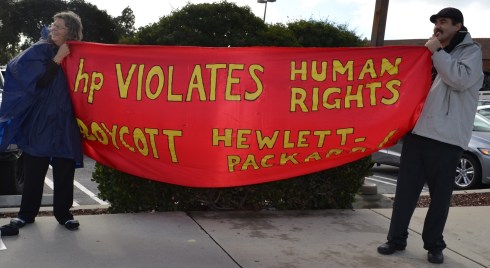
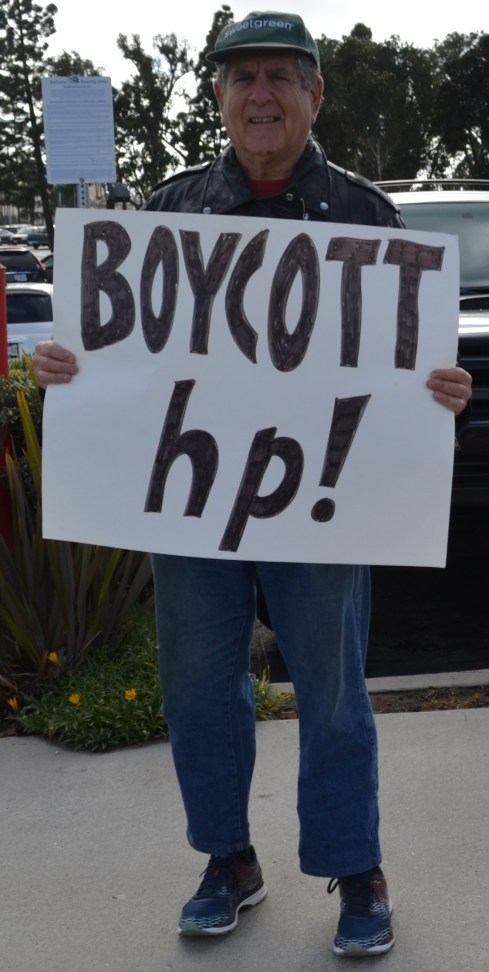
About 30 people, as part of the global week of action against the Hewlett-Packard Company, on Sunday, Nov. 27, stood on the sidewalk outside the Manhattan Beach store of Fry’s Electronics near the corner of Sepulveda Blvd. and Rosecrans Ave., displaying a mock Israeli apartheid wall, signs and banners denouncing HP’s complicity with Israeli apartheid.

While several people held up the mock Israeli apartheid wall, others carried signs or banners, and others passed out flyers explaining why they were there and asking people to boycott HP products.

Dennis Korteuer said he and Sherna Gluck, who are Professor Emeriti of Cal State University Long Beach, met with the store’s manager, Tonya Smith, and gave her a letter, which requested the store “to stop stocking products made by Hewlett-Packard” and which explained the reasons.
dsc_0018

Later, protesters chanted.  One chant was “Hewlett-Packard you will see.  Palestine will be free.  A second was “Segregation is a crime, from Ferguson to Palestine.” A third was “Not another checkpoint, not another wall, end the occupation, equal rights for all.”  A fourth chant was “Hewlett-Packard get in line, freedom now for Palestine.”   

The Palestinian Youth Movement, which its website characterizes itself as a “transnational, independent, grassroots movement of young Palestinians in Palestine and in exile worldwide,” sent an email before the action.  The email said that more than 90 actions worldwide were planned.

According to the BDS (Boycott, Divestment, Sanctions) movement website, the South Africa boycott of Polaroid inspired the global week of action.  Also according to the website, the HP company provides Israel the Biometric ID Card System used to restrict Palestinians’ freedom of movement and servers for the Israel Prison Service, where Palestinian children and political prisoners are routinely held without charge and where torture is widespread; the company manages the communications centers of the Israeli Navy, which collectively punishes the civilian population of Gaza through blockade; and, the company provides services to Israeli illegal settlements in the West Bank.

HP Media Relations and the management of Fry’s Electronics were unavailable for comment.

The full text of the letter given to the store manager may be viewed at http://hpboycott.org/content/menu/take_action/letter_to_store_managers.htm.

dsc_0015


Beth Miller Explains the Impact of the Israeli Military on Palestinian Youth

25 Oct
b

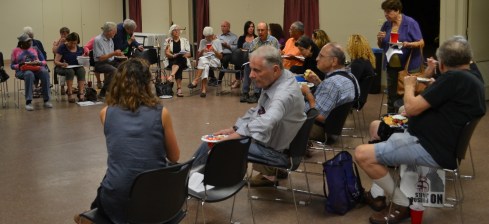
Beth Miller, who is the U.S. Advocacy Officer at the Defense for Children International Palestine, spoke on Friday, Oct. 7, at the Christ Lutheran Church in Long Beach, on the impact of the Israeli military occupation on Palestinian children and youth in the West Bank to about 30 people.

People for Palestinian – Israeli Justice sponsored Miller.  The cosponsors were Christ Lutheran Church, Jewish Voice for Peace – LA, Long Beach Area Peace Network, United Methodists’ Holy Land Task Force, Peace and Justice Ministry Team of Grace First Presbyterian Church of Long Beach and Friends of Sabeel – Los Angeles and Orange County, according to a flyer distributed before the event.

Dennis Kortheuer, who is a Professor Emeritus from Cal State University Long Beach, introduced the audience to PPIJ and Miller.  Regarding PPIJ, Kortheur said that PPIJ had recently had its two year anniversary and that PPIJ’s mission is “to work for a just resolution of the Palestinian-Israeli conflict through education, public discussion, coalition building and action.

Miller, who holds a master’s in Human Rights Law from the School of Oriental and African Studies of the University of London, said DCIP is an independent, local, Palestinian, child-rights organization, founded in 1991 and is based in Ramallah in the West Bank.  It started as a small group of volunteers to provide free, legal-aid services to Palestinian children the Israeli military arrested.  Now, besides providing the legal-aid services, DCIP monitors and documents all child-rights violations across the occupied Palestinian Territories.  It then uses the evidence gathered for its advocacy.

After describing DCIP and its work, Miller showed the 20-minute documentary, “Detaining Dreams,” which was produced in collaboration with the American Friends Service Committee.  It tells the stories of four Palestinian-male youth the Israel military detained and then prosecuted through the military courts for throwing stones.  The documentary, through the four’s own words, shows how the Israeli military ill-treated and tortured these youth and the trauma the four suffered from the experience. The four ranged in age from 14 to 16.

After the documentary, Miller spoke about the legal framework under martial law on the West Bank, specifically Israeli Military Order 1651, in which about 700 Palestinian youth are prosecuted yearly.  It is under 1651, which criminalizes throwing stones.  She did admit many Palestinian youth do throw stones.  Another criminal act defined under the same law is insulting the honor of an Israeli soldier.

She said, “So effectively, if you are a Palestinian child living on the West Bank you can be arrested by an Israeli soldier pretty much at any time for any reason…. Three out of four of the children who arrested in this way are going to experience physical violence at some point….They are using the system to control the population …and we see that how children are treated.”

After her presentation and during the discussion, Miller said Israel is the only country in the world that systematically prosecutes children in military courts.

dsc_0250


Pulitzer Prize Winner Sonia Nazario Speaks at the Long Beach Main Library

15 Mar

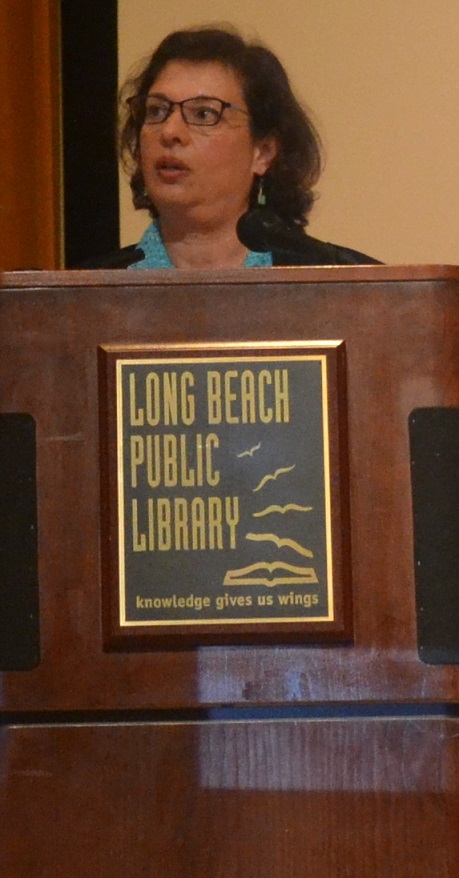
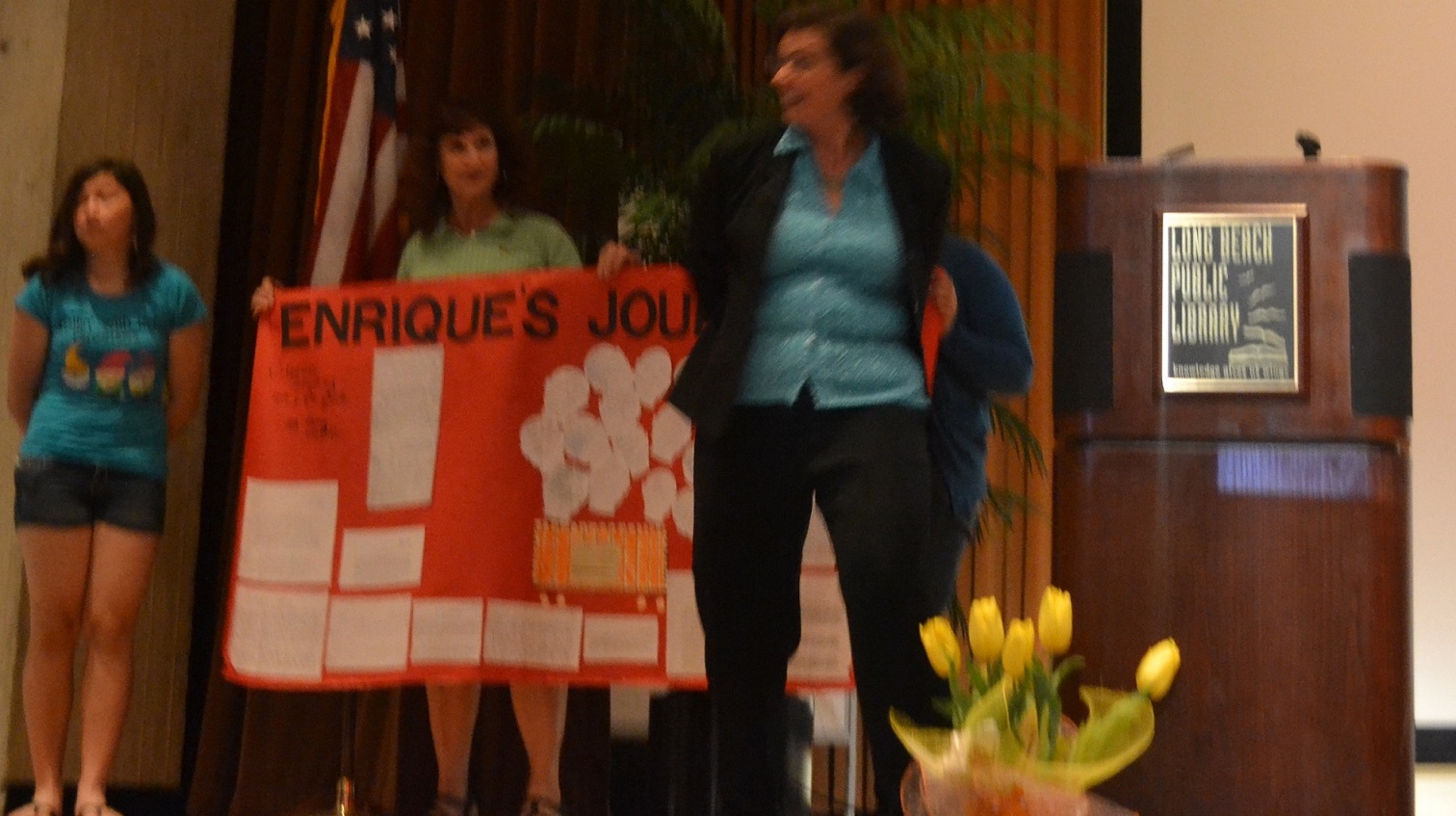
DSC_0246DSC_0248About 50 people heard Sonia Nazario, who won Pulitzer Prize for her Los Angeles Times series and in which the her book, “Enrique’s Journey” is based, speak on Saturday, March 15 in the Main Library Auditorium downtown.

The free event was sponsored by the Blanche Collins Forum.
“Enrique’s Journey” is about a 15 year-old boy who travels from Honduras to the United States in search of his mother, who left him when he was five.
Nazario first described her childhood in United States, where she was born, and in Argentina, during the Argentine military’s ‘dirty war.’ She told of one incident in Argentina, when she was 14. She was walking on a Buenos Aires street with her mother one day and saw blood on the ground. She asked her mother what had happened. Her mother told her the military had killed the two journalists because they told the truth about what was happening in Argentina. From that incident on, she said she was determined to become journalist.

Nazario wrote the Los Angeles Times series because she heard a common theme among many of the undocumented children she interviewed – that these children migrated to the United States in search of their parents who had left them behind. To write the story, Nazario said she followed the same route Enrique followed to be able to gather more details on Enrique’s journey.

After Nazario spoke, a book signing followed.

Immigrants and Their Supporters March in Long Beach

13 Jan

ImageImageImageAbout 100 people, in the late morning of Saturday, Jan. 11, marched from Orizaba Park to MacArthur Park in Long Beach for comprehensive immigration reform and to voice local grievances..

One marcher was Laura Merryfield.  Merryfield, who works for the Long Beach Immigrant Rights Coalition, said “We are marching for comprehensive immigration reform that is the big overarching theme…We have realized that there are local campaigns that are really important…that are advancing immigrant rights agenda…We are calling for a moratorium on car impoundments… Another thing we are asking for is to end wage theft…We brought together a diverse coalition.  We have groups that represent Latinos, Filipinos, Cambodians, (and) other residents of Long Beach because it is an issue where everyone is connected.”

Marissa Martinez, 16 was another marcher.  Martinez, who attends Wilson High School, said, “Just by being here, having people here, we are actually making a difference.”  Martinez said that her father drove her to march and that he supported her being there.

At MacArthur Park, Nicole Cababa, who identified herself as a community organizer with the Long Beach Coalition for Good Jobs and a Healthy Community and as a daughter of Filipino immigrants.  Cababa said, “When my mom first got here … she wanted to create a better life for her family.  She was faced with making sure she could support a young daughter with a studio apartment and a mattress and a rice cooker…The only work she could find was cleaning windows for a fast food restaurant….This is a common story that we hear today from many immigrant families….That is why we are here today in solidarity with all immigrant families to say we deserve living-wage jobs to be able to support ourselves, to be able to live and to work in dignity.”

At each end of the march, which was slighter longer than one mile, were chants and testimonials from individual.  All of program at both end points were in English and Spanish.  The chants were in English, Spanish, and Tagalog.  One chant was “Blacks, Latinos, Asians, Whites, We all stand up for human rights.”  Another chant was “Immigrants are under attack.  What do we do?  Stand up, fight back.”

On the sidewalk, the marchers marched from Orizaba Park down Orizaba Ave. to Anaheim Street, where they turned right; they then marched down Anaheim Str. until they arrived at MacArthur Park, 1312 E. Anaheim St.

Some of the local organizations that sponsored the march were the Long Beach Immigrant Rights Coalition, the Greater Long Beach Interfaith Community Organization (ICO), Khmer Girls in Action, Filipino Migrant Center, The Center, Long Beach and The Long Beach Coalition for Good Jobs and a Healthy Community.

Flying Home

6 Dec

I did not sleep well the morning of our flight, because of the chocolate.  I woke up about 4:15 a.m. and then I woke up Marlene.  She got upset, but quickly got over it.   We showered, finished packing, and ate our breakfast.  The taxi came on time, but we were a few minutes late.  The hotel clerk helped load up the taxi and the female taxi drove us to the airport.  It was about 7 a.m. at the airport.  No one was at the British Airways desk.  About 7:15 the desk opened. We were told then the security workers were on strike.  We made it through.  A woman who was flying to Toronto helped us find our plane.  We were on our way.  I must confess the plane food was good.


When we arrived at Heathrow, we know how difficult it was going to be to make our connecting flight, but we quickly found out.  We arrived near Terminal 5.  A bus took us to the terminal.  We had to carry our carry-on luggage.   We then took another bus to Terminal 3.  An hour had passed and we still had not gone through security.  At Terminal 3, security decided to check through everything Marlene carried on.  This was all her photography equipment she did not use.  The supervisor called ahead, so our plane would wait for us.  After checking our luggage, we hurried as fast as we could to get to our plane.  We finally made it.  After two hours going through Heathrow, we had a long flight ahead of us.  Again the food on the plane was good.  I don’t remember how long the flight was.  I’m guessing it was about 10 hours.


A couple of days before we were to fly home, Marlene suggested perhaps we should spend our first night back near the airport.  From Lisbon, I made the reservation.  While we had some wait for our luggage at LAX, once we were outside, we only had a short wait before the bus took us to airport.  The next day, we had a slow day getting home.  The house was in good order.  In all the years traveling with Marlene, this is the only year that we came home without any problems except for poor, sick TJ.  TJ was sick.  He was infested with fleas.  He had chewed himself raw while we were gone.

Last Day in Lisbon

4 Dec

That Thursday evening, we had dinner with Jorge and Chico at a little place of Jorge’s choosing.  It was across from the Bank of Portugal and close to their place.  The fish and the potatoes were great. Plus, I got Marlene’s potatoes and her Salmon skin.  I brought six little pastries Lisbon is known for.  The guys ate four.  I ate one and they took one home.  Almost like a comic routine, Jorge was on the phone and he Chico had a little spat.

Chico announced to us and Jorge officially he and Joanna are now a couple.  I only had a brief encounter with Joanna and it was positive.  She is quite witty and entertaining.  It was she I quoted about “thinking outside the box,” in a much earlier post.  Chico was driving to Porto that evening, because on Saturday, some of his Super 8 video will be in an art show.  I said it to Marlene and I’ll say it now, “I would not be surprised if Chico becomes famous someday.”  What little I saw of his work was really impressive.  He had in the room we stayed in an unsigned pen and ink drawing.  It looked like a Picasso, but I knew it wasn’t because it was not signed.  He also had some movie posters I found interesting.

At dinner, Jorge mentioned to Marlene he would like to have his electrical interface back.  She mentioned if he would have said something earlier to her she could have brought it with us.  Chico invited us to his opening, but I told him that Saturday we would be flying home.  It was raining and it was late for Marlene and me, so we got a taxi and went back to the hotel we were staying at.

The next day we returned the interface to Jorge.  We then took the metro from Anjos station to the Chiado Baixa, where not far from the metro stop we went to our first museum, the Chiado Museum, also known as the national gallery of contemporary art.  Marlene’s knees were hurting her.  She got a wheelchair, but one tire had no air it.  My back was bothering me.  Unfortunately only the permanent collection was available for viewing.  We rushed through it.  I wish we would have had more time.  I especially liked the most modern stuff.

We then took the metro to the San Sebastian metro station, where we went to another modern art museum complex, the Fundacao Calouste Glulbenkian.  It seems this complex houses three museum spaces.  We again rushed only covering one.  I only wish we had more time.  Marlene was tired.  We went to the museum cafeteria and ate something small because we were still going to have dinner.  We walked back to the English Court at the metro station.  Because it had been raining, we got wet when some cars splash water on us.  We bought our usual fare of fruit, cheese, bread, and lox.  I also bought some chocolate confection.  We then took the metro back to Anjos metro station.  From there we walked back to the restaurant we ate at the night before with Jorge and Chico.  The restaurant seasons the fish with a little salt and grills it.  Again it came with potatoes that I love and again I ate Marlene’s leftovers.  We then caught a taxi back to our hotel.  I ate the chocolate, but it upset my stomach causing me not to sleep well.  Marlene packed.  About midnight I packed.  We needed to be at the airport by 7 a.m. for our 10 a.m. flight.  We’ll by flying home soon.

Return to Lisbon

1 Dec

Driving from Loule to Lisbon was easy. In the dark, we drove into Lisbon with the GPS giving us instructions, with little problem or wasted time. Finding the hotel and its parking was easy too, but we needed food for the next morning.

The hotel clerk directed us a few blocks away toward the grocery store, Pingo Doce. At the story, we were able to buy everything we needed for our morning breakfast, consisting of instant coffee, lox, bread, cheeses, and our fresh fruit. Marlene had her whipped cream and I had my low fat milk. By the end of the trip, we were eating well.

We spent our first day adding money to the phone, getting lost in the subway, and returning the car to the airport. Even getting lost in the subway turned out fine because we found a wonderful Japanese restaurant, which we returned to later for dinner. It was one of a handful of restaurants, where Marlene enjoyed the food.

We spent our second day in Belem’s modern art museum, Museu Colecao Berardo, which is part of the Belem Cultural Center. At our last visit to the museum, we had missed “Happy Consumption.” The illustrations were part of the mass production in early advertising. Later the ad companies eliminated the work of the highly skilled illustrators by further automating the production process. I noticed one ad for music, which had an African-American male with his eyes popping out. Now such a caricature would not be tolerated. I saw many ads for cigarettes. Even our attitude toward cigarettes has changed.

After the museum, we went to, perhaps, Marlene’s most favorite restaurant, Este Oeste (East West). It was a fusion of Italian and Japanese food. Everything there was delicious. After lunch while walking to the tram stop, we learned from a tour guide how to get to the starting point of the Hills Tramcar Tour.

The next day we took the Metro to Cais do Sodre, we bought our tickets, we walked around the corner and we waited for the Aerobus. After a little wait, we boarded the Aerobus and it took us to the Placa do Comercio. I remember the bus did not leave us close to where we needed to board the tram. We walked back about two or three blocks. When we crossed the street and entered the plaza, I only realized then I had been there before. We finally caught the tram.

Horses pulled the first tramcars. About the beginning of the 20th Century, the Lisbon tramcars were electrified. We weaved through the narrow streets on tracks. It took us through the Lisbon neighborhoods, including the Alfama, the oldest. On the tram, Marlene decides to get off and I quickly followed. She then decides she wants to go to the Portuguese Decorative Arts Museum. It was once a little palace. Then, some sort of boarding house, but now it’s a museum. The son of a banker, Ricardo do Espirito Santo Silva, began collecting when he was 13-years-old. Silva bought the palace and restored it to house his collection. We ate lunch in the museum cafeteria. It was a simple buffet with a few delicious items. I had some pasta and fish, which I ate too much of. I ate the salad. Again, it was delightful and so was the desert and again I ate too much of it.

When we were waiting for the tram, suddenly a bunch of people moved into the space around Marlene, bumping into her. One man was smoking a cigarette near us and he distracted me. When we got on the tram, the people did not get on the tram, but suddenly did not board. Marlene’s earmuffs were missing. Her theory is when she was jostled around, she was pick pocketed. Both Marlene and I have been victims in the past. This time they did not get much, if her theory is correct.

We walked back to the metro and took it back to near our hotel. We took a taxi to the hotel, after we went grocery shopping. We were going to have dinner with Jorge and Chico.

Black Friday Brings Protests Outside Long Beach Walmart

30 Nov

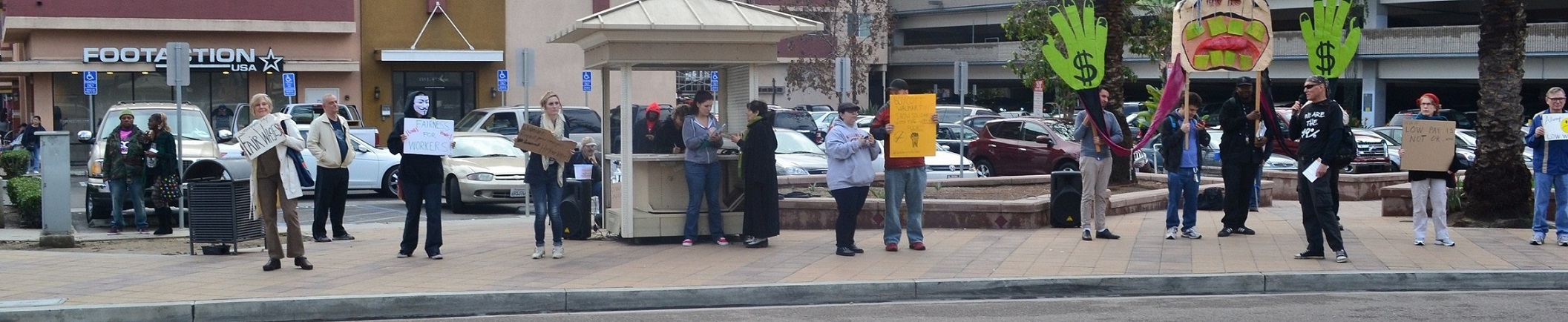
More than 30 people protested outside the Walmart in downtown Long Beach on Friday, Nov. 29, as part of a national protest against Walmart’s treatment of its workers.

One protester was D. Elizabeth Martin. Martin, who is a practicing lawyer and who once lived in Long Beach but now Orange County, said, “I’m here because we need to start learning that corporate greed and corporate welfare always seems to go unnoticed and it is the poor who pay the price for it and it is the poor who are stigmatized for it. Every Walmart store in the United States costs us on average $500,000 a year between (sic) the taxes lost, the food stamps their employee are qualified for, (and) the state insurance they qualify for. So, the low prices you see are not really low prices. We are all paying taxes to support the low wages of their workers.”

Martin’s law partner, Richard Spix, said, “Walmart has earned my eternal scorn and derision through their nefarious business…model that has so many well-known defects an inhuman treatment along their entire supply chain.”
DSC_0014

DSC_0015
DSC_0017

DSC_0021
Walmart, in a press release signed by David Tovar, Vice President, Corporate Communications, said, in part, “We’re not surprised that those trying to change our industry are using this platform to get their message out, and we respect their right to be heard. We expect some demonstrations at our stores today, although far fewer than what our critics are claiming and with hardly any actual Walmart associates participating. For our part, we want to be absolutely clear about our jobs, the pay and benefits we offer our associates, and the role retail jobs play in the U.S. economy. Walmart provides wages on the higher end of the retail average with full-time and part-time associates making, on average, close to $12.00 an hour. The majority of our workforce is full-time, and our average full-time hourly pay is $12.81 an hour. We are also proud of the benefits we offer our associates, including affordable health care, performance-based bonuses, education benefits, and access to a 401K.”

Lovely Loule

28 Nov

Loule is a delightful little city. In spite of any of our errors entering address information in the GPS, we found the hotel with little delay.

When we arrived, since the hotel clerk informed us a buffet breakfast as part of the room charge would be available the next morning and with our own fruit, cheese, and bread in the cold car, we decided we didn’t need to shop for any groceries but were hungry.
We found an Italian restaurant a couple of blocks down from the hotel. Typically, Marlene was not happy with the food but I enjoyed it. We then walked further and found a castle. The castle now houses an archeological museum. The museum entrance was locked. We then walked around the perimeter of the castle where we found written descriptions on plaques for some early buildings. One described the Convent and a second described a Moorish bathhouse. Next to the bathhouse was a fountain, which was once used by the locals for their water. We then walked back to the hotel.

On returning from our little adventure, Marlene realized she could not find her manilla folder, phone book, or phone. She searched everywhere, but could not find them. One drawer was jammed and could not be opened. After searching around for a while and noticing a window would not completely lock, she decided the most likely case was someone climbed into the window from the outside. I tried to explain to her that with all our hardware, meaning our computers and cameras that it did not make much sense for some burglar once in the room to only steal her cellphone. However, she was not listening to me. She was convinced the stuff was stolen.

By evening, she worked herself up so that she became frightened because she felt unsafe in the room. A light near the front of room several times turned off and on. Marlene became more frightened and I called the night clerk. He came to the room but had no explanation about the lights or the missing items. She got more frightened and asked me to hold her. I did.

In the morning after breakfast, she complained again to the morning hotel clerk and decided to file a police report. To Marlene’s credit, she was careful not to accuse anyone. The day clerk explained to her the existence of the second light switch on the head board, which the pillows covered. While the riddle of the light flashing off and all was solved, her things were still missing.

After breakfast, we walked to the police station to file the report. We arrived about noon. The police station only had one person who spoke English well enough for Marlene to give the report to and he was busy with someone else. We waited about an hour and he was still not available but then he walked into the waiting room, where we asked him when he thought he could see us. He told us 2:30 p.m. We decided to walk around a little while and then return to meet with the officer. We decided to go back to the castle, to its little archeological museum. We walked through the museum and around the castle turrets. We then walked up the street to the market. This was about halfway up the town according to our little, free map. About 2 p.m., we found a snack bar, where we ate. By the time the food was served and was eaten, it was approaching 3 p.m. We decided not to return to the police station but to leave and file the police report in Lisbon. On returning to the hotel, I noticed a car was parked behind us, which would have made it more difficult for us to leave.

When we got back to the hotel, hotel personnel asked Marlene to follow them back to the room. They then opened the jammed drawer. Marlene’s things were all there. She thanked everyone profusely and we left easily because the unknown parked car was gone. Everything was resolved. We were headed back to Lisbon and the tow roads approaching it.

Passing through Seville

27 Nov

After leaving Granada, Marlene and I drove to Seville. We had no problem finding the hotel, The Virgin of the Kings. Of course, being born Jewish and now an atheist, in my typical vulgar self, I had to make a joke about the name in the form of a riddle. Let me proceed and I hope I do not offend anyone who may read this. If one king had his way the virgin, then she could only be the virgin of one king and not more than one king. How can she be the Virgin of the Kings?

Let me return to our trip. While we had no problem finding the hotel, we had a horrible time finding the hotel’s parking, which was attached in the rear. Marlene got instructions on how to find the parking structure. While receptionist was telling her in Spanish how to get there, Marlene was telling me in English. However, I did not realize she expected me to remember the instructions. She tried to find the structure three or four times, driving around in circles. Each time, when it was obvious she made a wrong turn, I would put the GPS on to get us back to the front of the hotel. Finally she gave up and made me drive. Because I was following the GPS, I knew two of the three streets we needed to turn on and we knew the third was immediately behind the hotel. After following the instructions from the GPS carefully and then driving slowly, we found the parking structure. One problem still remained, the incline down the structure was narrow and dark and steep, so steep I could not see the bottom, but I made it through O.K. Not knowing the city, hungry, and needing to find fresh fruit for our morning breakfast, we starting walking to the English Court, which we saw in our travels to the parking structure. We ate there. I did not find the food good. I considered it overpriced. We then went shopping in the grocery store, which is usually, if not always at the bottom of the store. There we bought our fruit and bread. I then bought some cured tuna, which I ate in the hotel room and was horribly expensive but absolutely delicious. Unfortunately, we left the next morning without seeing any of Seville. Driving out of the parking structure was horrible. While driving up the incline, the car stalled. We rolled back and I think it is where we scratched the car. The path was so narrow that Marlene could not get out of the car to reopen the door to the structure. Backing up to straighten out the car and to give Marlene room to get out caused me to scratch the car a second time. Finally Marlene was able to get out and open the door. This time I gunned the engine and made it to the top. While driving up the ramp, I could feel the car vibrate up the incline. I was visibly shaken by the experience. I was exhausted without even driving far. While leaving the city, I saw a horse-drawn carriage, which is all I can remember. We then drove back to Portugal and spent the night in Loule, a tiny, ancient city, which once the Moors dominated.