Archive | News RSS feed for this section

State Senator Lena Gonzalez Hosts Telephone Town Hall on Unemployment Benefits and the CARES Act

12 Apr

California State Sen. Lena Gonzalez hosted a Telephone Town Hall, Friday, April 10, featuring Congressman Alan Lowenthal and George Warner of Legal Aid at Work on unemployment benefits and on the CARES (Coronavirus Aid, Relief and Economic Security) Act.

Gonzalez, who represents the 33rd California Senatorial District, emceed.

Warner, who is a fellow with the Wage Protection Program at Legal Aid at Work, said people should apply by fax, mail or online for unemployment insurance even if they are unsure whether they qualify.  He encouraged people to apply online and said it would take at least 21 days from applying to get their benefits. 

Warner, who graduated from Stanford Law School in 2017, according to the Legal Aid at Work website, said for those who do not qualify for unemployment, they may qualify for the new federal program that is administered by the states, the Pandemic Unemployment Assistance.

He said, “If you’re still employed and you or a family member is sick or needs preventive care, including if a public authority or doctor has recommended self-isolation or quarantine, you can use paid sick leave.  Every worker in California should have access to at least three paid sick-days a year, local laws may provide more, including if you work in Los Angeles or a hotel worker in Long Beach.”

“Additionally, effective April 1, federal law took effect, if you work for a company of less than 500 employees, you’re eligible for an additional 80 hours or 10 days of paid sick leave for issues related to the coronavirus.  These paid sick days are paid by your employer but are reimbursed by the federal government…There is no cost to your employer for those additional sick days and you can use those federal-paid sick days if you can’t work, because you are sick, because a family member is sick or because you are taking care of a child who is home from school.”

Congressman Alan Lowenthal, who represents the 47th Congressional District, discussing the $2 trillion CARES Act, said, “In the bill were $300 billion for direct cash payments to individuals, which means that if you filed taxes either in 2018 or in 2019 or if you are on Social Security and we know where you live that we’ve been sending payments…Those that have direct deposits will receive their checks first.  Those that receive their checks either from the IRS or from Social Security that are mailed they will be probably sent out within the next two weeks.

“You are going to get $1200, an individual, and if you earned up to $75,000 and then it’s taxed at $99,000.  So, if you earned more $99,000, you will not receive a check… If you are a family of four (two adults, two children), each spouse will get $1200 and each child will $500 for a total of about $3400.” 

The congressman added the IRS will be setting up a web-based portal to claim payments for those who have not filed taxes and IRS does not have either direct deposit information or mailing information; he stated the IRS would not contact a possible recipient and if people did not receive their money, people must use the portal.

The congressman said about $375 billion were allocated for small businesses in grants.  One is emergency grants of $10,000 to a small business; he said these must be paid back; according to National Public Radio, these are “to cover immediate operating costs.”  A second is what’s called the “Paycheck Protection Program,” which are forgivable, if “75 percent or more is used to keep current employees on the payroll for the next eight weeks.”  He added this program’s funding is being spent fast with $100 billion gone in the first four days of the $350 billion allocated and that these are first come, first served loans.”

The state senator said, “The state legislature…about three weeks ago enacted emergency funds for $1.1 billion in fact to ensure that we tackled local government issues relative to homeless services, our seniors, ensuring our health system service was upgraded, all related to Covid-19.  She added 2 million people in California have applied for unemployment insurance.

People may telephone Legal Aid at Work at 415-404-9093 to make an appointment and may visit its at website at https://legalaidatwork.org/unemployment/.

People wishing to apply for unemployment insurance online, they should go to https://www.edd.ca.gov/Unemployment/UI_Online_Registration.htm or wishing more information on pandemic unemployment assistance, they should go to https://edd.ca.gov/about_edd/coronavirus-2019/pandemic-unemployment-assistance.htm.

People may hear the Telephone Town Hall below.

California Senator Lena Gonzalez Holds Telephone Town Hall on Unemployment Benefits and CARES Act

10 Apr

California State Senator Lena Gonzalez held her second Telephone Town Hall, which included Assemblyman Patrick O’Donnell, Congressman Alan Lowenthal and George Warner of Legal Aid at Work on Friday, April 10, on unemployment benefits and the $2 trillion CARES (Coronavirus Aid, Relief and Economic Security) Act.

The entire Telephone Town Hall including questions and answers, is available below.

Yousef Baker Speaks to Long Beach Area Peace Network on Iran and Iraq (Audio)

9 Apr

Yesterday, Wednesday, April 8, I posted my story based on Professor Yousef Baker of California State University Long Beach talk to the Long Beach Area Peace Network.

For those of you who read the story, please note that there is a one-day difference for some dates between Dec. 27 and Jan. 8.  I’ve used the dates in the New York Times to be consistent.  Between New York City and Tehran, there is an eight and half-hour difference.  For example, when it’s midnight in New York, it’s 8:30 p.m. in Tehran.  

His talk is below.

Yousef Baker Speaks to Long Beach Area Peace Network on Iran and Iraq

8 Apr

Yousef Baker, who is an expert on Iran and Iraq, spoke to the Long Beach Area Peace Network, on Thursday, Jan. 16, providing a brief history of the Joint Comprehensive Plan of Action, known as the Iran nuclear deal followed by his thoughts on the consequences on the Iraqi uprising after the U.S. assassinated Qassim Suleimani. 

Baker, who is an assistant professor at California State University at Long Beach, said while each U.S. administration differed regarding tactics toward Iran, the stated policy was and still is regime change.  He pointed out from the perspective of the Iranians, they consider themselves at war and view themselves under “existential threat.”  Consequently, he said Iran’s regional policy has been partially shaped by or in response to the U.S. policy.

Yousef Baker, an expert on Iran and Iraq, spoke to the Long Beach Area Peace Network, on Thursday, Jan. 16, on Iran and Iraq since the United States assassinated Qassim Suleimani, a top Iranian general. Baker received his doctorate in sociology in 2014 from the University California at Santa Barbara; photo by Barry Saks.

The professor, who received his doctorate in sociology in 2014 from the University of California at Santa Barbara and whose thesis “Global Capitalism and Political Control: Investigating the Invasion and Occupation of Iraq,” said while the George W. Bush administration spoke a lot about “Iran’s supposed nuclear ambitions,” it refused to meet or speak with the Iranian government while the Europeans and others met regularly with the Iranian government. 

Comparing the George W. Bush to the Clinton administration, he added, “If you remember the Bush administration ramped up its threats against Iran after the Clinton administration had …worked to kind of cool the waters a bit.”

Regarding the Obama administration, the professor said, by the second term, as part of its general plan of moving away from the Middle East and towards the Asia-Pacific region, it wanted “to fix” the issue of the Iran nuclear program, so it entered into the negotiations. 

The United States signed onto the Iran nuclear deal, on July, 14, 2015, along with China, France, Russia, the United Kingdom, Germany and Iran.  However, the Saudis and the Israelis opposed the deal, according to Baker. 

The professor said, in response to opposition from the Saudis, the U.S. told the Saudis if they “put up with it,” in return the U.S. would allow the Saudis “to have the war…with Yemen and we (U.S.) will support the war.”

Baker said the Obama administration’s response to the Israeli opposition was it “pushed hard against Netanyahu’s objection to the deal.”  However, “(i)n return, the Obama administration increased the level of military aid to Israel at the time.”

According to Baker, the U.S. began to withdraw from the Iran nuclear deal on Oct.13, 2017 and completed the withdrawal by May 8, 2018.  With the withdrawal from the agreement, the Trump administration began the campaign ‘maximum pressure,’ which Baker characterized as “everything short of…actual physical assault or physical violence.”  The campaign includes banning travel for Iranians to the U.S. along with other Muslim countries, imposing “draconian sanctions on the Iranian economy,” which from his example, the Iranian currency lost 70 percent of its value.  The campaign includes “putting pressure on anyone doing business with Iran and (it) tried to cut off Iranian oil sales to other countries.”  In the case of India, Baker said, “So, Americans imposed or threatened to impose sanctions on India…one of the main consumers of Iranian oil.” And added that it was a “more drastic turn of events” because the U.S. was going to sanction other countries having independent relations with Iran. 

The professor said the U.S. campaign of ‘maximum pressure’ also included coordinated cyber-attacks on Iran and increased the “discursive narrative” relying on “old racist tropes.”  He said the U.S. “prodded the Iran’s military… hover(ing) closer and closer to Iranian waters, to borders” baiting the Iranian military to respond to justify U.S. retaliation. 

The professor recounted the tit-for-tat attacks between the Iranian and U.S. militaries of Dec. 27, 29, 31, Jan. 3 and Jan. 8.  According to the New York Times, the Iranian military, on Dec. 27, killed an American contractor at an Iraqi military base near the city of Kirkuk; the U.S. responded, on Dec. 29, with airstrikes on three Iranian-backed militias in Iran and on two in Syria and the Iranian-backed militias responded by storming the U.S. embassy in Baghdad, Iraq; the U.S. military again, on Dec. 31, attacked Iranian-backed militias; the U.S., on Jan. 3, assassinated by drone Suleimani; Iran, on Jan. 8, fired more than 20 ballistic missiles at two bases, where U.S. troops were stationed.

Baker pointed out that the Iranian-backed militias were able to surround the embassy in the Green Zone, which is about four square miles in central Baghdad under tight security, because “the supporters of these militias of these Popular Mobilization Units, of course, have close connections to the Iraqi-political elites, some the Iraqi political parties…Those  people were the ones that kind of allowed them to come in.”

Speculating on the Jan. 8 events, the professor said, “When the Iranians respond, they let the Iraqis know and when they let the Iraqi know, they do so, knowing that the Iraqis are going to tell the Americans.  So, that it was a carefully orchestrated attack, where the Iranians could say we have the capacity and capability to reach you and your forces but we’re not going to shoot you…That was kind of their thinking.”

The professor reminded the audience that since October 2019 anti-government protesters were in the streets, in the major cities, including in the south of the country where some of the most ardent supporters of the Iraqi elites were; by December, “the Iraqi politicians didn’t know what to do” and were in a “crisis of legitimacy.”

The New York Times reported, on Nov. 4, 2019, “more than 200,000 Iraqis marched in Baghdad, raging against the Iraqi government and a foreign occupier­­­­­­ — not the United States this time, but Iran.”  The same story also said, “It is a struggle, above all, between those who have profited handsomely since the American invasion toppled Saddam Hussein, and those who are struggling to get by and look on with fury as the political parties, some with ties to Iran, distribute payoffs to the well connected.”

According to the professor, the protesters were not only protesting the foreign intervention of the Iranians, and corruption, but also the lack of civilian infrastructure, meaning electricity, water and sewage.  

However, because of the assassination, the Iraqi political landscape changed.  The professor added, “But as a result of this assassination now, the United States has intervened and put itself, once again,…at the forefront of what’s happening in Iraq and it has made the obstacles that the Iraqi protesters, the Iraqi uprising had, in terms of what they wanted to do, about changing their government and their elites.  It made them completely secondary and made that problem even worse, because now what the Iraqis have … to venture into… a debate where they have to pick sides between the Americans or the Iranians.  Even though they have been adamant that what they have been actually fighting for is independence from intervention from Iran and the U.S. and the Israelis and the Saudis and the Turks….Once again, the United States and what it is attempting to do in the region become the central focus rather than this nascent democratic movement that had this possibility for an opening or change in Iraq.”

According to the Facebook page of the Long Beach Area Peace Network, it’s “a grassroots network of community organizations and individuals who are dedicated to serving the cause of world peace at home and abroad” and that it “also support(s) local and national organizations that fight for social, economic, and environmental justice.”

People who heard Professor Baker and read my story may have noticed a one-day difference for some dates between Dec. 27 and Jan. 8.  I’ve used the dates in the New York Times to be consistent.  Between New York City and Tehran, there is an eight and half-hour difference.  For example, when it’s midnight in New York, it’s 8:30 p.m. in Tehran.  

Grocery List Poem or Word Steps

24 Feb

Almonds and apples

Avocados and artichokes

Bagels, bacon, bananas and basil

Burgers, bourbon, broccoli and bread

Barb-e-cued black beans and blueberries

Parsley, pecans, peppers, pesto and potatoes

California Democratic Party Debates Palestine, Israel; Continues to Call for a “Two-State Solution,” Israel as “Democratic Jewish State”

6 Jan

The California Democratic Party finished its three-day convention in Long Beach on Sunday, Nov. 17 of 2019, which included endorsing candidates and adopting a platform only after an impassioned floor debate on a platform amendment regarding Israel and Palestine.

A convention rule states if an amendment garners at least 300 signatures, it qualifies for a debate on the convention floor. 

The amendment failed on the convention floor, after a six-minute debate with both sides getting equal time before the vote.  The amendment stated the party’s support for “a solution of the Israeli-Palestinian conflict negotiated by the parties that guarantees equality, security and democracy for all, no matter what the final settlement regarding states and borders.”  It also stated the party’s opposition to “any unilateral annexation of territory” and the party’s support for “right of all those who were forced from their homes to return to their homelands and receive compensation for their losses.”

Delegate David Mandel (center) confers with his colleagues, on Friday, Nov. 15, 2019, where the Platform Committee of the California Democratic Party had met and rejected the amendment on Israel and Palestine, which on Sunday came to the convention floor; photo by Barry Saks

The 2020 platform on Israel and Palestine, in part, continues to call Israel a “democratic Jewish state” and call for a “two-state solution,” meaning a separate state for Jews and a separate state for Palestinians.

Delegates David Mandel and Yassar Dahbour argued on the convention floor for the amendment.  Mandel, who wrote the amendment, said as an Israeli he fought against the occupation for ten years, while witnessing the acceleration of illegal settlements.  He added, “Our platform should not rule out any solution, but it should not attempt to dictate how many states or the nature of those states.  Instead, it should affirm the values of equality, human rights and international law which must be the foundation of any just peace.  Sadly, however, the democratic values we espouse…too often evaporate when it comes to the Palestinians.”

On Friday, Mandel acknowledged that a compromise was reached in which anti-BDS (Boycott, Divestment and Sanctions of Israel) language was removed from the platform.

Dahbour told his family’s history of forced migration in 1948 from Israel, first to a refugee camp in Lebanon, then to Syria.  He added because of the civil war in Syria, his extended family is spread among 16 countries on three continents.  In closing, Dahbour said, “When we defend the rights of our Jewish brother(s) and sisters against anti-Semitism, we (should) also stand by the Palestinians to end their oppression and occupation…Please vote yes…to support my right to exist.”

California State 43rd District Assemblywoman Laura Friedman argued against the amendment. The Assemblywoman said she sits on the board of the legislative progressive caucus.  Friedman, like Dahbour, told the audience some of her family’s history.  The Assemblywoman said she comes from a family with a long history progressive Jewish activism supporting civil and human rights.  She said, “My grandfather came to this country as a refugee between the wars, fleeing the deadly pogrom in Poland…His family, who stayed in Poland, were decimated during the Holocaust, with only about 5 percent of them surviving.  When they tried to flee, they were rejected from every nation on earth.  It wasn’t until the other countries of the world decided to send Jewish refugees to Israel did he have a place to call home.”  Friedman added she told her family’s story to explain “why the existence of the state of Israel is so important to so many American Jews.”  At the end, she said the amendment makes “Jews feel attacked and marginalized in the Democratic Party.”

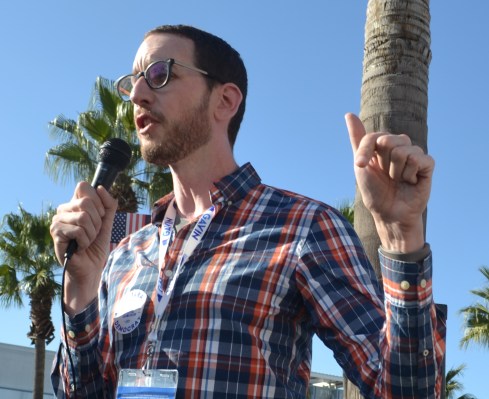
California State District 11 Senator Scott Weiner also spoke against the amendment.  Weiner said, “This amendment….eliminates the two-state solution of Israel and Palestine co-existing and it advocates for a one-state solution of Palestine.  The State Senator, echoing Friedman, reminded the delegates six million Jews were exterminated during the Jewish holocaust.

California State District 11 Senator Scott Weiner, on Saturday, Nov. 16, 2019, speaks at rally, organized by Progressive Zionists of California called “Facing Anti-Semitism, a Solidarity Rally” in a public space in front of the Long Beach Convention Center.

Before Sunday’s floor debate, Lisa Armony––Director of the Rose Project of the Jewish Federation and Family Services, Orange County––was passing out a flyer advocating against the amendment.  Armony said, “(F)undamentally at its core the BDS movement is anti-Semitic…because BDS calls for the elimination of the state of Israel.”

No verbiage on  the of the website of the BDS movement calls for the elimination of Israel.  However, it does characterize Israel as “a settler-colonial state” and makes an analogy with the apartheid of South Africa.  It does urge “nonviolent pressure on Israel until it complies with international law by meeting the three demands.”  The first is “(e)nding its occupation and colonization of all Arab lands and dismantling the Wall (sic).”  The second is “(r)ecognizing the fundamental rights of the Arab-Palestinian citizens of Israel to full equality.” And, the third is “(r)especting, protecting and promoting the rights of Palestinian refugees to return to their homes and properties as stipulated in UN Resolution 194.”

The day before, Progressive Zionists of California held a rally, called “Facing Anti-Semitism, a Solidarity Rally” outside in a public space in front of the convention center.

Mathew Finkelstein, who emceed, near the beginning of the rally, told the audience the circumstances that prompted him, Susan George and others to form PZC within the California Democratic Party.  Finkelstein said, “(In) 2017,….we attended the Progressive Caucus Rally…at the California Democratic Party and for a half an hour, the speakers spoke about why Israel is an evil, racist and apartheid state worthy of being singled out by the BDS movement as opposed to any other country on the planet.  As a Jewish person, I felt that my organic identity was not welcomed in many progressive spaces here in the California Democratic Party…We have since decided to organize with a group of our friends a truly progressive response to the problem of leftist anti-Semitism, one that is both progressive and Zionist.”    

The elected officials, who spoke at the rally were ­Assemblyman Jesse Gabriel, California State Senator Scott Weiner, Assemblywoman Rebecca Baur-Kahan and Los Angeles City Controller Ron Galperin­.

Hene Kelly, Region 6 Director of the California Democratic Party, holds her pro-Israel sign prior to the vote on the amendment on Sunday, Nov. 17, 2019

Hundreds Protest Climate Change in Long Beach

13 Oct

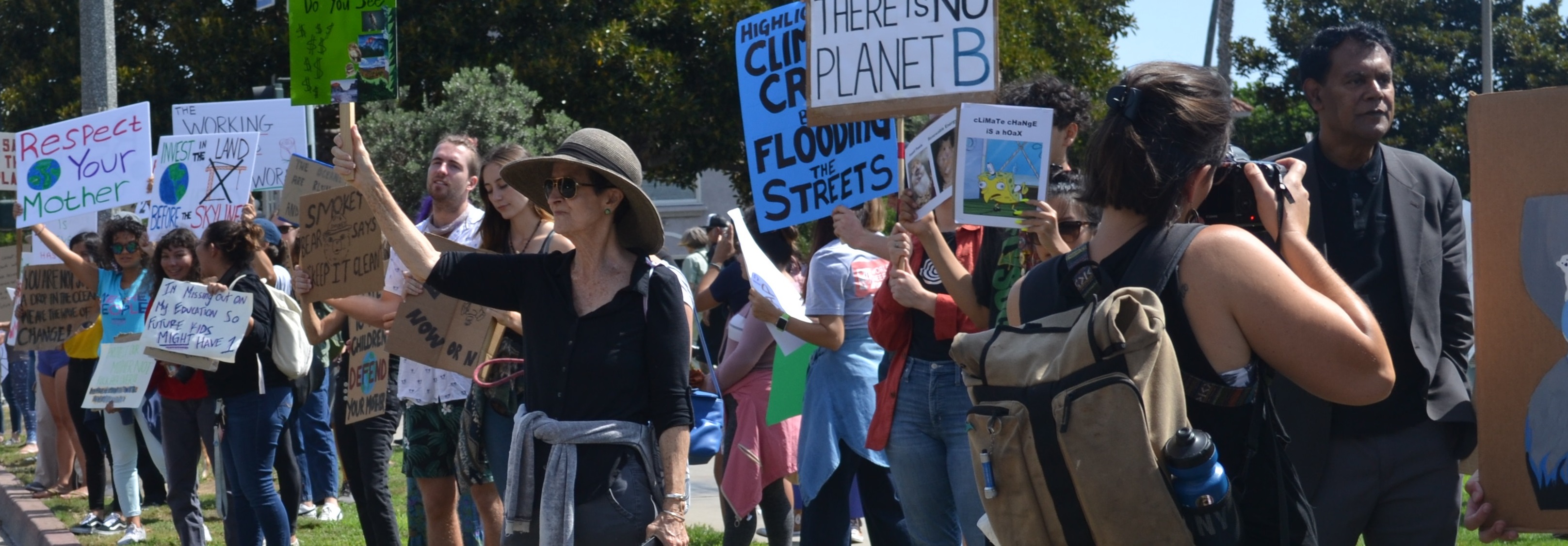
Protesters along Ocean Boulevard chanting with their signs on the Bluff in Bixby Park in Long Beach, on Friday, Sept. 27, as part of the Global Climate Strike; photo by Barry Saks

About two hundred people gathered in Long Beach on the bluff in Bixby Park, on Friday, Sept.27, as part of what was dubbed the “Global Climate Strike,” which was inspired by the 16-year-old Swedish climate activist Greta Thunberg.

Local groups, such as the Long Beach Environmental Alliance, the Long Beach Chapter of the Democratic Socialists of America (DSA-LB) and the Long Beach-South Bay Chapter of the Citizens Climate Lobby had set up their tables and displays.

The organizers, many of whom were members of DSA-LB, had planned the program consisting of what were called “grief circles,” followed with speakers. While some people participated in the circles, more instead chose to stand, on the south side of Ocean Boulevard with their signs facing toward the automobiles stopped at a traffic signal on Junipero Avenue, and chant.

They chanted: “No more coal, no more oil, keep your carbon in the soil;” “Hey, hey, ho, ho, fossil fuels have got to go;” “Wake up and hear the warning, let’s stop this global warming;” and “Climate Change is not a lie; do not let our planet die.” They also chanted using call and response. Someone would call out: “When our planet is under attack, what do we do?” and then the crowd would shout: “Stand up fight back.” Another was “What do we want? Climate Justice.”

Among the chanting crowd was Long Beach Second District Councilwoman Jeannine Pearce, who biked to the event.

Videographer Marlene Alvarado and Long Beach 2nd District Councilwoman Jeannine Pearce, on Friday, Sept. 27, pose on the Bluff at Bixby Park in Long Beach at the Global Climate Strike; photo by Barry Saks.

After chanting, the crowd formed in a semicircle on the grass and heard speakers.

Protesters, on the Bluff in Bixby Park in Long Beach, on Friday, Sept. 27, stand in a semicircle to hear speakers as part of the Global Climate Strike; photo by Barry Saks

A letter from the California Faculty Association at CSULB (California State University Long Beach) was read.  It expressed the union’s solidarity with the event and that Long Beach needs “a stronger Climate Action and Adaptation Plan.”

Alvin Engo, a graduate Cabrillo High School and a freshman at California State University Long Beach, said he was “tired of kids getting asthma” and “the fear of old people suffering from respiratory incidences.”  Engo, who is also the First Vice President of the Young Democratic Socialists of America Chapter at CSULB, added, “Corporate interests have completely taken over the (city) council and left the west side for dead.”

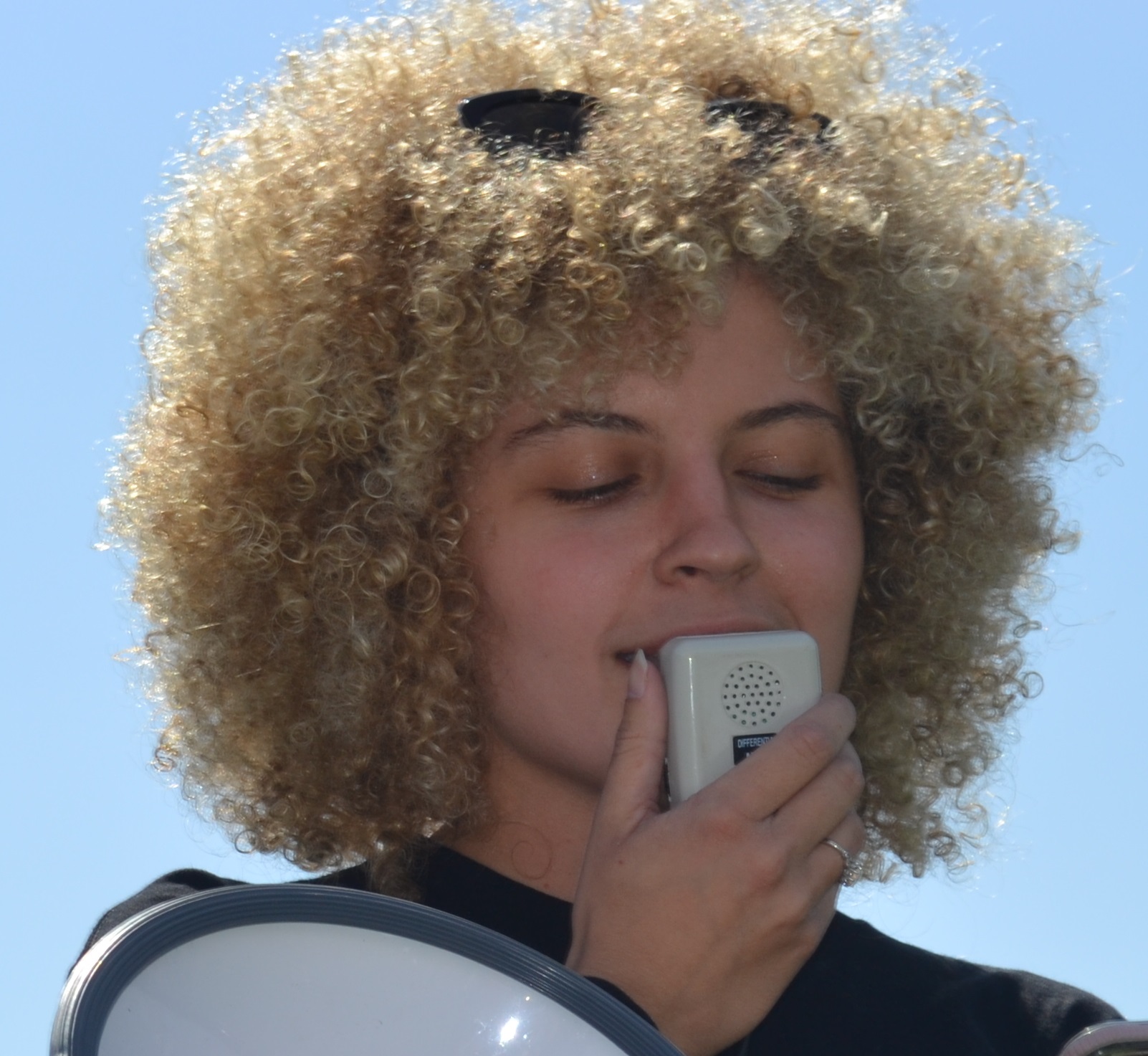
Hayli Antoniewicz, representing Students for Quality Education, speaks to crowd, on Sept. 27, as part of the Global Climate Strike; photo by Barry Saks.

Hayli Antoniewicz, 20, representing Students for Quality Education at CSULB, said, “I want politicians to stop sitting on their asses and denying Climate Change…The earth, our home, is dying.  Many people have already died due to the extreme weather conditions of our changing earth.  The rising temperatures reduce the quantity of our agriculture, putting heat stress on animals, rising sea temperatures harms the ocean’s fish and killing off our natural food.  The lack of rain fall causes mass droughts.”

DSA-LB member, Miles Haisley, started with a minute of silence for those who have been killed resisting fossil fuel extraction.  Haisley said, “We should all be very angry because there has been 50 years of inaction.  There are rising CO2 (carbon dioxide) emissions.  There’s species extinction, killer heat waves on the and at sea, stronger storms and fires, rising sea levels, political and economic misleadership.  We should all be angry because the window to significantly reduce the destruction of human civilization, as life on earth is closing…We have to ban together as a community and direct our anger to seize control of our lives and the life of earth, the habitability of earth.  We must direct our anger at the obscenely rich.”

DSA-LB member J Welsh, who emceed, after the event, said, it was important for people to understand we need to grieve the losses that have already occurred.

Barry Saks is an ecosocialist and is married to videographer Marlene Alvarado.

Immigrant Defender Law Center to Provide Immigration Legal Services for Long Beach Justice Fund

24 Apr

Long Beach immigrant rights advocates, at a press conference in the courtyard of Saint Luke’s Episcopal Church, 525 E. 7th Street, on Wednesday, April 17, announced that the Immigrant Defenders Law Center will provide immigration legal services for the Long Beach Justice Fund.

At the press conference, Long Beach First District Councilwoman Lena Gonzalez, who is in a run-off for the 33rd California Senate District, said, “As a city councilmember that represents over 60 percent my district which is Latino, when I have Cambodian families that are crying because they have had families separated, when we know that our Filipino friends have had less opportunities because of the fact that they are not documented.  All of this today is because of their tireless work and support.”

The video below has Councilwoman Gonzalez’s statement.


In the city press release the previous day, Mayor Robert Garcia said, “Long Beach is one of the most diverse cities in the country, and immigrants make big contributions to the culture, economy and spirit of our city.”  The Justice Fund will work to support immigrants and keep families together.”

Lindsay Toczylowski, the Executive Director of the Immigrant Defenders Law Center, said, “Now when Long Beach residents are detained by ICE (U.S. Immigration and Customs Enforcement), the mostly likely place they will go is one of the most hopeless places in all of California, in Adelanto, California, in the high desert, where there is a huge, for-profit prison that does ICE’s dirty work for it in holding our community members there, where people are very unlikely to have representation, Long Beach will be giving them hope….Ninety miles from downtown Los Angeles, where there are very few people with representation, we will be sending Immigrant Defenders lawyers in to meet with Long Beach residents to represent them and we know that with representation they are 1,100 percent (11 times) more likely to win their case.”


Toczylowski graduated from the University of Southern California Gould School of Law, according to the Immigrant Defenders website.  After the press conference, she said the fund provides “universal representation” meaning it could apply to anyone facing deportation in Long Beach regardless of criminal history and pointed out that this is “a commitment to due process for all.”  Toczylowski said one full-time attorney would be assigned as well as some management staff and that the possible number cases handled any year may be from 20 to 40.

Tania Sawczuk, of the Vera Institute of Justice, whose website states its mission is “to improve justice systems that ensure fairness,” said, “The people of Long Beach understand that the stakes are high in immigration court and that fairness dictates that no one should have to face exile from their communities, their family, their children, simply because they cannot afford an attorney.  One of the tenets of our nation is due process of law.  And, without access to legal representation, you can have no due process.”

According to the same city press release quoting the mayor, the selection of the Immigrant Defenders Law Center was “made through a competitive request for proposal process overseen by the City in partnership with Vera and community members.”


With the one-time $250,000 grant from the city of Long Beach and the one-time $100,000 catalyst grant from the Vera Institute of Justice, the Justice Fund is now $350,000.  The Long Beach Post, April 17, reported that no additional funding beyond the first two years has been found yet.

DSC_0236

Maria Lopez (Center), Director of Community Organizing for Housing Long Beach, emceed the April 17 press conference, announcing the selection of Immigrant Defenders Law Center for the Long Beach Justice Fund; photo by Barry Saks


Poor People’s Campaign Comes to Orange County

17 Apr

Inspired by the civil-rights movement, the Poor People’s Campaign, on Thursday, April 11, brought its “Truth and Poverty Tour” to four stops across Orange County “to challenge the evils of systemic racism, poverty, the war economy, ecological devastation and the nation’s distorted morality,” according to the meetup.com about page of the Orange County Poor People’s Campaign.

DSC_0196

On the second stop of the Orange County Poor People’s Campaign, a crowd of about two dozen people, on Thursday, April 11, gathered to hear speakers across the street of the Theo Lacey Facility in Orange, which houses detainees for the United States Immigration and Customs Enforcement; Photo by Barry Saks

The second stop was across the street of the Theo Lacey Facility, which houses detention centers for the Orange County Sheriff’s Department and the United States Immigration and Customs Enforcement.  The public leader of the OCPPC, Lisa Pedersen, who characterizes herself as “a community activist for human rights and social justice,” also on the same meetup.com site, introduced Jan Meslin.  Meslin, who helped, in 1984, found the Friends for Orange County Detainees, which visits detained immigrants, emceed.

In her introduction, Meslin, said, “There are several thousand men right now, right across the street who are in maximum security prison…. Each of these men has a story, each of these men has a family… a lot of them have lost their jobs, their apartments and they could be out here thriving…. A little more than 500 are there simply because they don’t have proper documents.”

DSC_0201

Jan Meslin, who is from Freedom for Immigrants, addresses, on Thursday, April 11, the crowd gathered across the street from the Theo Lacey ICE detention center in Orange at the second stop of the Orange County Poor People’s Campaign.

Meslin, who is now the director of social change development for Freedom for Immigrants, introduced Roberto Herrera as a Community Engagement Coordinator for the Resilience Orange County, which according to its website, is “a youth-oriented institution that works towards social-systemic transformation while promoting healing, trauma-informed and culturally relevant practices that are inclusive of all members of the community.”  Meslin said, “Roberto (Herrera) has worked to advance and defend the rights of immigrants and the undocumented community in Orange County, specifically those most marginalized, including the LGBTQ community, those with past criminal convictions, overly-criminalized youth and people of color.”

Herrera said, “The (California) Attorney General (Xavier Becerra) in February of this year released a report detailing the conditions inside this detention center.  What confirmed was what we already know, the egregious conditions inside.”  He added that this center doesn’t have a “proper grievance process.”  If detainees are “experiencing excess force by the sheriffs,” the detainees have no recourse because the grievances are not collected.

DSC_0216

Carlos Alexander Hidalgo, who had been detained at ICE detention centers in Adelando and the Theo Lacey in Orange, speaks, Thursday, April 11, across the street of  Theo Lacey about his incarceration and becoming an immigrant-rights activist; Photo by Barry Saks


After Herrera spoke, Meslin introduced Carlos Alexander Hidalgo and said she met him after he had been transferred from the Adelanto ICE detention center to Theo Lacey in retaliation to a hunger strike he started.

“He was born in El Salvador in 1967, came to the U.S. when he was 11-years old, he graduated from Bell Gardens High School (in Los Angeles County) and he made a life, got married, he had some children, he worked, and found himself in some legal trouble…served a little bit of time and instead of going on parole as if he were a U.S. citizen, he found himself in the detention-deportation system….He was able to get bonds and be released,” Meslin said.

Hidalgo, who is on the leadership council of Freedom for Immigrants, said, “The last five years with all that has happened to me, I’ve become an immigration activist.…I lost custody to my kids just because I couldn’t make it to court, (I lost) my business….I’m going to be the thorn in their eyes.”

After Hidalgo spoke, the Rev. Michelle Harris-Gloyer of the First Christian Church of Orange, Disciples of Christ, led the crowd in the song, “Someone is Hurting My Brother” and the second, which the reverend characterized as a mantra, “I am not Afraid.”


Los Angeles Board of Supervisors Votes to Cancel Plans to Build Women’s Jail in Lancaster

17 Feb

The Los Angeles County Board of Supervisors, after more than two and a half hours of public comment and before an audience of hundreds, voted on Tuesday, Feb.12, on the motion of the Third District Supervisor Sheila Kuehl, to cancel the plans to build a woman’s jail at Mira Loma in Lancaster, California.

Before public comments, Fourth District Supervisor Janice Hahn said more than 150 people were to speak.

Of the speakers providing public comment, about six spoke in favor of the project, mostly from the building trades unions.  The others spoke against the plan to build the women’s jail.

DSC_0096

Crowd gathers, before the press conference, on Tuesday, Feb. 12, outside the meeting of the Board of Supervisors to protest the building of women’s jail in Lancaster; photo by Barry Saks

To hear the entire Justice LA press conference, click here,

Earlier on the steps outside, Justice Los Angeles and its coalition members, held a press conference, emceed by Eunisses Hernandez, who is the Los Angeles Campaign Coordinator for Just Leadership USA and who said she is a member of the Executive team for the Justice LA Coalition.  Before the press conference, Hernandez, 29, said, “I am here today because I would like the county to prioritize building community-based services in all the districts of the county, instead of focusing on building…one main central facility.”  Hernandez added what is needed are “regional community centers that provide mental health services, health and human services, employment services.”  She was confident the plan would be voted down.  She supported the motions for the studies addressing the problem, “about four.”

After the press conference those gathered marched into the building chanted “Care not cages,” led again by Reggie Bush.


Before the press conference, rallies were held.  At the first, about 50 people, led by Reggie Bunch, the crowd briefly chanted: “Hey, hey, ho, ho, this jail system has got to go;” “Women’s jail has got to go; Men’s central jail has got to go, no more jails, no more jails.”  This toxic jail system has got to go.”  They also chanted: “We need care, we don’t need cages.”


At the second, immediately before the press conference, the protesters outside had grown to more than 100, sometimes chanting, “Jobs not jails,” sometimes chanting, “No more prisons, no more jails” and other times, “We need healing, mental health.”  The chants ended with “Black lives matter here” and “Brown lives matter here.”

Before the press conference, James Nelson, 52, said he was wrongly convicted of murder in 1986 and served 29 years.  I got out because I demonstrated I was suitable for parole.”  Nelson, who is featured on the Dignity and Power Now website, said black and brown are being “locked up” for profit, including the mentally ill, that the mentally ill need services, not criminalization.  Nelson said he first volunteered at DPN, but now works full-time for it.  He said DPN was a grassroots organization.  He said he was planning to speak before the Los Angeles County Board of Supervisors.

DSC_0055

Formerly incarcerated James Nelson, who said that he was wrongly convicted of murder and that he got out because he demonstrated he was suitable for parole, planned to speak, on Tuesday, Feb.12, before the Board of Supervisors; photo by Barry Saks

Also before the press conference, Mateo Nagassi, 40, said while he has never been incarcerated, he has two brothers, who are now in state prison, one serving 20 years and the other 24 years.  Nagassi, who identified himself as a member of Reform LA Jails and Dignity and Power Now, said besides being there because of his two brothers, he wants “to stop this cycle of incarceration.”  He added, “We need to start at the bottom, local and move countywide and then statewide.”  He also said instead of spending the money on more prisons, the money would be better spent on focusing on rehabilitation, treatment of addiction and on homelessness.