Archive | News RSS feed for this section

Free Outgoing: A Play About Gender Roles

19 Feb

Free Outgoing

By Anupama Chandrasekhar.  Directed by Snehal Desai.  Until March 12 at the David Henry Hwang Theater at the Union Center for the Arts, 120 Judge John Aiso St., Calif. 90012. (213) 625-7000, http://www.eastwestplayers.org.

For theatergoers who like tension, Free Outgoing by Anupama Chandrasekhar has a lot.  The tension builds and builds, however, with no denouement.  While no classical denouement exists, the plot moves forward rapidly with short scenes and an economy of words to Chandrasekhar’s credit.

It’s 2007.  The setting is the city of Chennai, India.  The plot centers on a family, whose 15-year-old daughter, Deepa, is caught on video having sex with her boyfriend, who shoots the video.  The video goes viral, because of the boyfriend sends the video to his male friends.  Once the video is on the web, the mass media further publicizes video, which enrages the population against Deepa and by extension, the whole family.

The main character is Malini, the family’s matriarch played by Anna Khaja.  Malini, at first, is in denial about her daughter’s willingness to participate in sex and the shooting of the video.  Soon, however, Malini realizes the truth.  While Khaja had a couple of missteps in her performance, she transfixed audience for most of her performance.

While the character, Malini, is rounded, the other characters are flat, unchanging.

Sharan, the son, is played by Kapil Talwalkar and Ramesh, Malini’s, awkward friend from work, is played by Anil Kumar.  The performances of Talwalkar and Kumar are well executed.

The play addresses the hypocrisy of gender roles not only in India, but in the West.  For this reason alone the play is worth seeing.  Because there are no scenes of sex, adults can bring their teenage boys and girls to the play as a means to discuss societal gender roles with their children, if the parents are so inclined.

Civil Disobediance in Solidarity with Standing Rock Sioux Ends with No Arrests

16 Feb

About 70 people, mostly young, in front of the Los Angeles District of the Army Corps of Engineers, Tuesday, Feb. 14, during rush hour, protested the granting of the easement to the Dakota Access LLC (Limited Liability Corporation) and the termination of the environmental impact statement.

According to the Facebook page, the protest was organized by Gender Justice Los Angeles, the National Queer Asian Pacific Islander Alliance and Mujeres De Maiz (Women of Corn).

One protester was Robert Gamboa, 40, said, “I’m part native American. So, to me, there is very sincere concern about sacred lands being compromised, being stolen back….I just feel like there is greedy people that are coming in trying to push their way through to take the land back … and use it for, you know, other purposes that is not good for the environment, that’s going to be hurting people.”

dsc_0060

Sally Escamilla holding protest sign 0n the sidewalk outside Los Angeles District of Army Corps of Engineers, Feb. 14.  Photo by Barry Saks

Another protester was Sally Escamilla, 64, who said she was from Nebraska.  She said she was concerned about the water, which runs through the river, which the buffalo, the birds and all the wildlife depend on.

A third protester was Courage, who said he had no last name and said he spent two months at Standing Rock.  He said he was part Sioux with roots with indigenous Mexico.  While at Standing Rock, he said he witnessed the police violate the rights of the protesters, as if they were terrorists, threatening them with pepper spray, grenades, water cannons, rubber bullets and attack dogs.

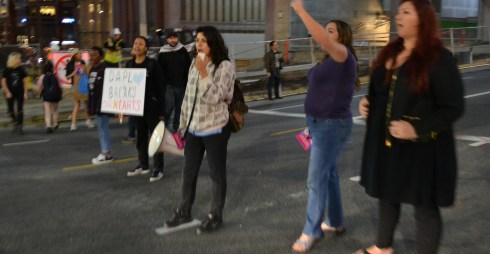
While Courage was beating a drum on the sidewalk, the protesters, while holding their signs, chanted in the street on Wilshire Blvd. at the intersection of Francisco St.

One chant was “Hey, Hey, Ho, Ho, this pipeline’s got to go.”  A second chant was “If we don’t get no (sic) justice, then they don’t get no (sic) peace.”  A third chant was “If indigenous rights are under attack, what do we do?  Stand up, fight back.”  A fourth chant was “Who stands with Standing Rock?  We stand with Standing Rock.”  A fifth chant was “Divest, defund, disrupt.”

One protest sign read, “You can’t drink oil, leave it in the soil.” Another, a child carried, read, “Kids for indigenous power.”   A third on the back of a dog with its owner nearby had two messages: “Dogs against DAPL” (Dakota Access Pipeline) and “Respect indigenous rights.” Another read, “Aqua is Vida (Water is life) and still another read, “We stand with Standing Rock.”

dsc_0025

Protesters at Wilshire Blvd. and Francisco St., Feb. 14.  Photo by Barry Saks

The protesters were divided into three groups.  One group of about 25 stood in the street near the corner of Wilshire and Francisco, blocking oncoming traffic.

dsc_0030

Driver stops auto in front of protesters and honks horn, Feb. 14.  Photo by Barry Saks

While most of the drivers slowed and turned right on Francisco to avoid the protesters, two did not.  One drove up to the protesters and honked the car’s horn continually for several minutes.  Finally, the driver stopped honking and turned right.

dsc_0039

Driver carries protester in front of car on Wilshire Blvd.  Photo by Barry Saks

A second driver drove through the protesters.  The driver, moving slowly, carried the protester with his feet off the ground on the front of the car about a couple hundred feet.  The car stopped and the protester got off the car.

A second group of about 20 stood in the street at the corner of Wilshire and Figueroa St. chanting, carrying signs and also blocking traffic on Wilshire.

A third group of about 25 people stood in front of the building on Wilshire on the north side of the street, which housed the district office, peacefully carrying signs and chanting.

After a little more than an hour, the Los Angeles Police Department warned the protesters if they did not halt their stopping of traffic, they would be arrested without any further warning.  The protesters at both locations stopped and held a brief rally in front of the district office.

The Omaha District of the United States Army Corps of Engineers in its press release of Feb. 8, said, it “granted an easement to Dakota Access, LLC allowing the installation of a thirty-inch diameter light crude oil pipeline under Federal lands … at the Oahe Reservoir.  The granting of this easement follows … the Army decision to terminate the Notice of Intent to Perform an Environmental Impact Statement and notification to Congress of the Army’s intent to grant an easement to Dakota Access for the Lake Oahe crossing.  In operating and maintaining the federally-authorized project at Lake Oahe, the Corps will ensure the portion of the pipeline that crosses Lake Oahe complies with the conditions of the easement.”

According to the press release of Energy Transfer Partners also of Feb. 8, when completed will consist of two parts.  The first part runs about 1,172 miles from North Dakota to Patoka, Illinois.  The second part is more than 700 miles that has been converted to crude oil service from Patoka to Nederland, Texas.  Together the pipeline will be more than 1,872 miles of pipeline and is expected to be in service by second quarter 2017.

In response to the intent of Army Corps of Engineers to grant the easement to Energy Partners and the cancellation of the environmental impact statement, according to a press release, Dave Archambault II, chairman of the Standing Rock Sioux Tribe, said, “The drinking water of millions of Americans is now at risk. We are a sovereign nation and we will fight to protect our water and sacred places from the brazen private interests trying to push this pipeline through to benefit a few wealthy Americans with financial ties to the Trump administration…. The environmental impact statement was wrongfully terminated. This pipeline was unfairly rerouted across our treaty lands.”

dsc_0066

Protesters at Wilshire and Figueroa, Feb. 14.  Photo by Barry Saks

Long Beach City Council Defies President, Supports California Bills–Values Act, Religious Freedom Act

10 Feb
3rdchosen

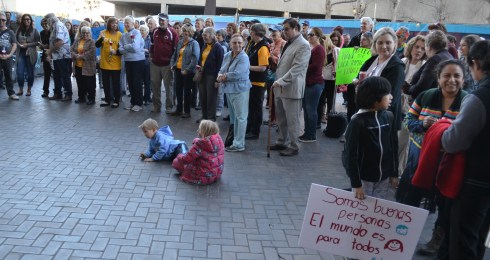
Photo by Barry Saks; Audience member holding sign, on Tuesday, Feb. 7, 2017 at Long Beach City Council Meeting

The Long Beach City Council, in a full chamber with a small overflow, on Tuesday, Feb. 7, voted to support California Senate Bills 31 and 54, as amended.

California State Senate Bill 31, known as California Religious Freedom Act, prevents the “state or local agency or public employee acting under color of the law” from (p)rovid(ing) or disclos(ing) to federal government authorities personally identifiable information regarding the religious beliefs, practices, or affiliation of any individual for the purpose of compiling a list, registry, or database of individuals based on religious affiliation, national origin or ethnicity” and prevents using “agency money, facilities, property equipment, or personnel” for the creation of a list, registry or database “for law enforcement or immigration purposes.”  California Senator Ricardo Lara (Democrat, 33rd District) introduced the bill.

California State Senate Bill 54, known as the “California Values Act,” states it will immediately take place, it prevents state and local law enforcement agencies from using “agency or department moneys, facilities, property, equipment, or personnel to investigate, interrogate, detain, detect, or arrest persons for immigration enforcement purposes.”  It also prevents those same law enforcement agencies from “(p)erforming the functions of an immigration officer.”  However, it doesn’t prevent the same law enforcement agencies “from responding to a request from federal immigration authorities for information about a specific person’s previous criminal arrests or convictions.”  California Senate Pro Tempore Kevin de Leon (Democrat, 24nd District) introduced the bill.

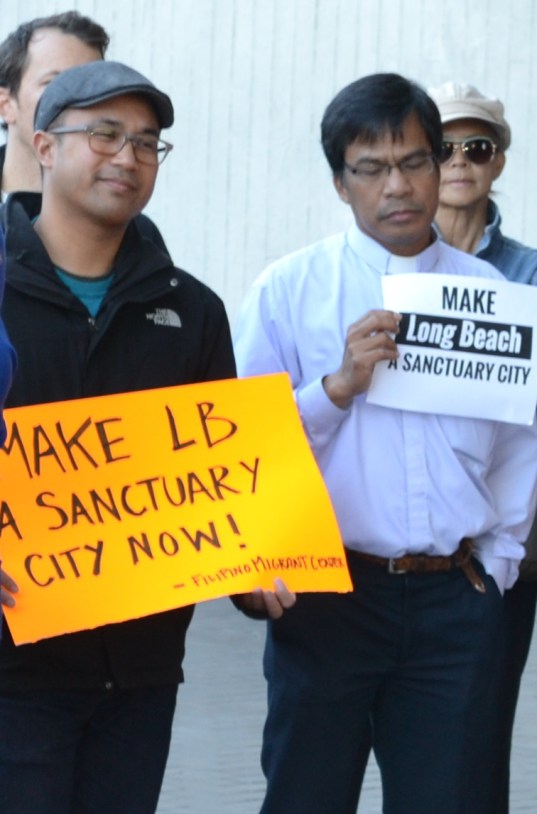
In the council chambers, during the comment period, while two speakers spoke against supporting the two bills, dozens of speakers spoke in favor and most added they wanted Long Beach to become a sanctuary city.
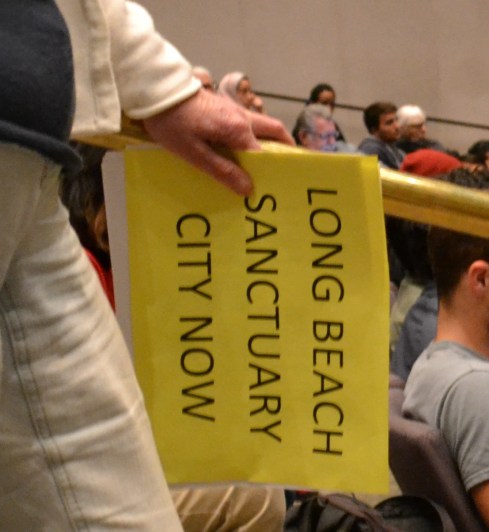
2ndchosen

Photo by Barry Saks; Member of Audience Holding Sign, at the Tuesday, Feb. 7 2017, While Standing in Line to Speak During the Time for Public Comments

Just before the last speaker, many in the audience stood up and chanted, “Sanctuary, not deportation.”
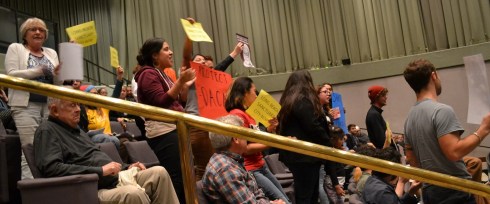
5thchosen

Photo by Barry Saks; Members of Audience Chanting Tuesday, Feb. 7, 2017, in Council Chambers during Long Beach City Council Meeting

After public comments, 1st District Councilwoman Lena Gonzalez, who put forward the support motion, said Senate Bill 54 sets a statewide standard and asked Diana Tang, Manager of Government Affairs, about the legislative process, the status of the bills, and more specifically the issue of violent and serious crime, and human trafficking as it is related to SB54. In response, Tang said both bills are now in the Senate and because both are emergency bills, a two-thirds vote will be required in both houses.  She said, if they pass, they then will be sent to the Governor for him to consider and that SB54 is still in its original form.

The Mayor, in response to the discussion between the councilwoman and Tang, reported he had spoken that day to the Senate Pro Tempore, who told the Mayor he is in discussion with the State Police Chiefs Association to ensure there is interagency communication, particularly regarding human trafficking and other issues, and that he is looking at and supports language that allows for interagency coordination with Federal law enforcement regarding violent and serious crimes.

Then, the Councilwoman Gonzalez said while she supports the two bills, she said she also supports the same amendments the Senate Pro Tempore is pursuing.  She then amended her motion to include her two concerns.

Then, 2nd District Councilwoman Jeannine Pearce, who also signed on in support of the two bills, reminded the other councilmembers that they supported last November a motion urging the Federal government to provide Jose Alvarez humanitarian parole and then said, “As a state and as city we have gone too far and we will not go back.”  She then asked how Long Beach Police Department has implemented the recently passed California Trust Act, (Assembly Bill 4), which prohibits law enforcement from detaining an individual for Federal Immigration after the individual becomes eligible for release from custody, unless specified conditions are met.

Deputy Police Chief Michael Beckman responded.  He said LBPD complies with the California Trust Act and said since the act’s implementation, “I.C.E. (U.S. Department of Homeland Security Immigration and Customs Enforcement) has never provided the Long Beach Police Department a signed court order and/or has traveled to the Long Beach Police Department to take custody of an undocumented immigrant.”

Then 7th District City Councilman Roberto Uranga, who also endorsed the motion of support, said, “We are experiencing a President who is a thug, who is a blackmailer and who is potentially an extortionist.  He is threatening to withhold federal funds to not only the states and the state of California, but to the City of Long Beach, as well.”

Then, 3rd District City Councilwoman Suzie Price said, “I am a descendant of immigrants from one of the countries, where there is currently the ‘non-ban’ and it has been a very scary time for people in my community, as well, and I actually had an opportunity to meet with them on Sunday…. and I explained to people in that community my concerns with sanctuary city.”  For the Councilwoman, her concerns centered on the fiscal impact of the city becoming a sanctuary city and asked for clarification.

Tang said it was unclear what the fiscal impact would be.

The Councilwoman then said Long Beach becoming a sanctuary city was not the agenda.  She then voiced her concerns about Senate Bill 54 and offered an amendment to support Senate Bill 31, but asked Senate Bill 54 be sent to the State Legislative Committee and the Public Safety Committee.

Councilwoman Gonzalez responded politely and then rejected Councilwoman Price’s amendment.

Then, 8th District Councilman Al Austin said it was a “no brainer” for him to support the motion.  He added, as a suggested amendment that there may be other bills, which could be supported.  Councilwoman Gonzalez accepted his amendment.

Then, 9th District Councilman and Vice Mayor Rex Richardson, who also initially supported the motion, said, “These bills on the table they demonstrate some very critical values, religious freedom and trust….The tone in Washington is quickly eroding that trust.”

The last councilperson to speak before the vote was 4th District Councilman Daryl Supernaw.  The councilman echoed Councilwoman Price that the issue of sanctuary city was not on the agenda.  He then said because the item was not put on the agenda until Friday afternoon, consequently he was not able to notify the people in his district.

After the councilmembers spoke, the Mayor stated his support for the motion and pointed out that Long Beach is not only a city of immigrants, but also of refugees.

The council voted 7-0 for the motion with the three amendments.  Absent were 5th District Councilwoman Stacy Mungo and 6th District Councilman Dee Andrews.
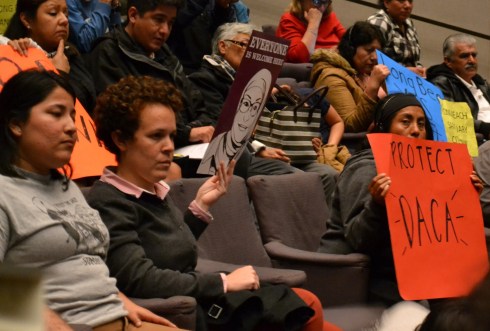
4thchosen

Photo by Barry Saks; audience holding signs, Tuesday, Feb. 7, 2017 during the Long Beach City Council Meeting.

Immigration Supporters to City Council: Make Long Beach a Sanctuary City

2 Feb
mydsc_0277

Pro-Immigration Rally of Tuesday Jan. 31, 2017, at Long Beach City Hall

More than a hundred Long Beach residents rallied outside City Hall on Tuesday, Jan. 31, to demonstrate their solidarity with immigrants and their opposition to President Donald J. Trump’s recent temporary ban on immigrants from the mostly-Muslim countries of Iran, Iraq, Libya, Somalia, Sudan, Syria and Yemen.

Clergy and Laity for Economic Justice (CLUE) organized the rally.  A recent statement from the CLUE website said, “Clergy and Laity United for Economic Justice reiterates (sic) our fervent belief that this country must be a haven for those escaping violence and crushing poverty.”

dsc_0275

Rev. Ricardo Avila of St. Luke’s Episcopal Church

The Rev. Ricardo Avila of St. Luke’s Episcopal Church emceed.  The Reverend in his opening remarks to a round of applause said his church last week had voted to become a “Sanctuary Parish.”  Near the end of his remarks he said, “We now ask Long Beach City leaders to not be threatened and rise as well by declaring Long Beach a Sanctuary City and committing to be on the front lines of resistance.”

The Rev. Noel Andersen, of Church World Service and a leader of the national sanctuary movement, said that since the Presidential election the national sanctuary movement has grown from 400 to 800 congregations.

dsc_0304

Rev. Noel Andersen of Church World Service

The other faith-based clergy who spoke from Long Beach were Pastor Gregory Sanders of The Rock Christian Fellowship, Pastor Melinda Teter Dodge of the Los Altos United Methodist Church, Rabbi Emeritus Howard O. Laibson of Shir Chadash Congregation, Rev. Leon Wood of the North Long Beach Community Prayer Center and the Executive Director of the South Coast Interfaith Council, Milia Islam-Majeed.

Besides the faith-based community, Long Beach City Councilmembers—Lena Gonzales representing the 1st District, Jeanine Pearce representing the 2nd District and Roberto Uranga representing the 7th District—spoke.

Besides the local elected representatives, representatives of the immigrant community also spoke.  One of them was Alicia Morales, who represents the Long Beach Immigrant Rights Coalition.  Morales, who now is covered by the Deferred Action for Childhood Arrivals (DACA) program, said that because she is undocumented she understands the fears the undocumented face.  She then said, with her voice quivering, “When you have the highest power in the country threatening your livelihood, threatening your humanity, threatening your dignity, it makes it very difficult to continually wake up in the morning…. We cannot allow this administration to relegate people to cages, to jail and to imprisonment.  We cannot let this administration determine who is deserving and who is not deserving because we are all deserving of a better life.”

dsc_0311

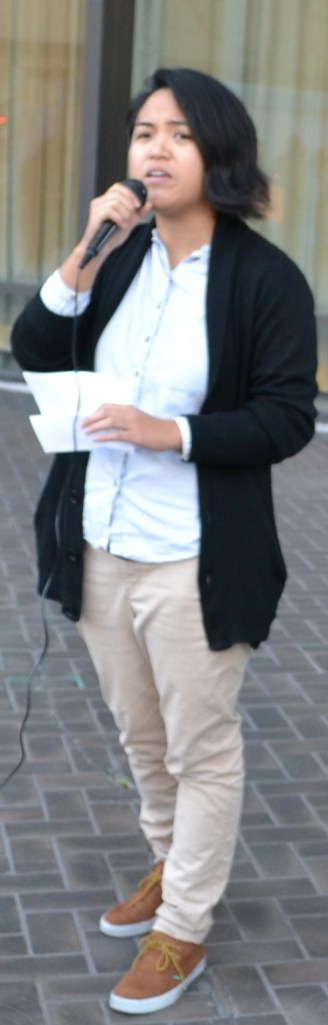
Nikole Cababa of the Filipino Migrant Center

Another speaker representing the immigrant community was Nikole Cababa from the Filipino Migrant Center.  Cababa, a long-time resident of Long Beach, said almost 30,000 Filipino immigrants live in Long Beach.  She then led the crowd in the chant, “Sanctuary, not deportation.”

Many of those who rallied came from the faith-based community.  Carol Quinlan, who is from the Unitarian Church of Long Beach, estimated about 20 members of her church with their yellow shirts rallied.  Quinlan said, “We are standing here on the side of love.”   Another person who rallied was long-time Long Beach resident Julie Baker.  Baker, who identified herself as a member of the North Long Beach Christian Church said she was there in solidarity.  A third person at the rally was Reina Mansilla, 62 and attends the St. Luke’s Episcopal Church, said there were more than ten people from her church at the rally.  Mansilla, who was originally from Guatemala, said she was at the rally because immigrants need to have rights.

dsc_0287

Error
This video doesn’t exist

Another version of this story was published at LBReport.com. It can be found at http://www.lbreport.com/news/saks/immig1.htm.

Women and their Allies March in Los Angeles

24 Jan

dsc_0225

Hundreds of thousands of people in Los Angeles marched from Pershing Square to City Hall, on Saturday, Jan. 21 in solidarity with the call for the Women’s March, as part of the local, national and worldwide protests in response to the newly inaugurated 45th President of the United States Donald J. Trump.

While most of the protesters were women, many men marched.  Many men and women wore knitted pink pussyhats.

dsc_0253

Some protesters showed their former support for Hillary Clinton.  While clearly a protest, the mood was festive, including drummers.

dsc_0245

Emmilene Pankhurst at Los Angeles Women’s March, Saturday, Jan. 21, on Olive St., outside of Pershing Square.

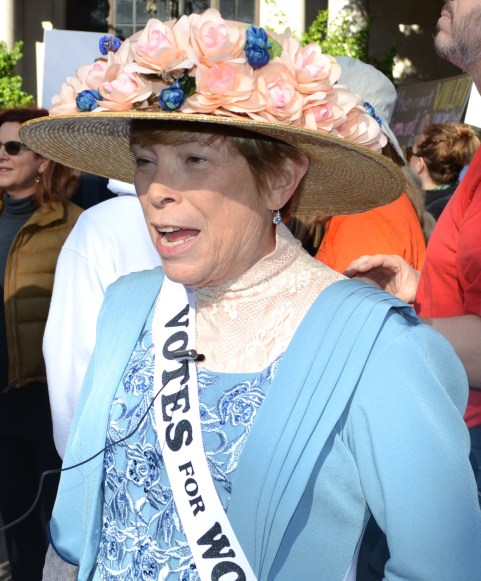
One protester, who was dressed as a suffragette, was Emmilene Pankhurst.  She said, “I march for my daughter and my granddaughter … for women, for all the most vulnerable in our society, and I march because this is just the beginning.  We’re going to organize.  We are going to take over the House (of Representatives) and the Senate.”

While most of the protesters marched from Pershing Square down Hill St. toward City Hall, some protesters at West 6th and Olive Streets marched down 6th toward Grand Ave.  At Grand, they turned right and marched up the steep incline toward City Hall.

While they marched up Grand, a group of five or six other women, sharing a bullhorn, chanted.  One chant was “Our bodies, our choice.”  A second chant was “Love trumps hate.”

dsc_0247

The mission and vision statement of the national Women’s March set the tone of the Los Angeles march. The statement, in part, said,The Women’s March on Washington will send a bold message to our new government … that women’s rights are human rights. We stand together, recognizing that defending the most marginalized among us is defending all of us.  We support the advocacy and resistance movements that reflect our multiple and intersecting identities…. This march is the first step towards unifying our communities, grounded in new relationships, to create change from the grassroots level up.”

The mission statement of the organizers’ of the national Women’s March can be found at https://www.womensmarch.com/mission.

Award-Winning Journalist to Speak on Friday, Jan. 13, in Long Beach, California

2 Jan
10757174_ben-ehrenreich-humanizes-the-israelipalestinian_be17a8be_m

From Creative Common, Images of Book Cover and Ben Ehrenreich

Award-winning journalist Ben Ehrenreich, on Friday, Jan.13, at 7 p.m., at the Christ Lutheran Church, at 6500 Stearns St. in Long Beach, will sign and discuss his new book, “The Way to the Spring: Life and Death in Palestine.”

In December of last year, the Economist magazine in Britain announced it considers Ehrenreich’s book one of the best of 2016.

The New York Times called his book a “Love Letter to Palestine.”

According to a flyer issued before the book signing, People for Palestinian-Israeli Justice will sponsor Ehrenreich along with the cosponsors: Christ Lutheran Church, Peace and Justice Ministry Team of the Grace First Presbyterian Church of Long Beach, Jewish Voice for Peace-Los Angeles, Long Beach Area Peace Network and United Methodists’ Holy Land Task Force.

When being interviewed by Anne Strainchamps, the host of “To the Best of Our Knowledge” of Wisconsin Public Radio, Ehrenreich, regarding violence, said, “I think suicide bombings are terrible.  I think attacks on civilians are terrible…. I do think there is, however, extraordinary hypocrisy in the way we talk about violence in this conflict in situation.  So basically every act of Israeli violence, whether it is the bombing of Gaza, which left 2,200 people, two-thirds of them civilians, dead or shooting a 15-year-old boy in the back who was throwing stones, as happened this week and killing him, all of this is legitimate, all of the violence of the (Israeli) state.  It is never questioned whether or not Israel has the right to exert lethal violence on a daily basis against the civilian population.  But if there even is the tiniest amount of violence coming from the Palestinian side, it is immediately condemned, called terrorism.”

Ehrenreich, who studied religion at Brown University, won, in 2012, a PEN Center USA award for his journalism.  According to the website of PEN Center USA, it is “a branch of PEN International, the world’s leading international literary and human rights organization.”

In 2011, he won an Ellie from the American Society of Magazine Editors for feature writing.  In 2009, he won a GLADD (Gay and Lesbian Alliance Against Defamation) media award for an outstanding magazine article.

Besides his immersion journalism, he’s written two novels, “Ether” and “The Suitors.”  His short stories have been published.  The Poetry Foundation has published his literary pieces.

Gatsby Books will be selling his book.

Parking and the event are free.  However, donations will be accepted.

People may call Dennis Korteuer at 310-427-2265 or email him at dkortheu@gmail.com for more information regarding the book signing.

The Atheist Who Loved Christmas Eve

16 Dec

If it wasn’t for my aunt Sylvia, the wife of my mother’s brother and my first cousin Wendy, their daughter, my Christmas Eve memories would be much colder and bleaker, or worse nonexistent.  These two women organized the Christmas Eve parties I have fond memories of.

As a child, as long as I could remember my Christmas Eves were always the same.  My father would drive my mother, my brother, sister, and me to somewhere behind the Santa Monica Airport in Los Angeles, where my aunt and uncle’s family lived.

I remember walking the short distance from my parents’ car to my aunt and uncle’s home and feeling the dank air.  Entering their home was always a pleasure, feeling the coziness of their home on Christmas Eve.  Usually a 6-foot tall or taller, Christmas tree, decorated in white or sometimes red, would grace one corner of the living room.  Under the tree, were numerous gifts for my aunt’s immediate family and small gifts for my brother, sister and me.  A fire would be burning in the fireplace.  Sometimes for what seemed like minutes, I would stare at the flames flickering.  I could smell the burning wood and scent of the tree.

The routine was always the same.  Sooner or later after arriving, the two families would eat dinner together, segregated—the adults at one table and the children at theirs.  There were six children: three from my family and the three of my aunt and uncle.  Wendy was my aunt and uncle’s middle child.

After dinner, youngest children got the honor of distributing the gifts to the people in the room.  Then the gifts were opened, in reverse order by age.  After the gifts were opened, the families entertained themselves with parlor games or reminiscing or my two female cousins would attempt to entertain by singing and dancing, with catcalls from the young males, particularly me.  My sister recently told me she remembers our aunt dressing up, wearing an ugly Santa Claus mask and then chasing the youngsters around the house.

I attended these gatherings through high school, after high school, much less frequently.   Many years pass.  My father died; my mother, my aunt and uncle, my sister and her husband, and my cousin Wendy and her husband moved to Nevada.

By then, my cousin Wendy was teaching and had the responsibility of organizing the Christmas Eve parties.  After many years, Marlene, my wife, and I attended a couple more.

Wendy new how to entertain and could match my quick wit.  Two favorite things of hers were giving gag gifts and singing karaoke.  Some of the gag gifts were re-gifted over and over.  I appreciated her low-brow humor.  Once somehow I got a gift of a toy brown cow that dispensed chocolate candy out of its rectum.  Then there was the karaoke.  My cousin made sure everyone at her parties participated in the karaoke round.  It was great fun.

My aunt and uncle lived until their 90s.  They died five years ago.  Then, my cousin died two years later.  Now I only have those memories of Christmas Eve.

Oh, I forgot.  My parents were Ashkenazi Jews.  My uncle called himself an agnostic and I call myself an atheist.

Amy Hunter Talks on Race and Palestine

12 Dec

Amy Hunter, who is now the manager of diversity and inclusion at the St. Louis Children’s Hospital, spoke on Friday, Dec. 9, at the Christ Lutheran Church in Long Beach, on the similarities between racism in the U.S. and Palestine to more than 20 people.

People for Palestinian-Israeli Justice hosted Hunter’s talk.  Jewish Voice for Peace-LA and the Long Beach Area Peace Network co-hosted.

Dennis Korteuer, who is a Professor Emeritus from Cal State University, introduced Hunter.  In part, he said, “Hunter’s been seen on CNN, ABC, NBC, PBS, and interviewed by NPR and a host of print media publications.  She has published works and has presented on issues of race and social justice throughout the United States and globally.”

dsc_0178

He ended his introduction by quoting Hunter: “My lens is truth and liberation. My stance was a bit calmer before going to Palestine and now my sense of urgency has heightened.  With my travel to Palestine, there were so many similarities to what I had participated and witnessed in Ferguson.”

Near the beginning of her talk, Hunter admitted she uses Critical Race Theory, which Purdue University’s Online Writing Lab defines as “a theoretical and interpretive mode that examines the appearance of race and racism across dominant cultural modes of expression,” as a way to understand the history of property rights.

dsc_0192

She then explained the racist connections she saw between the United States and Palestine.  She said, “When I went to Palestine, of course, those things resonated…. This is America, with native-American people and the stealing their land and so it wasn’t hard to make the connection.  The over-policing of black bodies looked like the over-policing of Palestinians, while I was in Palestine and the conversations were very similar.  And so not only is it important to recognize what colonization in the country looks like, but globally what looks like to really inspire a global movement to decolonize.”

She soon defined what she meant by decolonization, when she said, “(It) will have to look like something different and if you’ve never belonged to community, it’s really hard to talk about community building, but ultimately … that’s what solidarity will look like between blacks and Palestinians … because the similarity between the communities are so very the same.”

Near the end of her talk, she said, “I would like to see a different world for my children, for all children and that’s why I do this work…. I’m pretty intentional to say what liberation looks like, what free looks like.  I’m really … clear that I’m not free until they’re free.”

Hunter’s Lucky Zip Codes TED talk may be viewed at http://www.youtube.com/watch?v=g36ijwr3wc8.

dsc_0196


The City of Long Beach Stands with the Standing Rock Sioux

9 Dec

dsc_0145

About 40 people, in the plaza outside City Hall, before the meeting of Long Beach City Council on Tuesday, Dec. 6, rallied with speakers in solidarity with the Standing Rock Sioux Tribe and against the construction of the Dakota Access Pipeline, in anticipation of the city council agenda item on the same subject.

The rally began with Tongva elder, Gloria Arellanes, leading a prayer and blessing, followed with speakers.

Noe Ramirez, Long Beach resident, emceed.  The first speaker Ramirez introduced was Elliot Gonzales. Gonzales is a leader of Stop Fracking Long Beach and according to the city’s website, a member of the city’s sustainable commission.  He said, “It is time as an environmental community we begin to recognize indigenous rights as part of why it is necessary for us to be able to sustain life on this planet…. We will perish, if we do not speak up to the abuses that are happening to our native brothers and sisters, I guarantee that it will happen to us…. We must become active in resisting in every aspect of our lives, like in government, in society, as in community.” He said environmentalists should view themselves as allies to the indigenous.

Ramirez then introduced George Funmaker, as a resident of Long Beach.  Funmaker belongs to the Dakota Ho-Chunk tribe.  He said, “As native people we’re healing from something called historical trauma.  Historical trauma is when the United States Government put us in boarding schools and we were not allowed to speak our language, we were not allowed to do our ceremonies and it wasn’t until 1978 (with the) American Indian Religious Freedom Act, where we were able openly  practice our ceremonies.”  He said one issue needing to be address is white privilege and white supremacy.  He said originally the pipeline was to go through Bismarck, North Dakota, but the mostly Caucasian city would not allow it, the company listened to them and the company decided to run it through native land.

dsc_0143

Then, Funmaker with some others shared a no DAPL (Dakota Access Pipeline) song with the audience.  He ended by pointing out that it was the women who provided the leadership for their movement.

The council chambers was about half-full, when the agenda item came.  Before public comment, First District Councilwomen Lena Gonzalez argued for the resolution and pointed out that “the protest and fight is not just about oil.  It is about respect for our indigenous communities and respect for the rights of treaties that were signed with this tribe more than 150 years ago.”

Second District Councilwoman Jeanine Pearce also argued for the resolution.  She said the protesters against the pipeline “were met with disproportionate use of force, in…freezing temperatures, tear gas, rubber bullets, even grenades, yet they still remained strong.”

During the public comments, Funmaker said that “Long Beach has to look at their own oil addiction…. It’s not (just) about this pipeline, it’s about transitioning to renewable energy and keeping fossil fuels in the ground.”

Another speaker during the public comment, in favor was Alex Montances, who identified himself as living in the Sixth District, as being from the Filipino Migrant Center and the National Alliances for Filipino Concerns.  Montez said that during the Thanksgiving weekend he was part of a six-person delegation who drove from Long Beach “to stand with the Standing Rock Sioux.”  Montances ended by quoting a native-American artist he met, who said, “It was the first time in history that almost all of the native-American tribes are united together to protect what is sacred to them: water, land and Mother Earth.”

After public comment but before the city council vote, Fourth District Councilman Daryl Supernaw thanked all the supporters and speakers and said he is working with others to bring forward a motion to create a Native Heritage Commission for the city.  Mayor Robert Garcia said he was a “strong supporter” of the resolution.

No city councilmember or anyone during the public comments spoke against the resolution.  The resolution passed unanimously.

dsc_0165


Low-Wage Workers Protest in Los Angeles and LAX

1 Dec

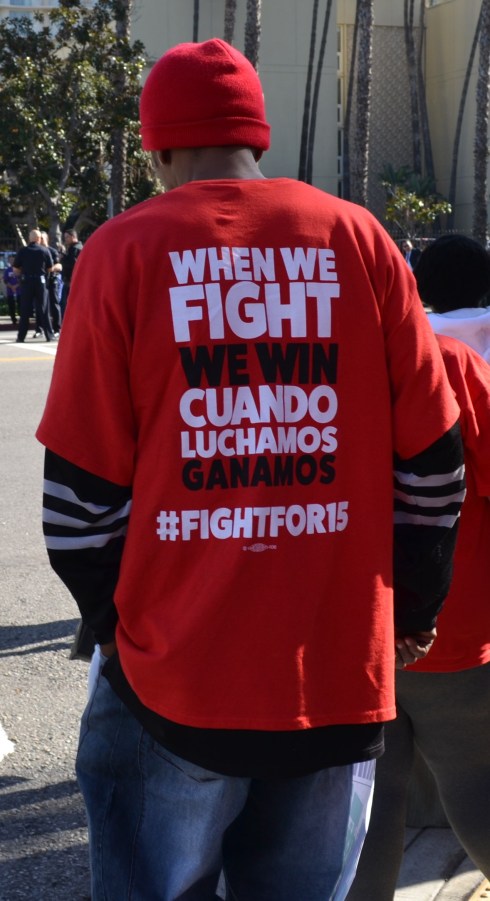
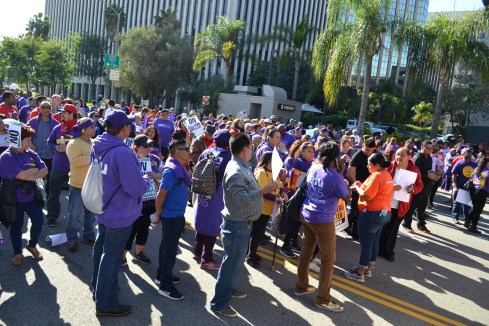
Hundreds of low wage workers, mostly people of color, and their allies marched and protested around the Los Angeles Airport, as part of a national protest in 340 cities, on Tuesday, Nov. 29, for $15-an-hour jobs, for unions, immigrant rights, and against cuts in the Affordable Care Act, against racist policies, which put newly elected President Trump on notice that his policies would be resisted.

Three groups marched and protested around LAX.  One group, around noon, walked and chanted on the sidewalk from West 98th Street and Aviation Blvd. toward Avion Dr.  At Avion, the group turned left toward Century and headed toward the airport proper.  Around Vicksburg Ave., gathered a Los Angeles Police Department contingent, where no sidewalk existed.  Near Vicksburg the group turned around before the sidewalk disappeared and headed back from where it came.   Two chants the group shouted out, while walking, were “If we don’t get it, shut it down” and “No Justice, No Peace.”

The local NBC affiliate, quoting an LAX management statement, it said, “Shortly before noon, two groups of demonstrators gathered on the Upper Level at LAX, with one group on the north side and the other group on the south side, marching toward the Tom Bradley International Terminal.”

No arrests occurred at LAX.

dsc_0029

Later in the early afternoon, on Aviation between 98th and Century, hundreds rallied and heard speakers on a flatbed truck.

One of the speakers was 44th District Congresswoman Janice Hahn, who was recently elected as the 4th District Supervisor.  Regarding the profits of the airline industry, Hahn said, “While these airlines are making record profits, we know that the workers are not getting their fair share.  Last year these airlines made over $25 billion in profit across the county, but 42 percent of all airline workers live below the poverty line…. I’m here in solidarity with you.”

A second elected official who spoke was Los Angeles Councilman Curran Price.  He reminded the audience his support for raising the minimum wage and for immigrant rights by his support for Los Angeles being a sanctuary city.

A third speaker was Tim Maddox, a vice president of USWW (United Service Workers West).  USWW represents service property workers, such as janitors, cabin cleaners, stadium and arena workers, and other airport workers.  Maddox said, “The Airport used to be good jobs….Reagan began busting the unions when he fired air traffic controllers who were on strike….This was the beginning of outsourcing our labor at the airport and deregulation…. Moments later on a more optimistic note, he added, “But, we know when we take action and fight back, we win…We have won wage increases in Los Angeles, New York City, Newark, Minneapolis, Boston, Philadelphia, Seattle, Portland and Fort Lauderdale.”

The same NBC affiliate, which reported on LAX, said, “The first (of the day) protest began about 6 a.m. at Seventh and Alameda streets in downtown Los Angeles. About an hour into the rally, protesters blocked the intersection of Seventh and Alameda streets and police arrested 40 of them, the Los Angeles Police Department reported.”

CNN reported dozens of arrests in Oakland and New York with a strike at O’Hare International Airport of janitors, baggage handlers, cabin cleaners and wheelchair attendants.  Reuters reported arrests in Cambridge Massachusetts and in Detroit.

dsc_0072